 Add to Chrome
 Add to Firefox
 Add to Edge
ARMOR: Agentic Reasoning for Methods Orchestration and Reparameterization for Robust Adversarial Attacks
Jan 26, 2026
Existing automated attack suites operate as static ensembles with fixed sequences, lacking strategic adaptation and semantic awareness. This paper introduces the Agentic Reasoning for Methods Orchestration and Reparameterization (ARMOR) framework to address these limitations. ARMOR orchestrates three canonical adversarial primitives, Carlini-Wagner (CW), Jacobian-based Saliency Map Attack (JSMA), and Spatially Transformed Attacks (STA) via Vision Language Models (VLM)-guided agents that collaboratively generate and synthesize perturbations through a shared ``Mixing Desk". Large Language Models (LLMs) adaptively tune and reparameterize parallel attack agents in a real-time, closed-loop system that exploits image-specific semantic vulnerabilities. On standard benchmarks, ARMOR achieves improved cross-architecture transfer and reliably fools both settings, delivering a blended output for blind targets and selecting the best attack or blended attacks for white-box targets using a confidence-and-SSIM score.

Camera Model Identification Using Audio and Visual Content from Videos
Jun 25, 2024

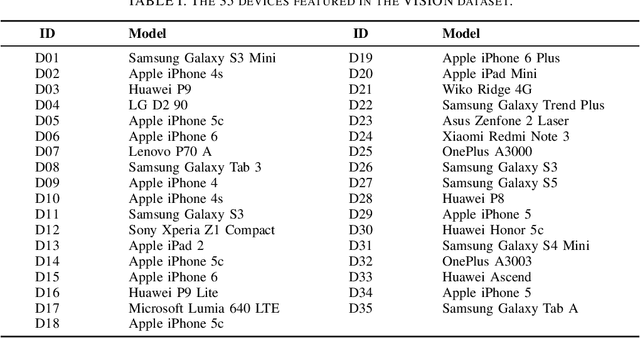
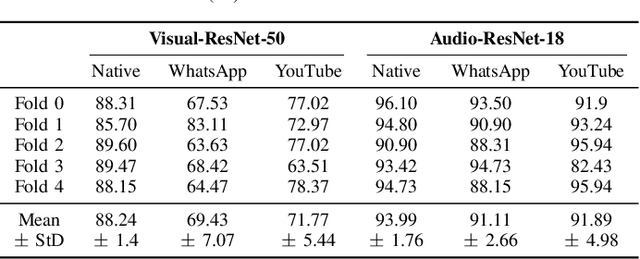
The identification of device brands and models plays a pivotal role in the realm of multimedia forensic applications. This paper presents a framework capable of identifying devices using audio, visual content, or a fusion of them. The fusion of visual and audio content occurs later by applying two fundamental fusion rules: the product and the sum. The device identification problem is tackled as a classification one by leveraging Convolutional Neural Networks. Experimental evaluation illustrates that the proposed framework exhibits promising classification performance when independently using audio or visual content. Furthermore, although the fusion results don't consistently surpass both individual modalities, they demonstrate promising potential for enhancing classification performance. Future research could refine the fusion process to improve classification performance in both modalities consistently. Finally, a statistical significance test is performed for a more in-depth study of the classification results.
On Spectrogram Analysis in a Multiple Classifier Fusion Framework for Power Grid Classification Using Electric Network Frequency
Mar 27, 2024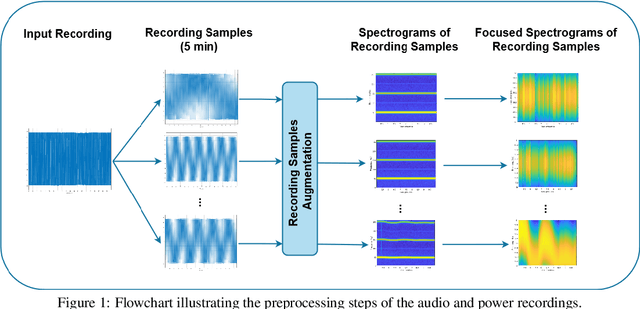
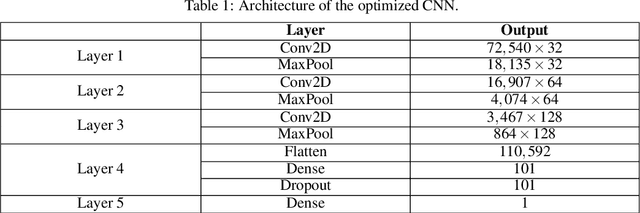
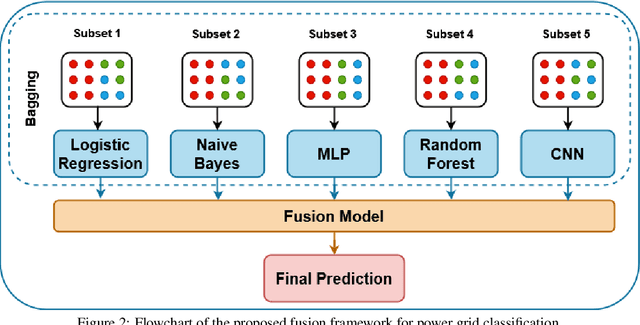
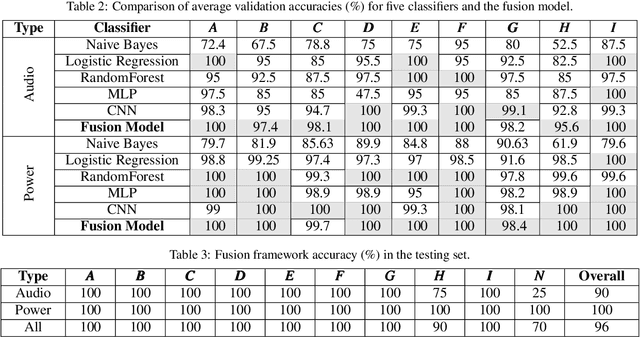
The Electric Network Frequency (ENF) serves as a unique signature inherent to power distribution systems. Here, a novel approach for power grid classification is developed, leveraging ENF. Spectrograms are generated from audio and power recordings across different grids, revealing distinctive ENF patterns that aid in grid classification through a fusion of classifiers. Four traditional machine learning classifiers plus a Convolutional Neural Network (CNN), optimized using Neural Architecture Search, are developed for One-vs-All classification. This process generates numerous predictions per sample, which are then compiled and used to train a shallow multi-label neural network specifically designed to model the fusion process, ultimately leading to the conclusive class prediction for each sample. Experimental findings reveal that both validation and testing accuracy outperform those of current state-of-the-art classifiers, underlining the effectiveness and robustness of the proposed methodology.