 Add to Chrome
 Add to Firefox
 Add to Edge
DopplerGLRTNet for Radar Off-Grid Detection
Feb 14, 2026
Off-grid targets whose Doppler (or angle) does not lie on the discrete processing grid can severely degrade classical normalized matched-filter (NMF) detectors: even at high SNR, the detection probability may saturate at operationally relevant low false-alarm rates. A principled remedy is the continuous-parameter GLRT, which maximizes a normalized correlation over the parameter domain; however, dense scanning increases test-time cost and remains sensitive to covariance mismatch through whitening. We propose DopplerGLRTNet, an amortized off-grid GLRT: a lightweight regressor predicts the continuous Doppler within a resolution cell from the whitened observation, and the detector outputs a single GLRT/NMF-like score given by the normalized matched-filter energy at the predicted Doppler. Monte Carlo simulations in Gaussian and compound-Gaussian clutter show that DopplerGLRTNet mitigates off-grid saturation, approaches dense-scan performance at a fraction of its cost, and improves robustness to covariance estimation at the same empirically calibrated Pfa.

GEPC: Group-Equivariant Posterior Consistency for Out-of-Distribution Detection in Diffusion Models
Jan 30, 2026Diffusion models learn a time-indexed score field $\mathbf{s}_θ(\mathbf{x}_t,t)$ that often inherits approximate equivariances (flips, rotations, circular shifts) from in-distribution (ID) data and convolutional backbones. Most diffusion-based out-of-distribution (OOD) detectors exploit score magnitude or local geometry (energies, curvature, covariance spectra) and largely ignore equivariances. We introduce Group-Equivariant Posterior Consistency (GEPC), a training-free probe that measures how consistently the learned score transforms under a finite group $\mathcal{G}$, detecting equivariance breaking even when score magnitude remains unchanged. At the population level, we propose the ideal GEPC residual, which averages an equivariance-residual functional over $\mathcal{G}$, and we derive ID upper bounds and OOD lower bounds under mild assumptions. GEPC requires only score evaluations and produces interpretable equivariance-breaking maps. On OOD image benchmark datasets, we show that GEPC achieves competitive or improved AUROC compared to recent diffusion-based baselines while remaining computationally lightweight. On high-resolution synthetic aperture radar imagery where OOD corresponds to targets or anomalies in clutter, GEPC yields strong target-background separation and visually interpretable equivariance-breaking maps. Code is available at https://github.com/RouzAY/gepc-diffusion/.
Out-of-Distribution Radar Detection with Complex VAEs: Theory, Whitening, and ANMF Fusion
Jan 26, 2026We investigate the detection of weak complex-valued signals immersed in non-Gaussian, range-varying interference, with emphasis on maritime radar scenarios. The proposed methodology exploits a Complex-valued Variational AutoEncoder (CVAE) trained exclusively on clutter-plus-noise to perform Out-Of-Distribution detection. By operating directly on in-phase / quadrature samples, the CVAE preserves phase and Doppler structure and is assessed in two configurations: (i) using unprocessed range profiles and (ii) after local whitening, where per-range covariance estimates are obtained from neighboring profiles. Using extensive simulations together with real sea-clutter data from the CSIR maritime dataset, we benchmark performance against classical and adaptive detectors (MF, NMF, AMF-SCM, ANMF-SCM, ANMF-Tyler). In both configurations, the CVAE yields a higher detection probability Pd at matched false-alarm rate Pfa, with the most notable improvements observed under whitening. We further integrate the CVAE with the ANMF through a weighted log-p fusion rule at the decision level, attaining enhanced robustness in strongly non-Gaussian clutter and enabling empirically calibrated Pfa control under H0. Overall, the results demonstrate that statistical normalization combined with complex-valued generative modeling substantively improves detection in realistic sea-clutter conditions, and that the fused CVAE-ANMF scheme constitutes a competitive alternative to established model-based detectors.
Impact of PolSAR pre-processing and balancing methods on complex-valued neural networks segmentation tasks
Oct 28, 2022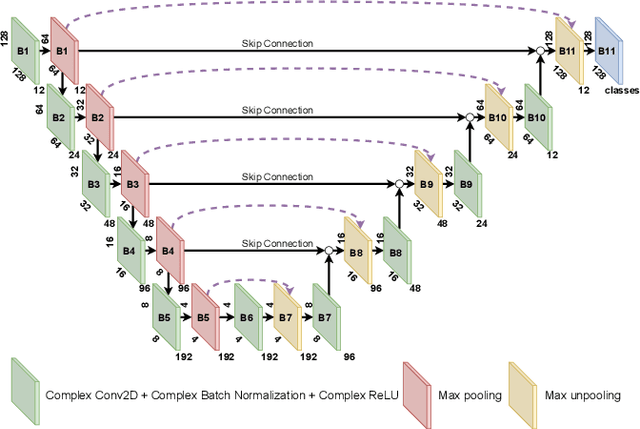
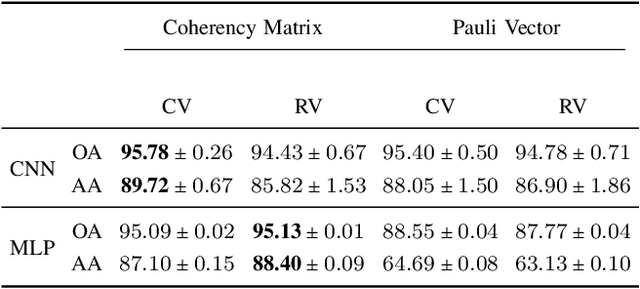
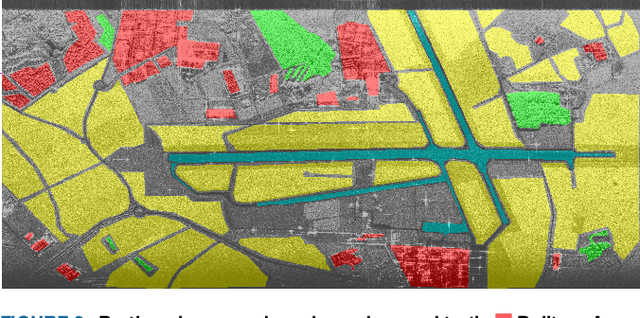
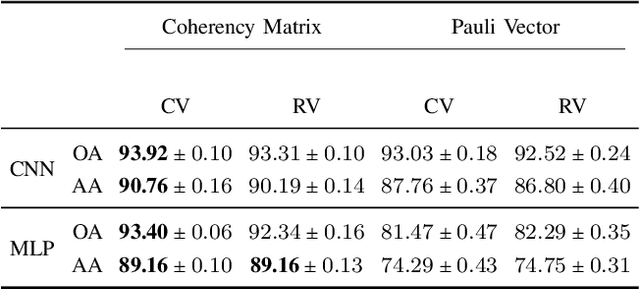
In this paper, we investigated the semantic segmentation of Polarimetric Synthetic Aperture Radar (PolSAR) using Complex-Valued Neural Network (CVNN). Although the coherency matrix is more widely used as the input of CVNN, the Pauli vector has recently been shown to be a valid alternative. We exhaustively compare both methods for six model architectures, three complex-valued, and their respective real-equivalent models. We are comparing, therefore, not only the input representation impact but also the complex- against the real-valued models. We then argue that the dataset splitting produces a high correlation between training and validation sets, saturating the task and thus achieving very high performance. We, therefore, use a different data pre-processing technique designed to reduce this effect and reproduce the results with the same configurations as before (input representation and model architectures). After seeing that the performance per class is highly different according to class occurrences, we propose two methods for reducing this gap and performing the results for all input representations, models, and dataset pre-processing.