 Add to Chrome
 Add to Firefox
 Add to Edge
Covariance-Guided Resource Adaptive Learning for Efficient Edge Inference
Mar 15, 2026
For deep learning inference on edge devices, hardware configurations achieving the same throughput can differ by 2$\times$ in power consumption, yet operators often struggle to find the efficient ones without exhaustive profiling. Existing approaches often rely on inefficient static presets or require expensive offline profiling that must be repeated for each new model or device. To address this problem, we present CORAL, an online optimization method that discovers near-optimal configurations without offline profiling. CORAL leverages distance covariance to statistically capture the non-linear dependencies between hardware settings, e.g., DVFS and concurrency levels, and performance metrics. Unlike prior work, we explicitly formulate the challenge as a throughput-power co-optimization problem to satisfy power budgets and throughput targets simultaneously. We evaluate CORAL on two NVIDIA Jetson devices across three object detection models ranging from lightweight to heavyweight. In single-target scenarios, CORAL achieves 96% $\unicode{x2013}$ 100% of the optimal performance found by exhaustive search. In strict dual-constraint scenarios where baselines fail or exceed power budgets, CORAL consistently finds proper configurations online with minimal exploration.

Learning-based decentralized offloading decision making in an adversarial environment
Apr 26, 2021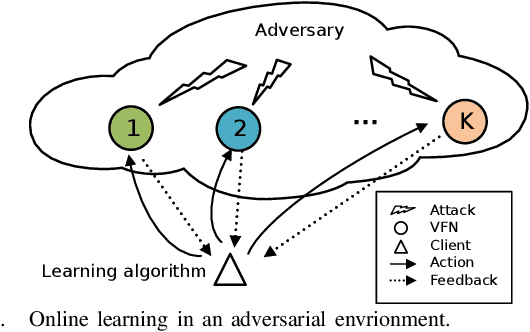
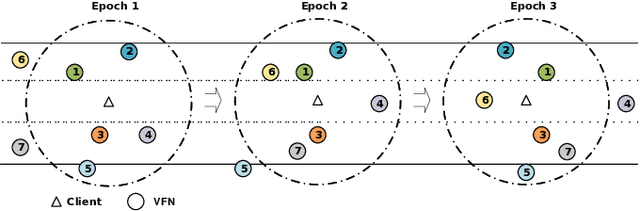
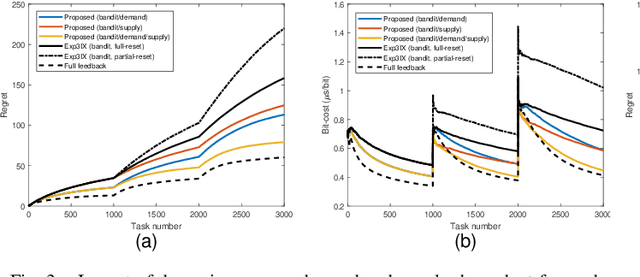
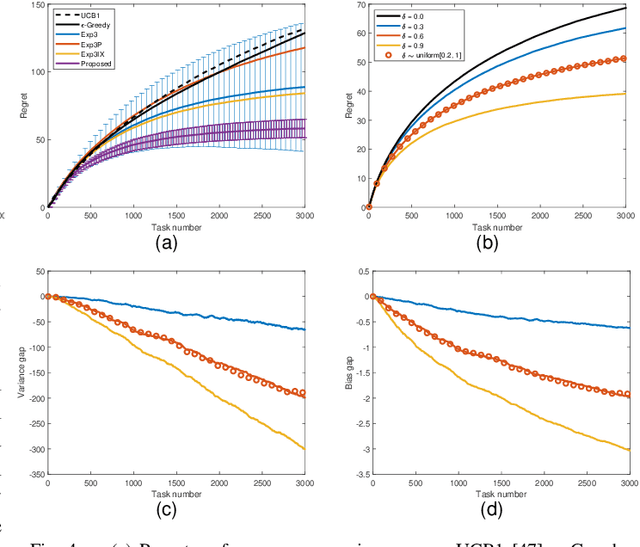
Vehicular fog computing (VFC) pushes the cloud computing capability to the distributed fog nodes at the edge of the Internet, enabling compute-intensive and latency-sensitive computing services for vehicles through task offloading. However, a heterogeneous mobility environment introduces uncertainties in terms of resource supply and demand, which are inevitable bottlenecks for the optimal offloading decision. Also, these uncertainties bring extra challenges to task offloading under the oblivious adversary attack and data privacy risks. In this article, we develop a new adversarial online algorithm with bandit feedback based on the adversarial multi-armed bandit theory, to enable scalable and low-complex offloading decision making on the fog node selection toward minimizing the offloading service cost in terms of delay and energy. The key is to implicitly tune exploration bonus in selection and assessment rules of the designed algorithm, taking into account volatile resource supply and demand. We theoretically prove that the input-size dependent selection rule allows to choose a suitable fog node without exploring the sub-optimal actions, and also an appropriate score patching rule allows to quickly adapt to evolving circumstances, which reduces variance and bias simultaneously, thereby achieving better exploitation exploration balance. Simulation results verify the effectiveness and robustness of the proposed algorithm.