 Add to Chrome
 Add to Firefox
 Add to Edge
Soft Partition-based KAPI-ELM for Multi-Scale PDEs
Jan 13, 2026
Physics-informed machine learning holds great promise for solving differential equations, yet existing methods struggle with highly oscillatory, multiscale, or singularly perturbed PDEs due to spectral bias, costly backpropagation, and manually tuned kernel or Fourier frequencies. This work introduces a soft partition--based Kernel-Adaptive Physics-Informed Extreme Learning Machine (KAPI-ELM), a deterministic low-dimensional parameterization in which smooth partition lengths jointly control collocation centers and Gaussian kernel widths, enabling continuous coarse-to-fine resolution without Fourier features, random sampling, or hard domain interfaces. A signed-distance-based weighting further stabilizes least-squares learning on irregular geometries. Across eight benchmarks--including oscillatory ODEs, high-frequency Poisson equations, irregular-shaped domains, and stiff singularly perturbed convection-diffusion problems-the proposed method matches or exceeds the accuracy of state-of-the-art Physics-Informed Neural Network (PINN) and Theory of Functional Connections (TFC) variants while using only a single linear solve. Although demonstrated on steady linear PDEs, the results show that soft-partition kernel adaptation provides a fast, architecture-free approach for multiscale PDEs with broad potential for future physics-informed modeling. For reproducibility, the reference codes are available at https://github.com/vikas-dwivedi-2022/soft_kapi

Curriculum Learning-Driven PIELMs for Fluid Flow Simulations
Mar 08, 2025This paper presents two novel, physics-informed extreme learning machine (PIELM)-based algorithms for solving steady and unsteady nonlinear partial differential equations (PDEs) related to fluid flow. Although single-hidden-layer PIELMs outperform deep physics-informed neural networks (PINNs) in speed and accuracy for linear and quasilinear PDEs, their extension to nonlinear problems remains challenging. To address this, we introduce a curriculum learning strategy that reformulates nonlinear PDEs as a sequence of increasingly complex quasilinear PDEs. Additionally, our approach enables a physically interpretable initialization of network parameters by leveraging Radial Basis Functions (RBFs). The performance of the proposed algorithms is validated on two benchmark incompressible flow problems: the viscous Burgers equation and lid-driven cavity flow. To the best of our knowledge, this is the first work to extend PIELM to solving Burgers' shock solution as well as lid-driven cavity flow up to a Reynolds number of 100. As a practical application, we employ PIELM to predict blood flow in a stenotic vessel. The results confirm that PIELM efficiently handles nonlinear PDEs, positioning it as a promising alternative to PINNs for both linear and nonlinear PDEs.
Variable length genetic algorithm with continuous parameters optimization of beam layout in proton therapy
May 17, 2022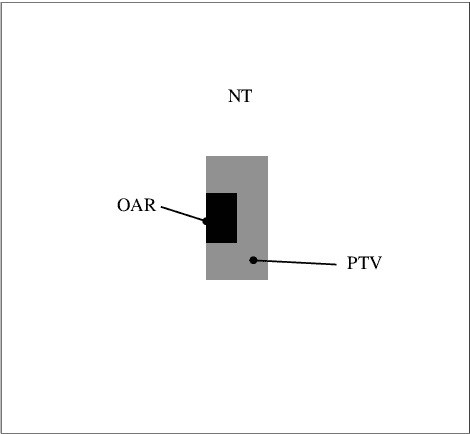
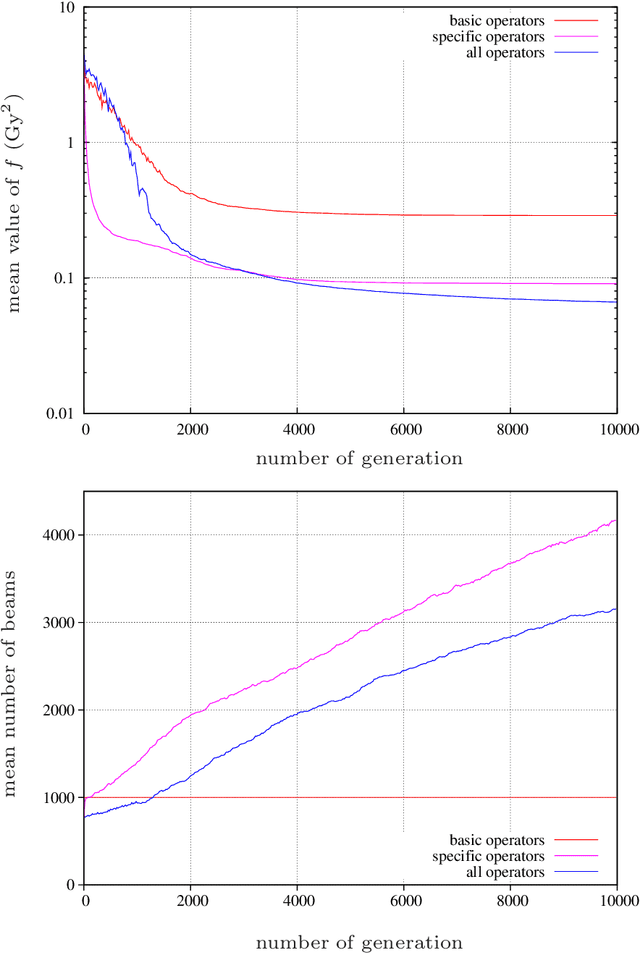
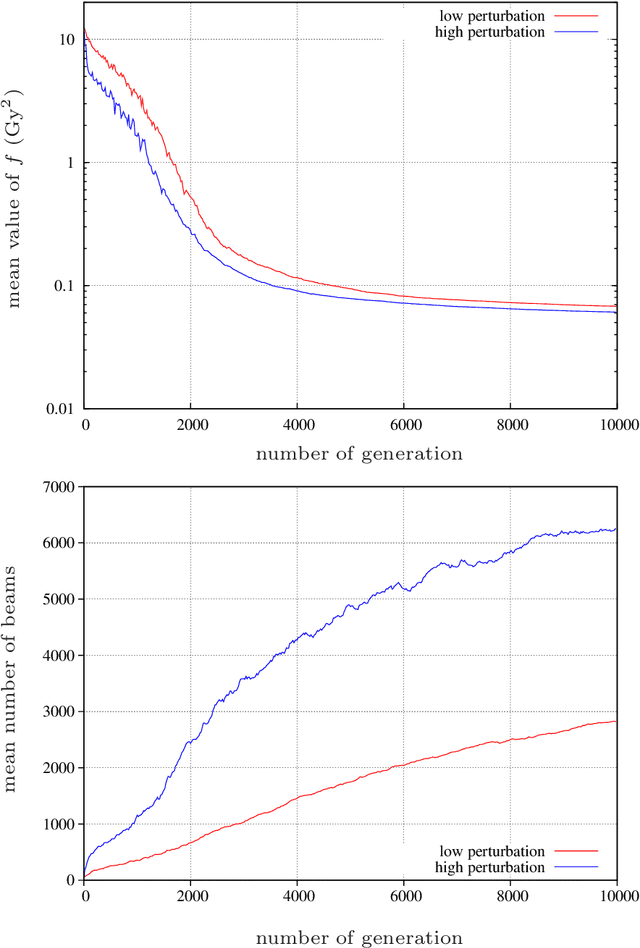
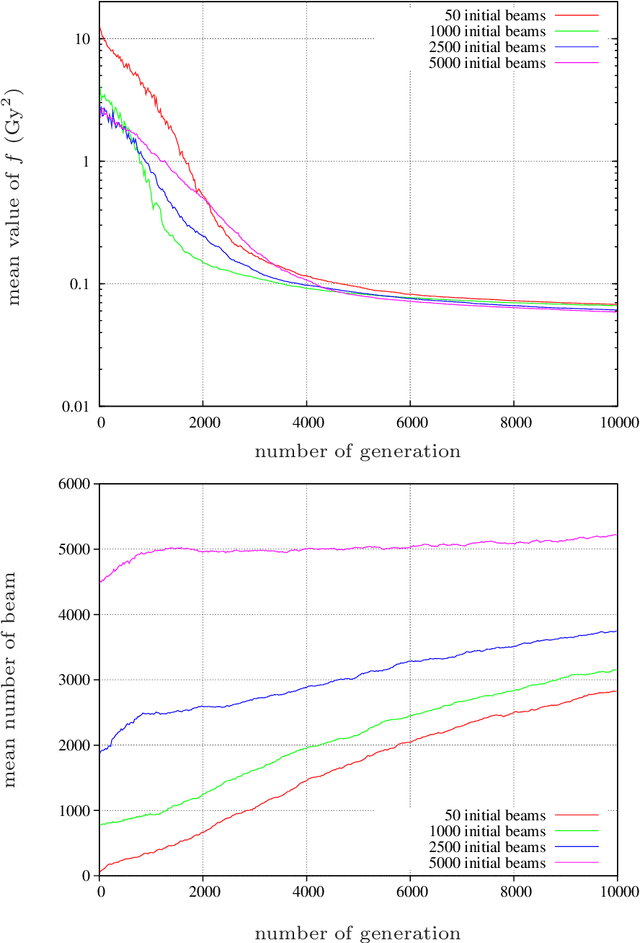
Proton therapy is a modality in fast development. Characterized by a maximum dose deposition at the end of the proton trajectory followed by a sharp fall-off, proton beams can deliver a highly conformal dose to the tumor while sparing organs at risk and surrounding healthy tissues. New treatment planning systems based on spot scanning techniques can now propose multi-field optimization. However, in most cases, this optimization only processes the field fluences whereas the choice of ballistics (field geometry) is left to the oncologist and medical physicist. In this work, we investigate a new optimization framework based on a genetic approach. This tool is intended to explore new irradiation schemes and to evaluate the potential of actual or future irradiation systems. We propose to optimize simultaneously the target points and beam incidence angles in a continuous manner and with a variable number of beams. No \textit{a priori} technological constraints are taken into account, \textit{i.e.}~the beam energy values, incidence directions and target points are free parameters. The proposed algorithm is based on a modified version of classical genetic operators: mutation, crossover and selection. We use the real coding associated with random perturbations of the parameters to obtain a continuous variation of the potential solutions. We also introduce a perturbation in the exchange points of the crossover to allow variations of the number of beams. These variations are controlled by introducing a beam fluence lower limit. In this paper, we present a complete description of the algorithm and of its behaviour in an elementary test case. The proposed method is finally assessed in a clinically-realistic test case.
Towards the optimization of ballistics in proton therapy using genetic algorithms: implementation issues
May 17, 2022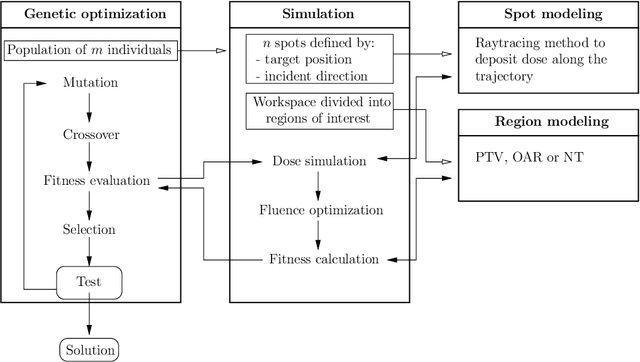
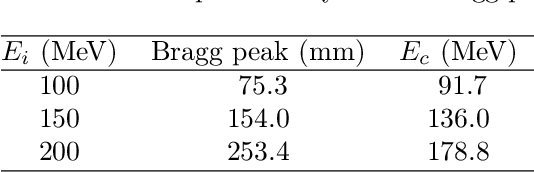
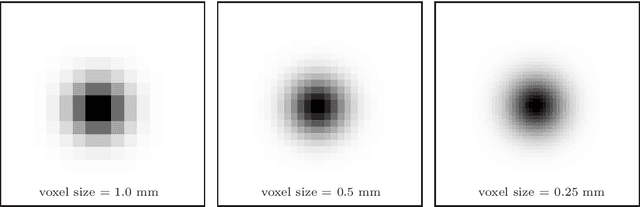
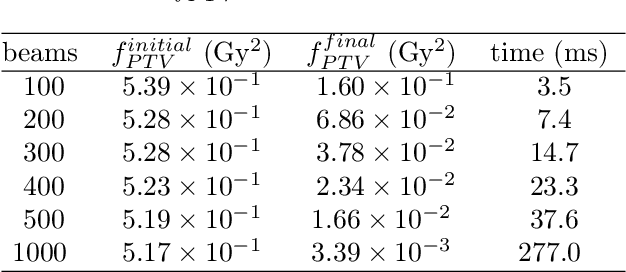
The dose delivered to the planning target volume by proton beams is highly conformal, sparing organs at risk and normal tissues. New treatment planning systems adapted to spot scanning techniques have been recently proposed to simultaneously optimize several fields and thus improve dose delivery. In this paper, we investigate a new optimization framework based on a genetic algorithm approach. This tool is intended to make it possible to explore new schemes of treatment delivery, possibly with future enhanced technologies. The optimization framework is designed to be versatile and to account for many degrees of freedom, without any {\it a priori} technological constraint. To test the behavior of our algorithm, we propose in this paper, as an example, to optimize beam fluences, target points and irradiation directions at the same time. The proposed optimization routine takes typically into account several thousands of spots of fixed size. The evolution is carried out by the three standard genetic operators: mutation, crossover and selection. The figure-of-merit (or fitness) is based on an objective function relative to the dose prescription to the tumor and to the limits set for organs at risk and normal tissues. Fluence optimization is carried out via a specific scheme based on a plain gradient with analytical solution. Several specific genetic algorithm issues are addressed: (i) the mutation rate is tuned to balance the search and selection forces, (ii) the initial population is selected using a bootstrap technique and (iii) to scale down the computation time, dose calculations are carried out with a fast analytical ray tracing method and are multi-threaded. In this paper implementation issues of the optimization framework are thoroughly described. The behavior of the proposed genetic algorithm is illustrated in both elementary and clinically-realistic test cases.