 Add to Chrome
 Add to Firefox
 Add to Edge
Towards Operational Automated Greenhouse Gas Plume Detection
May 27, 2025
Operational deployment of a fully automated greenhouse gas (GHG) plume detection system remains an elusive goal for imaging spectroscopy missions, despite recent advances in deep learning approaches. With the dramatic increase in data availability, however, automation continues to increase in importance for natural and anthropogenic emissions monitoring. This work reviews and addresses several key obstacles in the field: data and label quality control, prevention of spatiotemporal biases, and correctly aligned modeling objectives. We demonstrate through rigorous experiments using multicampaign data from airborne and spaceborne instruments that convolutional neural networks (CNNs) are able to achieve operational detection performance when these obstacles are alleviated. We demonstrate that a multitask model that learns both instance detection and pixelwise segmentation simultaneously can successfully lead towards an operational pathway. We evaluate the model's plume detectability across emission source types and regions, identifying thresholds for operational deployment. Finally, we provide analysis-ready data, models, and source code for reproducibility, and work to define a set of best practices and validation standards to facilitate future contributions to the field.

Learning Radiative Transfer Models for Climate Change Applications in Imaging Spectroscopy
Jun 08, 2019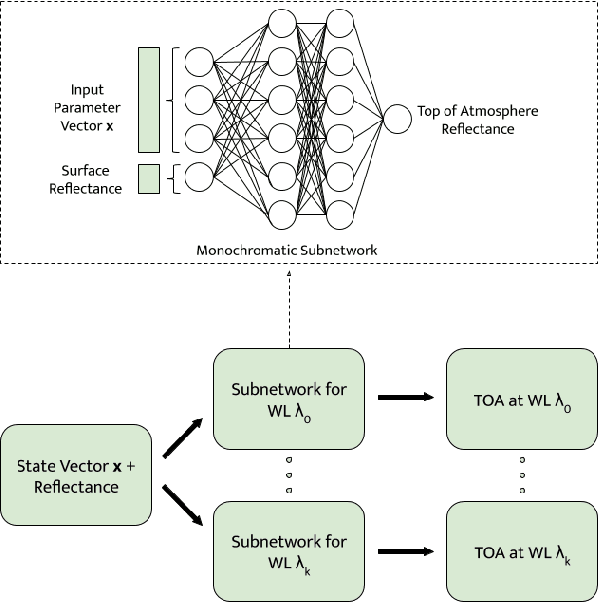
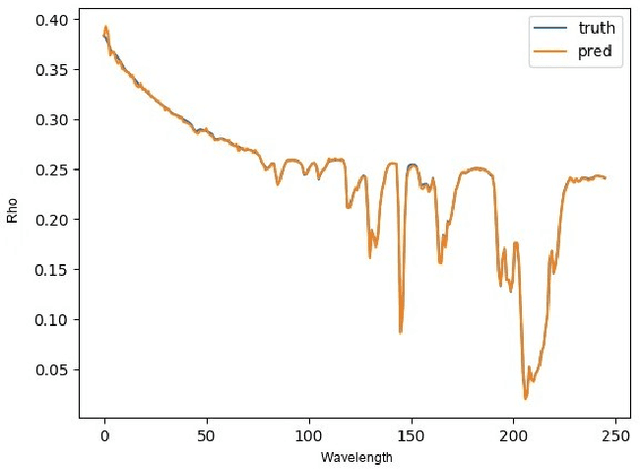
According to a recent investigation, an estimated 33-50% of the world's coral reefs have undergone degradation, believed to be as a result of climate change. A strong driver of climate change and the subsequent environmental impact are greenhouse gases such as methane. However, the exact relation climate change has to the environmental condition cannot be easily established. Remote sensing methods are increasingly being used to quantify and draw connections between rapidly changing climatic conditions and environmental impact. A crucial part of this analysis is processing spectroscopy data using radiative transfer models (RTMs) which is a computationally expensive process and limits their use with high volume imaging spectrometers. This work presents an algorithm that can efficiently emulate RTMs using neural networks leading to a multifold speedup in processing time, and yielding multiple downstream benefits.