 Add to Chrome
 Add to Firefox
 Add to Edge
Auditing Fairness under Model Updates: Fundamental Complexity and Property-Preserving Updates
Jan 09, 2026
As machine learning models become increasingly embedded in societal infrastructure, auditing them for bias is of growing importance. However, in real-world deployments, auditing is complicated by the fact that model owners may adaptively update their models in response to changing environments, such as financial markets. These updates can alter the underlying model class while preserving certain properties of interest, raising fundamental questions about what can be reliably audited under such shifts. In this work, we study group fairness auditing under arbitrary updates. We consider general shifts that modify the pre-audit model class while maintaining invariance of the audited property. Our goals are two-fold: (i) to characterize the information complexity of allowable updates, by identifying which strategic changes preserve the property under audit; and (ii) to efficiently estimate auditing properties, such as group fairness, using a minimal number of labeled samples. We propose a generic framework for PAC auditing based on an Empirical Property Optimization (EPO) oracle. For statistical parity, we establish distribution-free auditing bounds characterized by the SP dimension, a novel combinatorial measure that captures the complexity of admissible strategic updates. Finally, we demonstrate that our framework naturally extends to other auditing objectives, including prediction error and robust risk.

Active Fourier Auditor for Estimating Distributional Properties of ML Models
Oct 10, 2024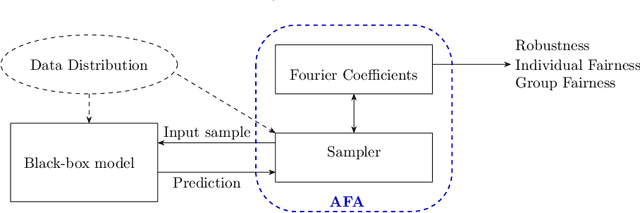
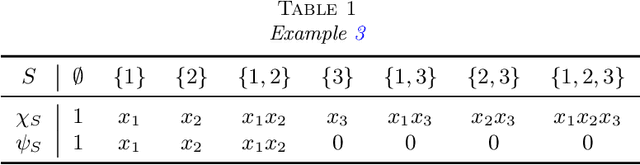
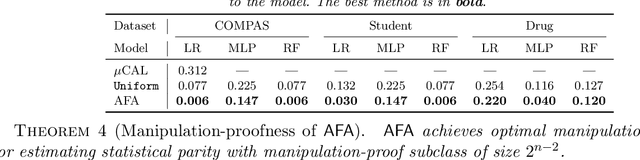
With the pervasive deployment of Machine Learning (ML) models in real-world applications, verifying and auditing properties of ML models have become a central concern. In this work, we focus on three properties: robustness, individual fairness, and group fairness. We discuss two approaches for auditing ML model properties: estimation with and without reconstruction of the target model under audit. Though the first approach is studied in the literature, the second approach remains unexplored. For this purpose, we develop a new framework that quantifies different properties in terms of the Fourier coefficients of the ML model under audit but does not parametrically reconstruct it. We propose the Active Fourier Auditor (AFA), which queries sample points according to the Fourier coefficients of the ML model, and further estimates the properties. We derive high probability error bounds on AFA's estimates, along with the worst-case lower bounds on the sample complexity to audit them. Numerically we demonstrate on multiple datasets and models that AFA is more accurate and sample-efficient to estimate the properties of interest than the baselines.