 Add to Chrome
 Add to Firefox
 Add to Edge
SPOT: Spatio-Temporal Obstacle-free Trajectory Planning for UAVs in an Unknown Dynamic Environment
Feb 01, 2026
We address the problem of reactive motion planning for quadrotors operating in unknown environments with dynamic obstacles. Our approach leverages a 4-dimensional spatio-temporal planner, integrated with vision-based Safe Flight Corridor (SFC) generation and trajectory optimization. Unlike prior methods that rely on map fusion, our framework is mapless, enabling collision avoidance directly from perception while reducing computational overhead. Dynamic obstacles are detected and tracked using a vision-based object segmentation and tracking pipeline, allowing robust classification of static versus dynamic elements in the scene. To further enhance robustness, we introduce a backup planning module that reactively avoids dynamic obstacles when no direct path to the goal is available, mitigating the risk of collisions during deadlock situations. We validate our method extensively in both simulation and real-world hardware experiments, and benchmark it against state-of-the-art approaches, showing significant advantages for reactive UAV navigation in dynamic, unknown environments.

Design And Flight Testing Of LQRi Attitude Control For Quadcopter UAV
Apr 18, 2024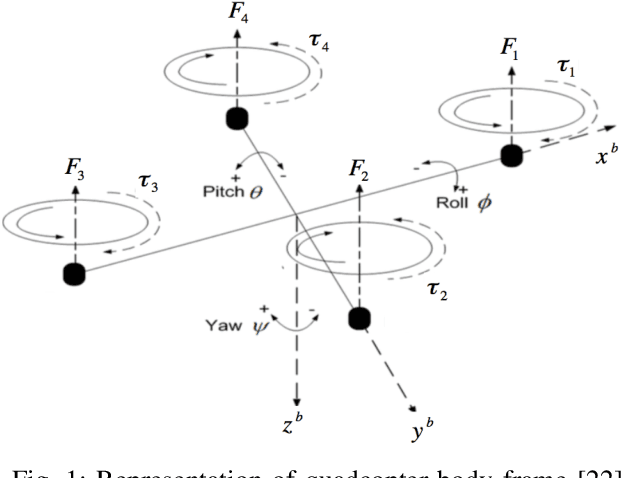
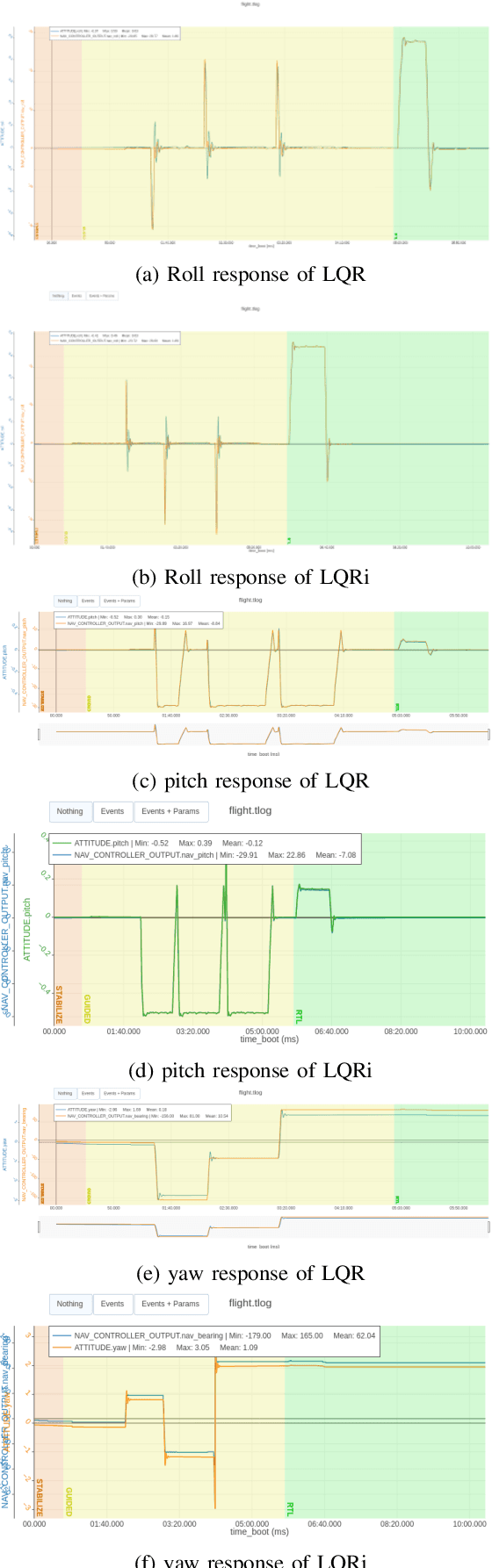
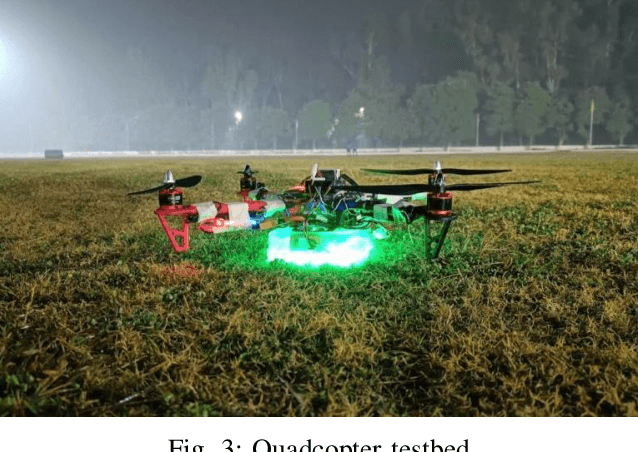
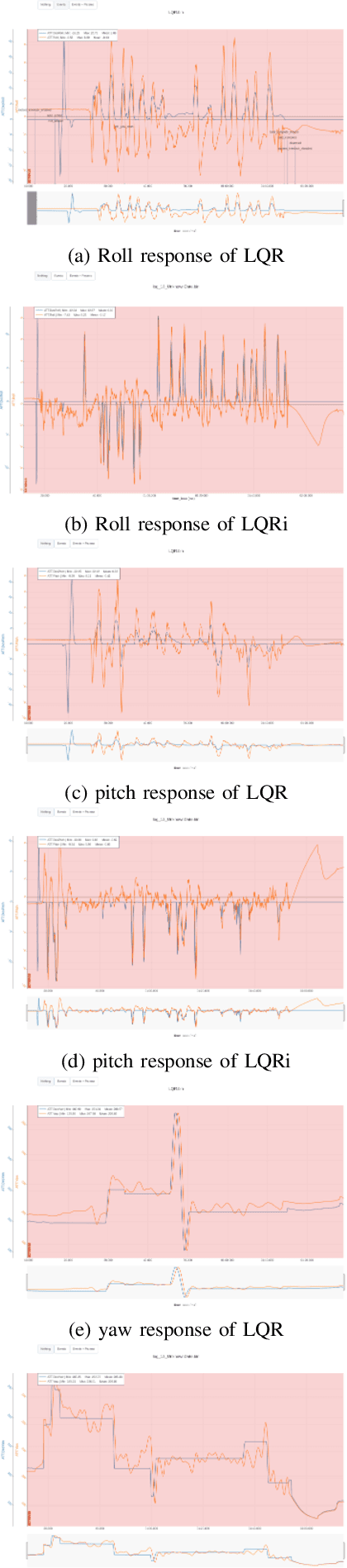
This paper presents the design, implementation, and flight test results of linear quadratic integral regulator (LQRi) based attitude control for a quadcopter UAV. We present the derivation of the mathematical model for the kinematics and dynamics of the UAV, along with the linearized state space representation of the system about hover conditions. LQR and LQRi controllers are then designed to stabilize the UAV in hover conditions and to track desired attitude commands. The controllers are then implemented onboard the Pixhawk flight controller and flight test results are discussed. Finally, the code related to this paper has been published open-source for replication and further research
A reformulation of collision avoidance algorithm based on artificial potential fields for fixed-wing UAVs in a dynamic environment
Aug 05, 2022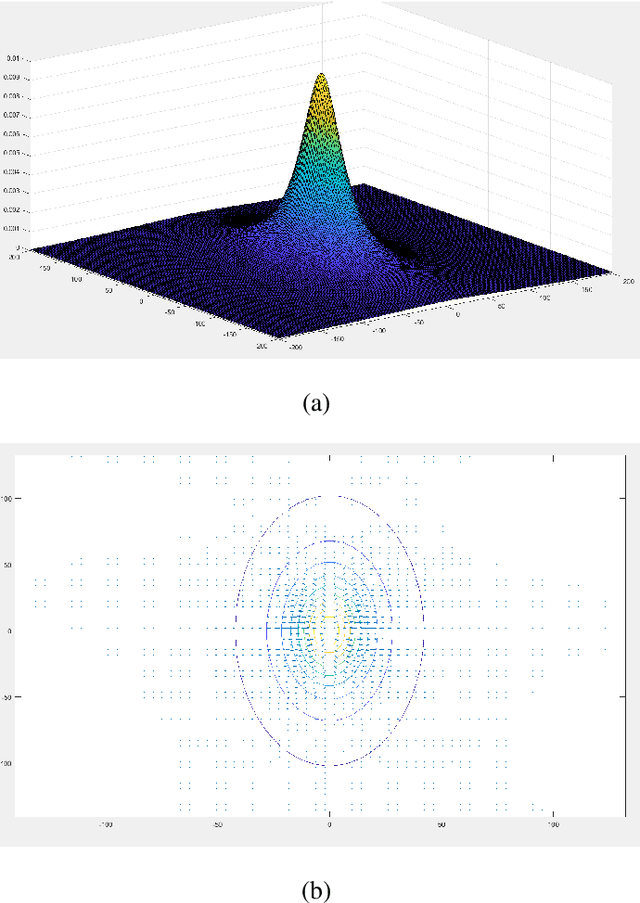
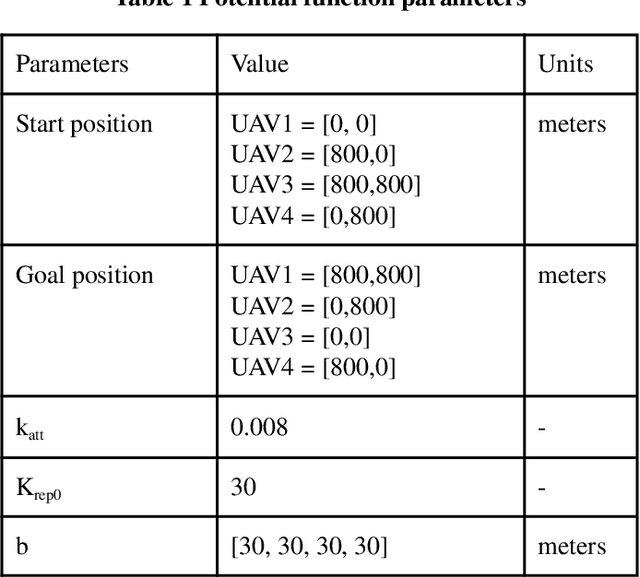
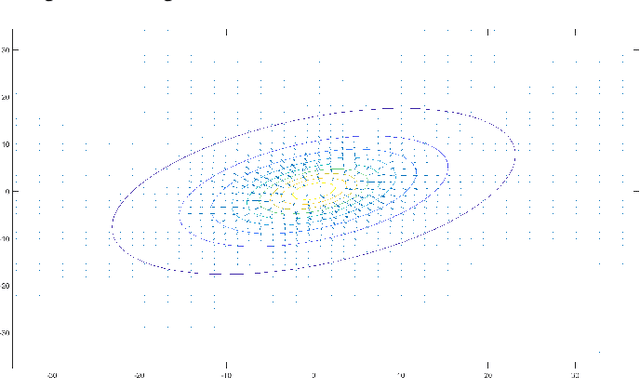
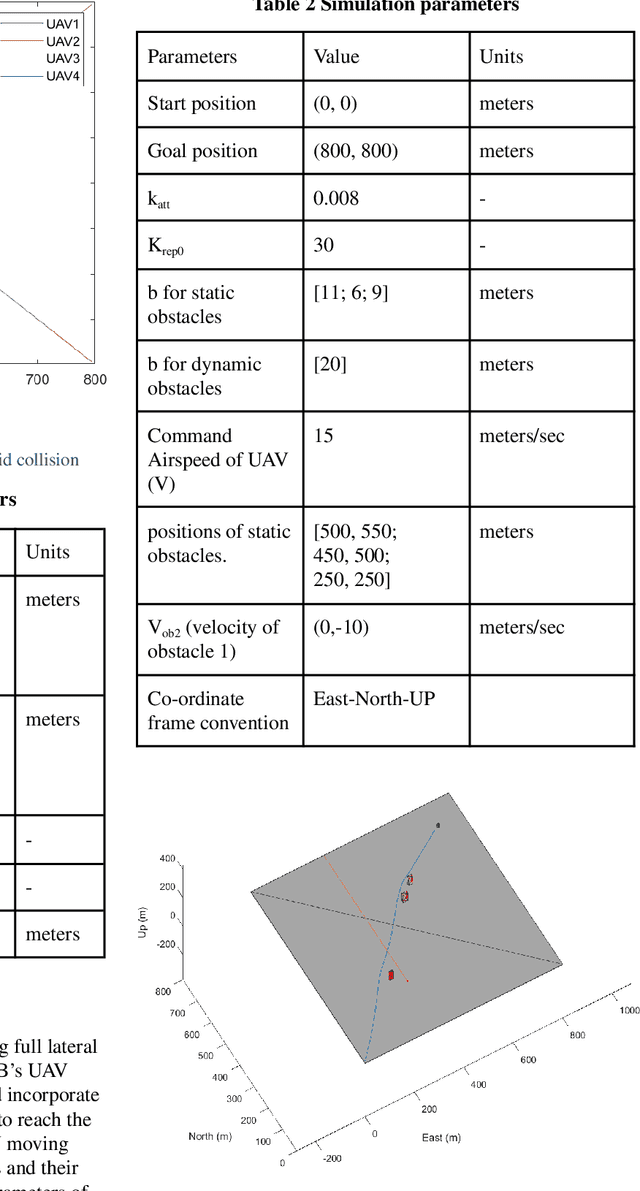
As mini UAVs become increasingly useful in the civilian work domain, the need for a method for them to operate safely in a cluttered environment is growing, especially for fixed-wing UAVs as they are incapable of following the stop-decide-execute methodology. This paper presents preliminary research to design a reactive collision avoidance algorithm based on the improved definition of the repulsive forces used in the Artificial potential field algorithms to allow feasible and safe navigation of fixed-wing UAVs in cluttered, dynamic environments. We present simulation results of the improved definition in multiple scenarios, and we have also discussed possible future studies to improve upon these results.