 Add to Chrome
 Add to Firefox
 Add to Edge
MedVerse: Efficient and Reliable Medical Reasoning via DAG-Structured Parallel Execution
Feb 07, 2026
Large language models (LLMs) have demonstrated strong performance and rapid progress in a wide range of medical reasoning tasks. However, their sequential autoregressive decoding forces inherently parallel clinical reasoning, such as differential diagnosis, into a single linear reasoning path, limiting both efficiency and reliability for complex medical problems. To address this, we propose MedVerse, a reasoning framework for complex medical inference that reformulates medical reasoning as a parallelizable directed acyclic graph (DAG) process based on Petri net theory. The framework adopts a full-stack design across data, model architecture, and system execution. For data creation, we introduce the MedVerse Curator, an automated pipeline that synthesizes knowledge-grounded medical reasoning paths and transforms them into Petri net-structured representations. At the architectural level, we propose a topology-aware attention mechanism with adaptive position indices that supports parallel reasoning while preserving logical consistency. Systematically, we develop a customized inference engine that supports parallel execution without additional overhead. Empirical evaluations show that MedVerse improves strong general-purpose LLMs by up to 8.9%. Compared to specialized medical LLMs, MedVerse achieves comparable performance while delivering a 1.3x reduction in inference latency and a 1.7x increase in generation throughput, enabled by its parallel decoding capability.

A Generative Model Method for Unsupervised Multispectral Image Fusion in Remote Sensing
Feb 07, 2021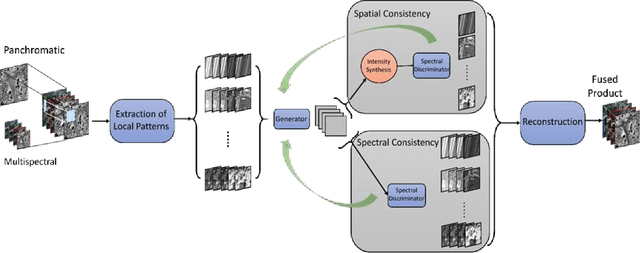
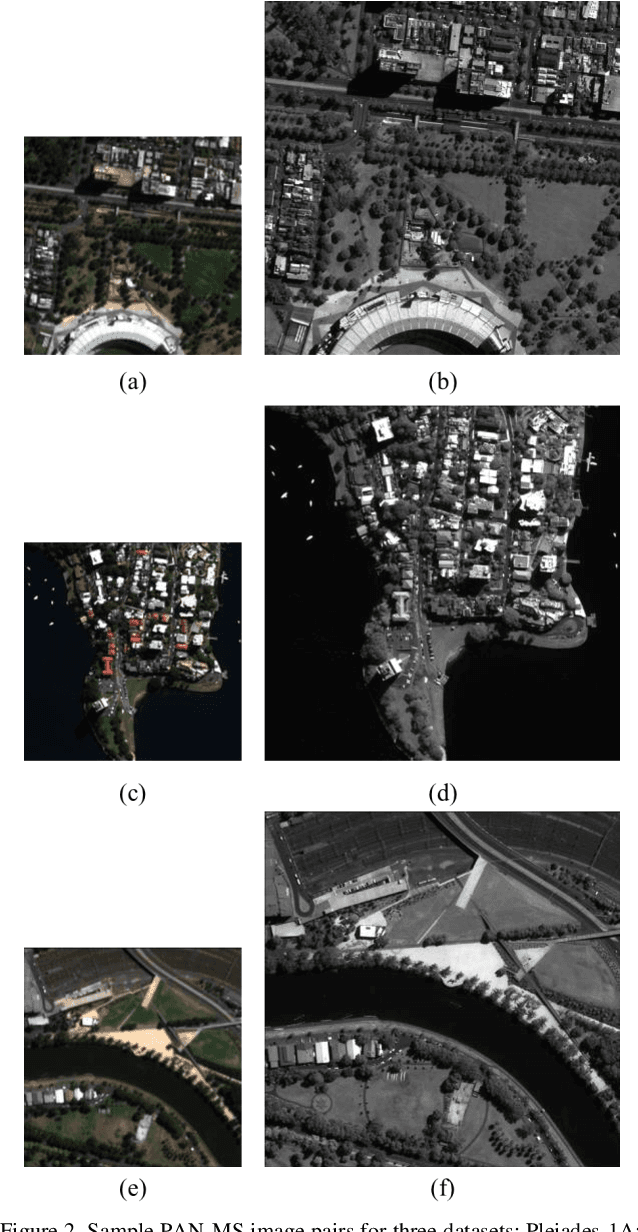
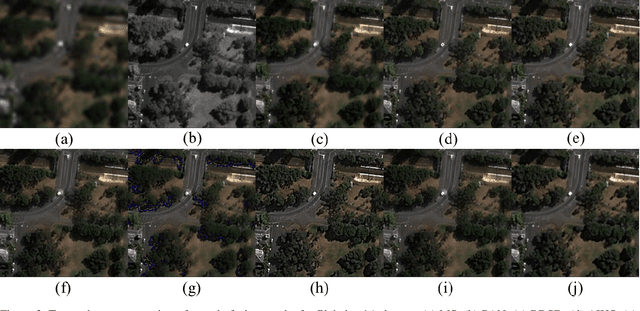
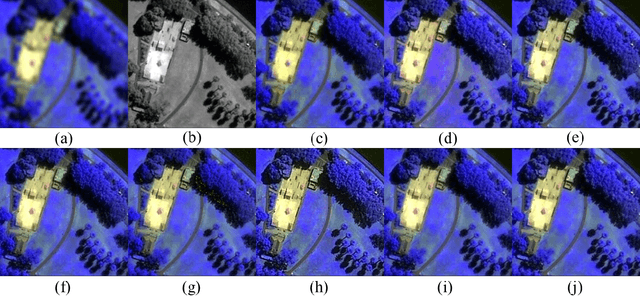
This paper presents a generative model method for multispectral image fusion in remote sensing which is trained without supervision. This method eases the supervision of learning and it also considers a multi-objective loss function to achieve image fusion. The loss function incorporates both spectral and spatial distortions. Two discriminators are designed to minimize the spectral and spatial distortions of the generative output. Extensive experimentations are conducted using three public domain datasets. The comparison results across four reduced-resolution and three full-resolution objective metrics show the superiority of the developed method over several recently developed methods.
Deep Learning-Based Detail Map Estimation for MultiSpectral Image Fusion in Remote Sensing
Feb 07, 2021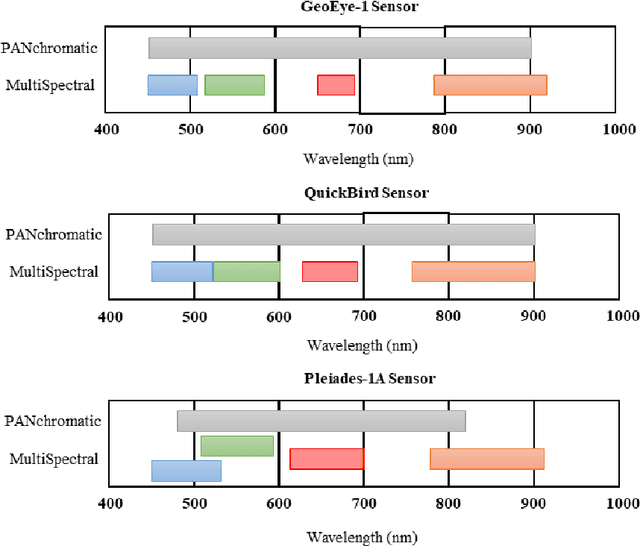
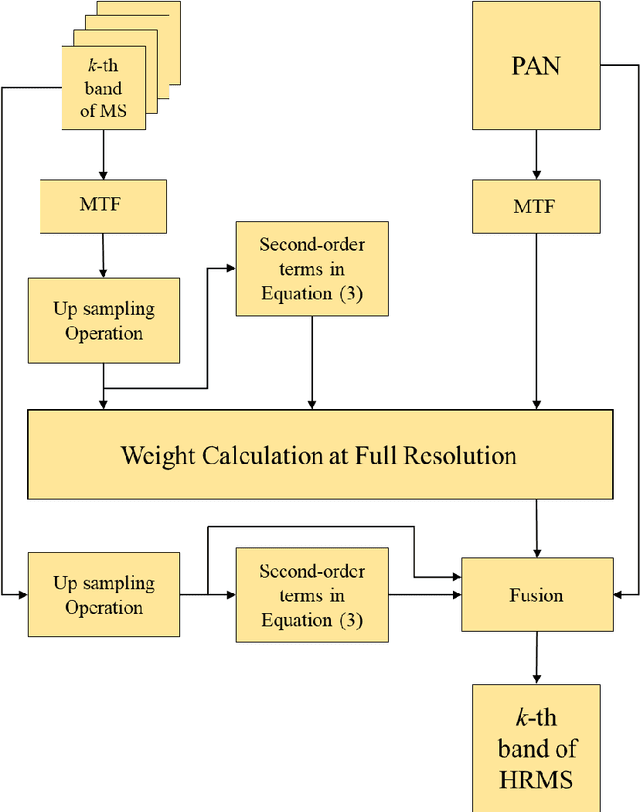
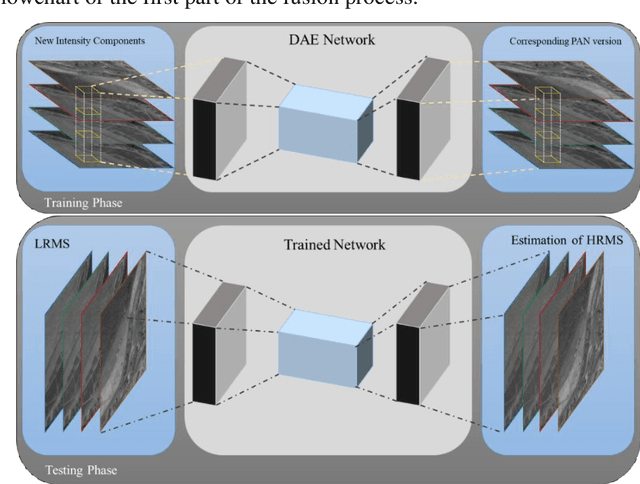
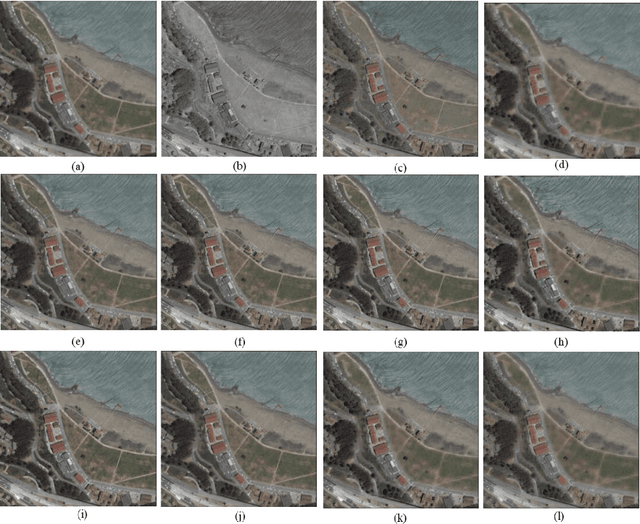
This paper presents a deep learning-based estimation of the intensity component of MultiSpectral bands by considering joint multiplication of the neighbouring spectral bands. This estimation is conducted as part of the component substitution approach for fusion of PANchromatic and MultiSpectral images in remote sensing. After computing the band dependent intensity components, a deep neural network is trained to learn the nonlinear relationship between a PAN image and its nonlinear intensity components. Low Resolution MultiSpectral bands are then fed into the trained network to obtain an estimate of High Resolution MultiSpectral bands. Experiments conducted on three datasets show that the developed deep learning-based estimation approach provides improved performance compared to the existing methods based on three objective metrics.