 Add to Chrome
 Add to Firefox
 Add to Edge
Implicit score matching meets denoising score matching: improved rates of convergence and log-density Hessian estimation
Dec 30, 2025
We study the problem of estimating the score function using both implicit score matching and denoising score matching. Assuming that the data distribution exhibiting a low-dimensional structure, we prove that implicit score matching is able not only to adapt to the intrinsic dimension, but also to achieve the same rates of convergence as denoising score matching in terms of the sample size. Furthermore, we demonstrate that both methods allow us to estimate log-density Hessians without the curse of dimensionality by simple differentiation. This justifies convergence of ODE-based samplers for generative diffusion models. Our approach is based on Gagliardo-Nirenberg-type inequalities relating weighted $L^2$-norms of smooth functions and their derivatives.

Score-based change point detection via tracking the best of infinitely many experts
Aug 26, 2024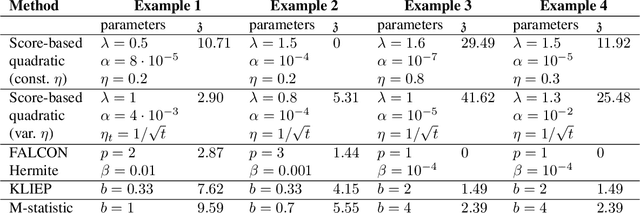
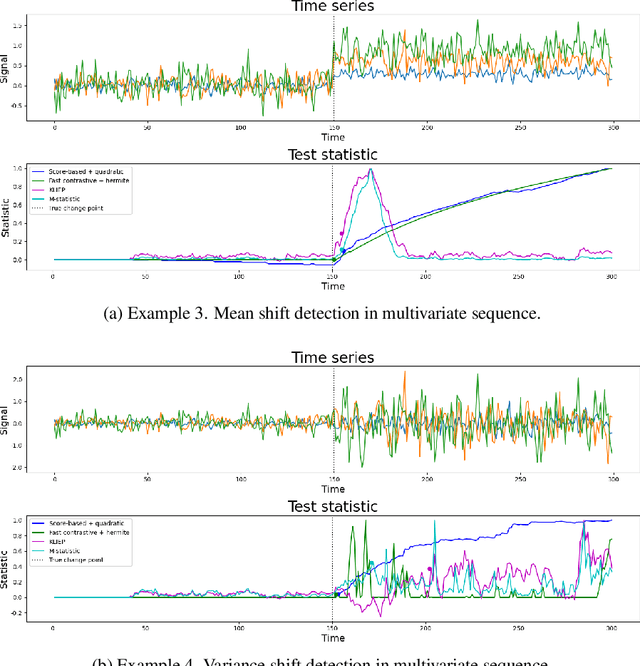
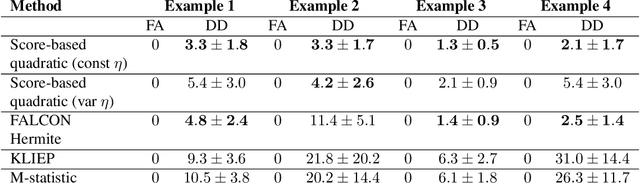
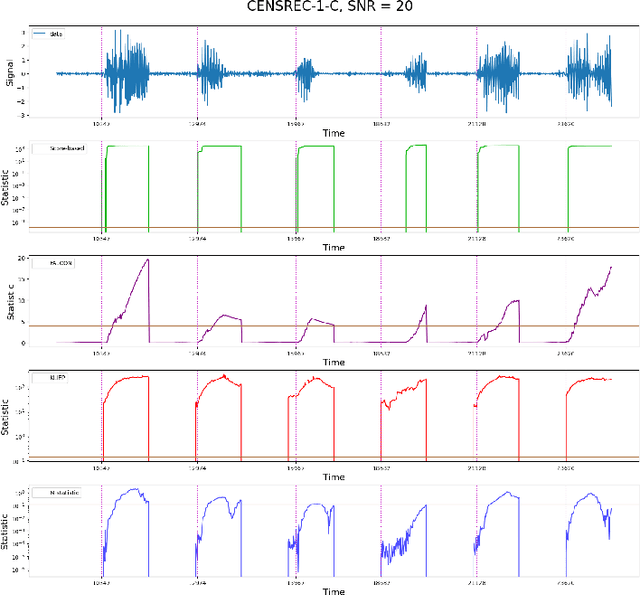
We suggest a novel algorithm for online change point detection based on sequential score function estimation and tracking the best expert approach. The core of the procedure is a version of the fixed share forecaster for the case of infinite number of experts and quadratic loss functions. The algorithm shows a promising performance in numerical experiments on artificial and real-world data sets. We also derive new upper bounds on the dynamic regret of the fixed share forecaster with varying parameter, which are of independent interest.