 Add to Chrome
 Add to Firefox
 Add to Edge
Topological Spatial Graph Coarsening
Dec 30, 2025
Spatial graphs are particular graphs for which the nodes are localized in space (e.g., public transport network, molecules, branching biological structures). In this work, we consider the problem of spatial graph reduction, that aims to find a smaller spatial graph (i.e., with less nodes) with the same overall structure as the initial one. In this context, performing the graph reduction while preserving the main topological features of the initial graph is particularly relevant, due to the additional spatial information. Thus, we propose a topological spatial graph coarsening approach based on a new framework that finds a trade-off between the graph reduction and the preservation of the topological characteristics. The coarsening is realized by collapsing short edges. In order to capture the topological information required to calibrate the reduction level, we adapt the construction of classical topological descriptors made for point clouds (the so-called persistent diagrams) to spatial graphs. This construction relies on the introduction of a new filtration called triangle-aware graph filtration. Our coarsening approach is parameter-free and we prove that it is equivariant under rotations, translations and scaling of the initial spatial graph. We evaluate the performances of our method on synthetic and real spatial graphs, and show that it significantly reduces the graph sizes while preserving the relevant topological information.

Graph Counterfactual Explainable AI via Latent Space Traversal
Jan 15, 2025Explaining the predictions of a deep neural network is a nontrivial task, yet high-quality explanations for predictions are often a prerequisite for practitioners to trust these models. Counterfactual explanations aim to explain predictions by finding the ''nearest'' in-distribution alternative input whose prediction changes in a pre-specified way. However, it remains an open question how to define this nearest alternative input, whose solution depends on both the domain (e.g. images, graphs, tabular data, etc.) and the specific application considered. For graphs, this problem is complicated i) by their discrete nature, as opposed to the continuous nature of state-of-the-art graph classifiers; and ii) by the node permutation group acting on the graphs. We propose a method to generate counterfactual explanations for any differentiable black-box graph classifier, utilizing a case-specific permutation equivariant graph variational autoencoder. We generate counterfactual explanations in a continuous fashion by traversing the latent space of the autoencoder across the classification boundary of the classifier, allowing for seamless integration of discrete graph structure and continuous graph attributes. We empirically validate the approach on three graph datasets, showing that our model is consistently high-performing and more robust than the baselines.
* Published at Northern Lights Deep Learning Conference 2025
Interpreting Equivariant Representations
Jan 23, 2024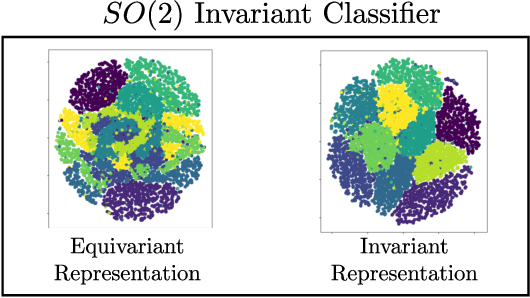
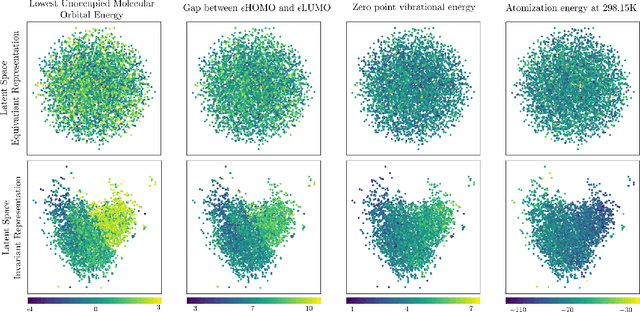
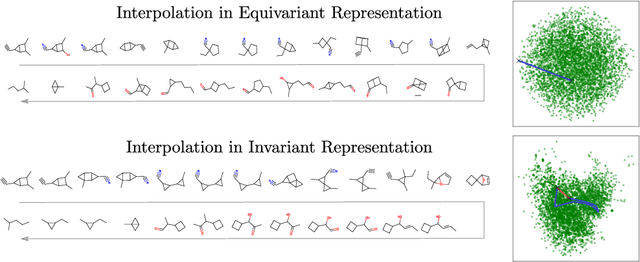
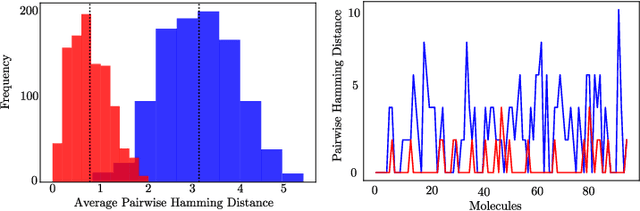
Latent representations are used extensively for downstream tasks, such as visualization, interpolation or feature extraction of deep learning models. Invariant and equivariant neural networks are powerful and well-established models for enforcing inductive biases. In this paper, we demonstrate that the inductive bias imposed on the by an equivariant model must also be taken into account when using latent representations. We show how not accounting for the inductive biases leads to decreased performance on downstream tasks, and vice versa, how accounting for inductive biases can be done effectively by using an invariant projection of the latent representations. We propose principles for how to choose such a projection, and show the impact of using these principles in two common examples: First, we study a permutation equivariant variational auto-encoder trained for molecule graph generation; here we show that invariant projections can be designed that incur no loss of information in the resulting invariant representation. Next, we study a rotation-equivariant representation used for image classification. Here, we illustrate how random invariant projections can be used to obtain an invariant representation with a high degree of retained information. In both cases, the analysis of invariant latent representations proves superior to their equivariant counterparts. Finally, we illustrate that the phenomena documented here for equivariant neural networks have counterparts in standard neural networks where invariance is encouraged via augmentation. Thus, while these ambiguities may be known by experienced developers of equivariant models, we make both the knowledge as well as effective tools to handle the ambiguities available to the broader community.