 Add to Chrome
 Add to Firefox
 Add to Edge
Synthetic Contrastive Reasoning for Multi-Table Q&A
Jun 03, 2026
Multi-table question answering requires models to retrieve relevant evidence, link schemas, and perform compositional reasoning across relational tables. Existing multi-table Q&A resources typically provide questions and final answers but lack reasoning supervision that explains how answers are derived. To address this gap, we construct a synthetic contrastive reasoning-trace dataset for MMQA by generating validated positive traces and plausible negative traces with heterogeneous LLMs. We then use the resulting preference pairs to fine-tune open-weight LLMs with Contrastive Preference Optimization (CPO). Across Qwen3-14B, Mistral-8B, and Llama-3.1-8B, CPO achieves absolute average improvements over Q&A supervised fine-tuning ranging from 9.7%-16.3%, with gains up to 21 percentage points on MMQA. Ablations show that heterogeneous positive and negative trace generators strengthen the contrastive signal, and automated as well as human evaluations indicate that the generated pairs are largely faithful, coherent, and meaningfully contrastive.

Noisy Low Rank Column-wise Sensing
Sep 12, 2024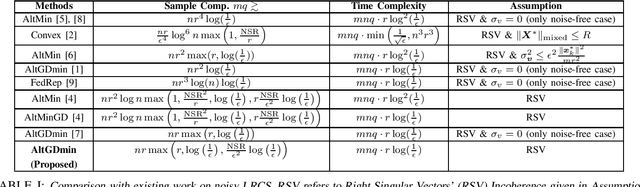
This letter studies the AltGDmin algorithm for solving the noisy low rank column-wise sensing (LRCS) problem. Our sample complexity guarantee improves upon the best existing one by a factor $\max(r, \log(1/\epsilon))/r$ where $r$ is the rank of the unknown matrix and $\epsilon$ is the final desired accuracy. A second contribution of this work is a detailed comparison of guarantees from all work that studies the exact same mathematical problem as LRCS, but refers to it by different names.
Byzantine-Resilient Federated PCA and Low Rank Matrix Recovery
Sep 25, 2023In this work we consider the problem of estimating the principal subspace (span of the top r singular vectors) of a symmetric matrix in a federated setting, when each node has access to estimates of this matrix. We study how to make this problem Byzantine resilient. We introduce a novel provably Byzantine-resilient, communication-efficient, and private algorithm, called Subspace-Median, to solve it. We also study the most natural solution for this problem, a geometric median based modification of the federated power method, and explain why it is not useful. We consider two special cases of the resilient subspace estimation meta-problem - federated principal components analysis (PCA) and the spectral initialization step of horizontally federated low rank column-wise sensing (LRCCS) in this work. For both these problems we show how Subspace Median provides a resilient solution that is also communication-efficient. Median of Means extensions are developed for both problems. Extensive simulation experiments are used to corroborate our theoretical guarantees. Our second contribution is a complete AltGDmin based algorithm for Byzantine-resilient horizontally federated LRCCS and guarantees for it. We do this by developing a geometric median of means estimator for aggregating the partial gradients computed at each node, and using Subspace Median for initialization.