 Add to Chrome
 Add to Firefox
 Add to Edge
Robust Representation Learning in Masked Autoencoders
Feb 03, 2026
Masked Autoencoders (MAEs) achieve impressive performance in image classification tasks, yet the internal representations they learn remain less understood. This work started as an attempt to understand the strong downstream classification performance of MAE. In this process we discover that representations learned with the pretraining and fine-tuning, are quite robust - demonstrating a good classification performance in the presence of degradations, such as blur and occlusions. Through layer-wise analysis of token embeddings, we show that pretrained MAE progressively constructs its latent space in a class-aware manner across network depth: embeddings from different classes lie in subspaces that become increasingly separable. We further observe that MAE exhibits early and persistent global attention across encoder layers, in contrast to standard Vision Transformers (ViTs). To quantify feature robustness, we introduce two sensitivity indicators: directional alignment between clean and perturbed embeddings, and head-wise retention of active features under degradations. These studies help establish the robust classification performance of MAEs.

Latent Space Characterization of Autoencoder Variants
Dec 06, 2024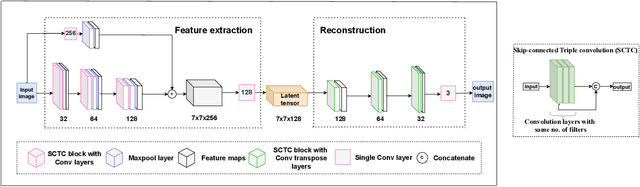
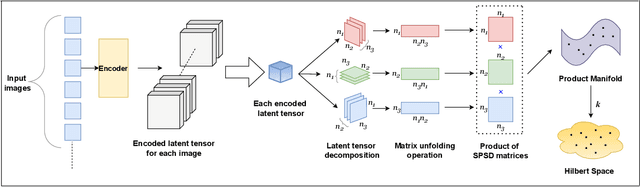
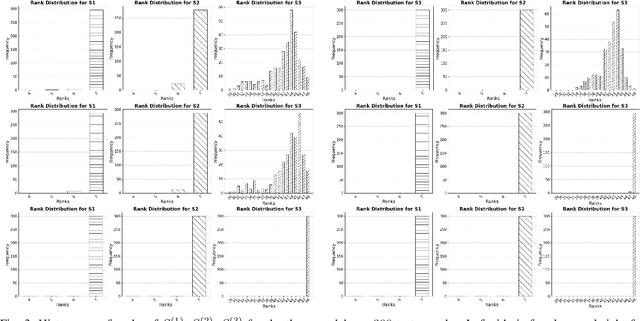
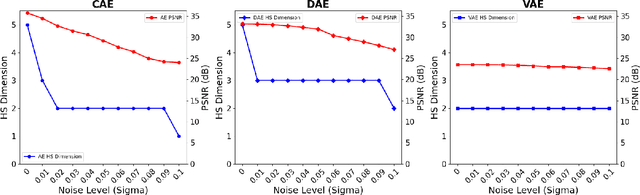
Understanding the latent spaces learned by deep learning models is crucial in exploring how they represent and generate complex data. Autoencoders (AEs) have played a key role in the area of representation learning, with numerous regularization techniques and training principles developed not only to enhance their ability to learn compact and robust representations, but also to reveal how different architectures influence the structure and smoothness of the lower-dimensional non-linear manifold. We strive to characterize the structure of the latent spaces learned by different autoencoders including convolutional autoencoders (CAEs), denoising autoencoders (DAEs), and variational autoencoders (VAEs) and how they change with the perturbations in the input. By characterizing the matrix manifolds corresponding to the latent spaces, we provide an explanation for the well-known observation that the latent spaces of CAE and DAE form non-smooth manifolds, while that of VAE forms a smooth manifold. We also map the points of the matrix manifold to a Hilbert space using distance preserving transforms and provide an alternate view in terms of the subspaces generated in the Hilbert space as a function of the distortion in the input. The results show that the latent manifolds of CAE and DAE are stratified with each stratum being a smooth product manifold, while the manifold of VAE is a smooth product manifold of two symmetric positive definite matrices and a symmetric positive semi-definite matrix.