 Add to Chrome
 Add to Firefox
 Add to Edge
Motif Diversity in Human Liver ChIP-seq Data Using MAP-Elites
Jan 25, 2026
Motif discovery is a core problem in computational biology, traditionally formulated as a likelihood optimization task that returns a single dominant motif from a DNA sequence dataset. However, regulatory sequence data admit multiple plausible motif explanations, reflecting underlying biological heterogeneity. In this work, we frame motif discovery as a quality-diversity problem and apply the MAP-Elites algorithm to evolve position weight matrix motifs under a likelihood-based fitness objective while explicitly preserving diversity across biologically meaningful dimensions. We evaluate MAP-Elites using three complementary behavioral characterizations that capture trade-offs between motif specificity, compositional structure, coverage, and robustness. Experiments on human CTCF liver ChIP-seq data aligned to the human reference genome compare MAP-Elites against a standard motif discovery tool, MEME, under matched evaluation criteria across stratified dataset subsets. Results show that MAP-Elites recovers multiple high-quality motif variants with fitness comparable to MEME's strongest solutions while revealing structured diversity obscured by single-solution approaches.

Evolving Flying Machines in Minecraft Using Quality Diversity
Feb 01, 2023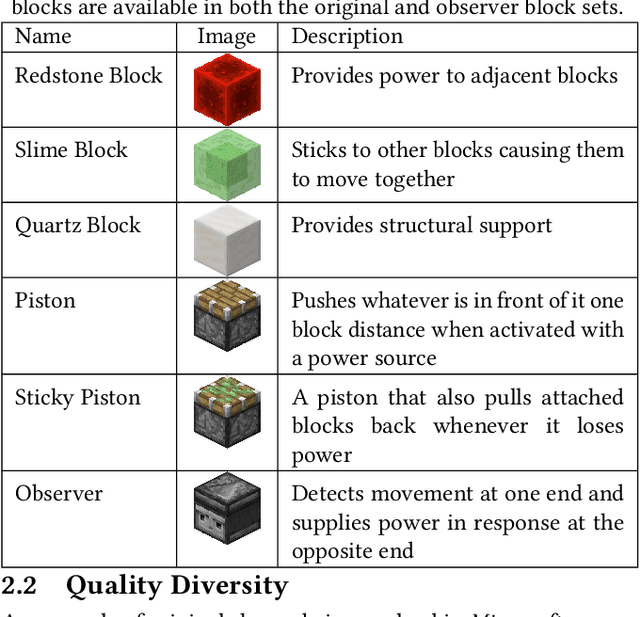
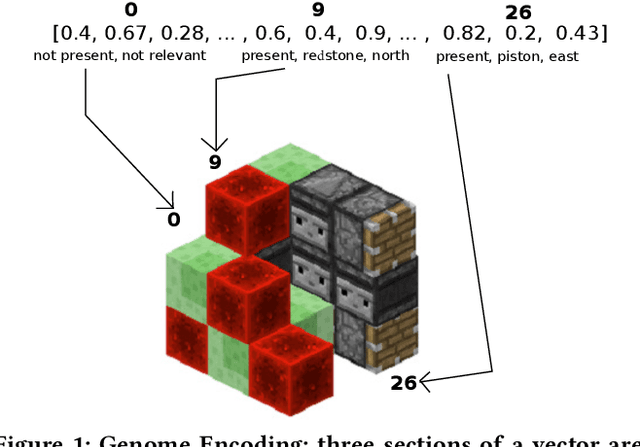
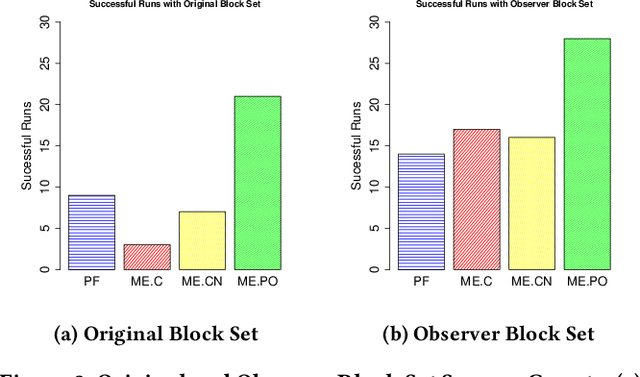
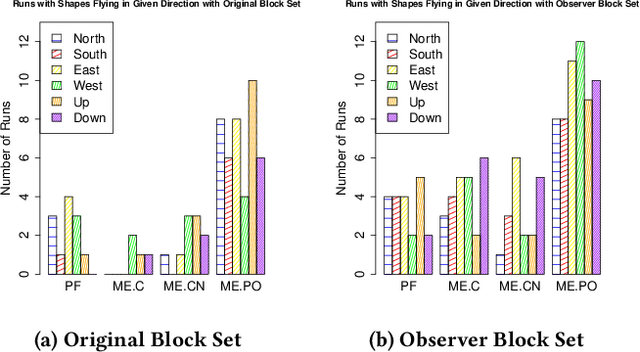
Minecraft is a great testbed for human creativity that has inspired the design of various structures and even functioning machines, including flying machines. EvoCraft is an API for programmatically generating structures in Minecraft, but the initial work in this domain was not capable of evolving flying machines. This paper applies fitness-based evolution and quality diversity search in order to evolve flying machines. Although fitness alone can occasionally produce flying machines, thanks in part to a more sophisticated fitness function than was used previously, the quality diversity algorithm MAP-Elites is capable of discovering flying machines much more reliably, at least when an appropriate behavior characterization is used to guide the search for diverse solutions.