 Add to Chrome
 Add to Firefox
 Add to Edge
The Agentic Leash: Extracting Causal Feedback Fuzzy Cognitive Maps with LLMs
Dec 31, 2025
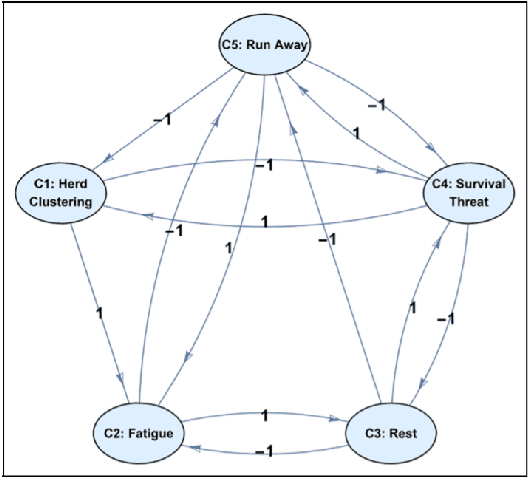
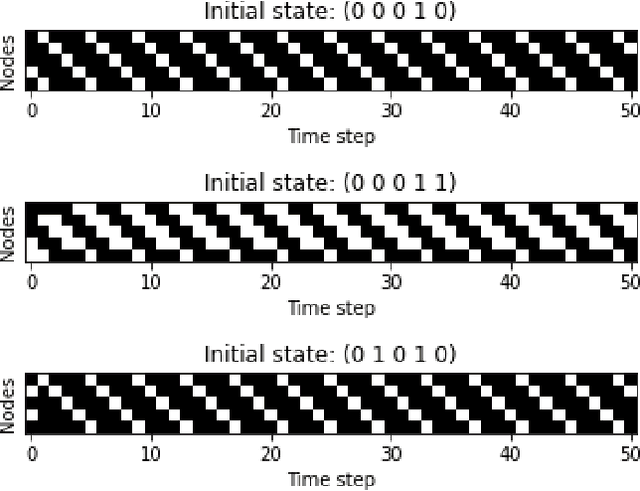
We design a large-language-model (LLM) agent that extracts causal feedback fuzzy cognitive maps (FCMs) from raw text. The causal learning or extraction process is agentic both because of the LLM's semi-autonomy and because ultimately the FCM dynamical system's equilibria drive the LLM agents to fetch and process causal text. The fetched text can in principle modify the adaptive FCM causal structure and so modify the source of its quasi-autonomy--its equilibrium limit cycles and fixed-point attractors. This bidirectional process endows the evolving FCM dynamical system with a degree of autonomy while still staying on its agentic leash. We show in particular that a sequence of three finely tuned system instructions guide an LLM agent as it systematically extracts key nouns and noun phrases from text, as it extracts FCM concept nodes from among those nouns and noun phrases, and then as it extracts or infers partial or fuzzy causal edges between those FCM nodes. We test this FCM generation on a recent essay about the promise of AI from the late diplomat and political theorist Henry Kissinger and his colleagues. This three-step process produced FCM dynamical systems that converged to the same equilibrium limit cycles as did the human-generated FCMs even though the human-generated FCM differed in the number of nodes and edges. A final FCM mixed generated FCMs from separate Gemini and ChatGPT LLM agents. The mixed FCM absorbed the equilibria of its dominant mixture component but also created new equilibria of its own to better approximate the underlying causal dynamical system.

Controlled Causal Hallucinations Can Estimate Phantom Nodes in Multiexpert Mixtures of Fuzzy Cognitive Maps
Dec 31, 2024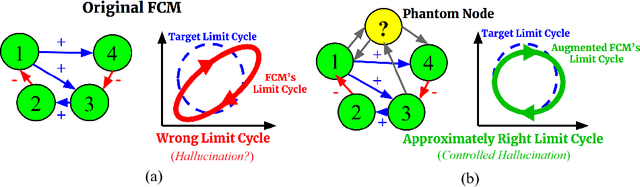
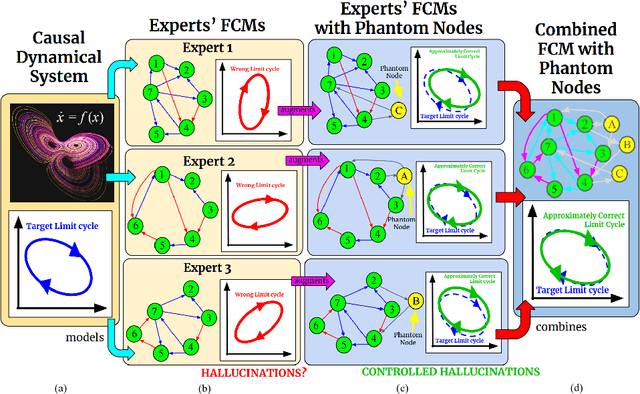
An adaptive multiexpert mixture of feedback causal models can approximate missing or phantom nodes in large-scale causal models. The result gives a scalable form of \emph{big knowledge}. The mixed model approximates a sampled dynamical system by approximating its main limit-cycle equilibria. Each expert first draws a fuzzy cognitive map (FCM) with at least one missing causal node or variable. FCMs are directed signed partial-causality cyclic graphs. They mix naturally through convex combination to produce a new causal feedback FCM. Supervised learning helps each expert FCM estimate its phantom node by comparing the FCM's partial equilibrium with the complete multi-node equilibrium. Such phantom-node estimation allows partial control over these causal hallucinations and helps approximate the future trajectory of the dynamical system. But the approximation can be computationally heavy. Mixing the tuned expert FCMs gives a practical way to find several phantom nodes and thereby better approximate the feedback system's true equilibrium behavior.