 Add to Chrome
 Add to Firefox
 Add to Edge
DisQ-HNet: A Disentangled Quantized Half-UNet for Interpretable Multimodal Image Synthesis Applications to Tau-PET Synthesis from T1 and FLAIR MRI
Feb 26, 2026
Tau positron emission tomography (tau-PET) provides an in vivo marker of Alzheimer's disease pathology, but cost and limited availability motivate MRI-based alternatives. We introduce DisQ-HNet (DQH), a framework that synthesizes tau-PET from paired T1-weighted and FLAIR MRI while exposing how each modality contributes to the prediction. The method combines (i) a Partial Information Decomposition (PID)-guided, vector-quantized encoder that partitions latent information into redundant, unique, and complementary components, and (ii) a Half-UNet decoder that preserves anatomical detail using pseudo-skip connections conditioned on structural edge cues rather than direct encoder feature reuse. Across multiple baselines (VAE, VQ-VAE, and UNet), DisQ-HNet maintains reconstruction fidelity and better preserves disease-relevant signal for downstream AD tasks, including Braak staging, tau localization, and classification. PID-based Shapley analysis provides modality-specific attribution of synthesized uptake patterns.

An Ensemble Approach for Brain Tumor Segmentation and Synthesis
Nov 26, 2024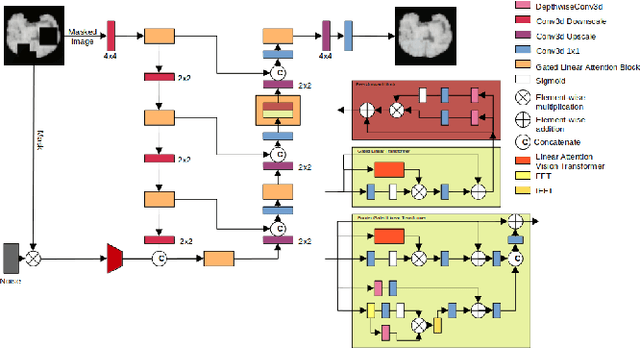
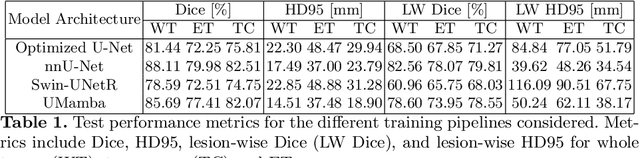
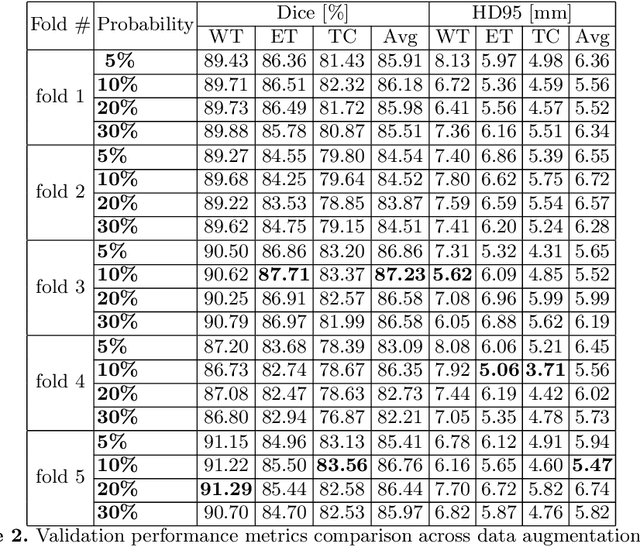
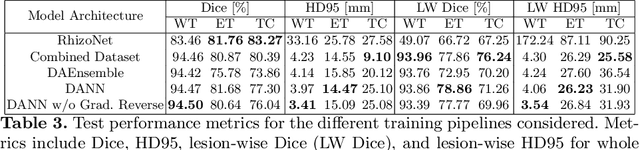
The integration of machine learning in magnetic resonance imaging (MRI), specifically in neuroimaging, is proving to be incredibly effective, leading to better diagnostic accuracy, accelerated image analysis, and data-driven insights, which can potentially transform patient care. Deep learning models utilize multiple layers of processing to capture intricate details of complex data, which can then be used on a variety of tasks, including brain tumor classification, segmentation, image synthesis, and registration. Previous research demonstrates high accuracy in tumor segmentation using various model architectures, including nn-UNet and Swin-UNet. U-Mamba, which uses state space modeling, also achieves high accuracy in medical image segmentation. To leverage these models, we propose a deep learning framework that ensembles these state-of-the-art architectures to achieve accurate segmentation and produce finely synthesized images.