 Add to Chrome
 Add to Firefox
 Add to Edge
Gravity Falls: A Comparative Analysis of Domain-Generation Algorithm (DGA) Detection Methods for Mobile Device Spearphishing
Mar 03, 2026
Mobile devices are frequent targets of eCrime threat actors through SMS spearphishing (smishing) links that leverage Domain Generation Algorithms (DGA) to rotate hostile infrastructure. Despite this, DGA research and evaluation largely emphasize malware C2 and email phishing datasets, leaving limited evidence on how well detectors generalize to smishing-driven domain tactics outside enterprise perimeters. This work addresses that gap by evaluating traditional and machine-learning DGA detectors against Gravity Falls, a new semi-synthetic dataset derived from smishing links delivered between 2022 and 2025. Gravity Falls captures a single threat actor's evolution across four technique clusters, shifting from short randomized strings to dictionary concatenation and themed combo-squatting variants used for credential theft and fee/fine fraud. Two string-analysis approaches (Shannon entropy and Exp0se) and two ML-based detectors (an LSTM classifier and COSSAS DGAD) are assessed using Top-1M domains as benign baselines. Results are strongly tactic-dependent: performance is highest on randomized-string domains but drops on dictionary concatenation and themed combo-squatting, with low recall across multiple tool/cluster pairings. Overall, both traditional heuristics and recent ML detectors are ill-suited for consistently evolving DGA tactics observed in Gravity Falls, motivating more context-aware approaches and providing a reproducible benchmark for future evaluation.

BLADERUNNER: Rapid Countermeasure for Synthetic (AI-Generated) StyleGAN Faces
Oct 14, 2022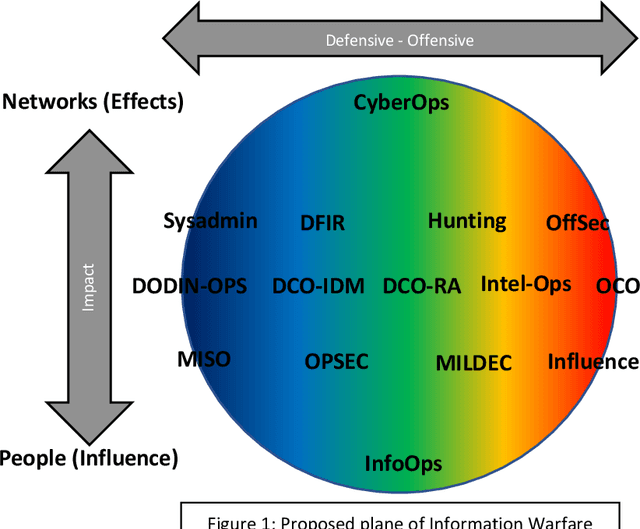
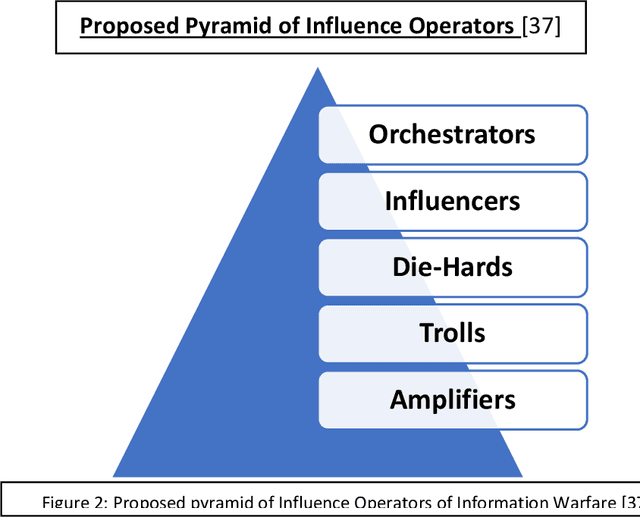
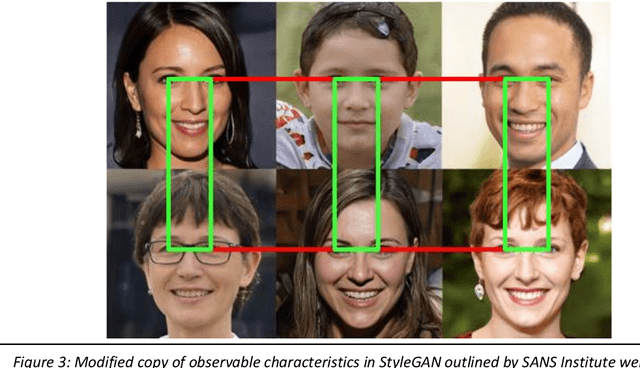
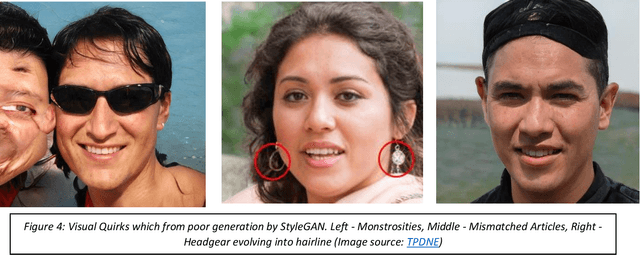
StyleGAN is the open-sourced TensorFlow implementation made by NVIDIA. It has revolutionized high quality facial image generation. However, this democratization of Artificial Intelligence / Machine Learning (AI/ML) algorithms has enabled hostile threat actors to establish cyber personas or sock-puppet accounts in social media platforms. These ultra-realistic synthetic faces. This report surveys the relevance of AI/ML with respect to Cyber & Information Operations. The proliferation of AI/ML algorithms has led to a rise in DeepFakes and inauthentic social media accounts. Threats are analyzed within the Strategic and Operational Environments. Existing methods of identifying synthetic faces exists, but they rely on human beings to visually scrutinize each photo for inconsistencies. However, through use of the DLIB 68-landmark pre-trained file, it is possible to analyze and detect synthetic faces by exploiting repetitive behaviors in StyleGAN images. Project Blade Runner encompasses two scripts necessary to counter StyleGAN images. Through PapersPlease acting as the analyzer, it is possible to derive indicators-of-attack (IOA) from scraped image samples. These IOAs can be fed back into Among_Us acting as the detector to identify synthetic faces from live operational samples. The opensource copy of Blade Runner may lack additional unit tests and some functionality, but the open-source copy is a redacted version, far leaner, better optimized, and a proof-of-concept for the information security community. The desired end-state will be to incrementally add automation to stay on-par with its closed-source predecessor.