 Add to Chrome
 Add to Firefox
 Add to Edge
OpenSpatial: A Principled Data Engine for Empowering Spatial Intelligence
Apr 09, 2026
Spatial understanding is a fundamental cornerstone of human-level intelligence. Nonetheless, current research predominantly focuses on domain-specific data production, leaving a critical void: the absence of a principled, open-source engine capable of fully unleashing the potential of high-quality spatial data. To bridge this gap, we elucidate the design principles of a robust data generation system and introduce OpenSpatial -- an open-source data engine engineered for high quality, extensive scalability, broad task diversity, and optimized efficiency. OpenSpatial adopts 3D bounding boxes as the fundamental primitive to construct a comprehensive data hierarchy across five foundational tasks: Spatial Measurement (SM), Spatial Relationship (SR), Camera Perception (CP), Multi-view Consistency (MC), and Scene-Aware Reasoning (SAR). Leveraging this scalable infrastructure, we curate OpenSpatial-3M, a large-scale dataset comprising 3 million high-fidelity samples. Extensive evaluations demonstrate that versatile models trained on our dataset achieve state-of-the-art performance across a wide spectrum of spatial reasoning benchmarks. Notably, the best-performing model exhibits a substantial average improvement of 19 percent, relatively. Furthermore, we provide a systematic analysis of how data attributes influence spatial perception. By open-sourcing both the engine and the 3M-scale dataset, we provide a robust foundation to accelerate future research in spatial intelligence.

HiRO-Nav: Hybrid ReasOning Enables Efficient Embodied Navigation
Apr 09, 2026Embodied navigation agents built upon large reasoning models (LRMs) can handle complex, multimodal environmental input and perform grounded reasoning per step to improve sequential decision-making for long-horizon tasks. However, a critical question remains: \textit{how can the reasoning capabilities of LRMs be harnessed intelligently and efficiently for long-horizon navigation tasks?} In simple scenes, agents are expected to act reflexively, while in complex ones they should engage in deliberate reasoning before acting.To achieve this, we introduce \textbf{H}ybr\textbf{i}d \textbf{R}eas\textbf{O}ning \textbf{Nav}igation (\textbf{HiRO-Nav}) agent, the first kind of agent capable of adaptively determining whether to perform thinking at every step based on its own action entropy. Specifically, by examining how the agent's action entropy evolves over the navigation trajectories, we observed that only a small fraction of actions exhibit high entropy, and these actions often steer the agent toward novel scenes or critical objects. Furthermore, studying the relationship between action entropy and task completion (i.e., Q-value) reveals that improving high-entropy actions contributes more positively to task success.Hence, we propose a tailored training pipeline comprising hybrid supervised fine-tuning as a cold start, followed by online reinforcement learning with the proposed hybrid reasoning strategy to explicitly activate reasoning only for high-entropy actions, significantly reducing computational overhead while improving decision quality. Extensive experiments on the \textsc{CHORES}-$\mathbb{S}$ ObjectNav benchmark showcases that HiRO-Nav achieves a better trade-off between success rates and token efficiency than both dense-thinking and no-thinking baselines.
UI-Voyager: A Self-Evolving GUI Agent Learning via Failed Experience
Mar 25, 2026Autonomous mobile GUI agents have attracted increasing attention along with the advancement of Multimodal Large Language Models (MLLMs). However, existing methods still suffer from inefficient learning from failed trajectories and ambiguous credit assignment under sparse rewards for long-horizon GUI tasks. To that end, we propose UI-Voyager, a novel two-stage self-evolving mobile GUI agent. In the first stage, we employ Rejection Fine-Tuning (RFT), which enables the continuous co-evolution of data and models in a fully autonomous loop. The second stage introduces Group Relative Self-Distillation (GRSD), which identifies critical fork points in group rollouts and constructs dense step-level supervision from successful trajectories to correct failed ones. Extensive experiments on AndroidWorld show that our 4B model achieves an 81.0% Pass@1 success rate, outperforming numerous recent baselines and exceeding human-level performance. Ablation and case studies further verify the effectiveness of GRSD. Our method represents a significant leap toward efficient, self-evolving, and high-performance mobile GUI automation without expensive manual data annotation.
What Breaks Embodied AI Security:LLM Vulnerabilities, CPS Flaws,or Something Else?
Feb 19, 2026Embodied AI systems (e.g., autonomous vehicles, service robots, and LLM-driven interactive agents) are rapidly transitioning from controlled environments to safety critical real-world deployments. Unlike disembodied AI, failures in embodied intelligence lead to irreversible physical consequences, raising fundamental questions about security, safety, and reliability. While existing research predominantly analyzes embodied AI through the lenses of Large Language Model (LLM) vulnerabilities or classical Cyber-Physical System (CPS) failures, this survey argues that these perspectives are individually insufficient to explain many observed breakdowns in modern embodied systems. We posit that a significant class of failures arises from embodiment-induced system-level mismatches, rather than from isolated model flaws or traditional CPS attacks. Specifically, we identify four core insights that explain why embodied AI is fundamentally harder to secure: (i) semantic correctness does not imply physical safety, as language-level reasoning abstracts away geometry, dynamics, and contact constraints; (ii) identical actions can lead to drastically different outcomes across physical states due to nonlinear dynamics and state uncertainty; (iii) small errors propagate and amplify across tightly coupled perception-decision-action loops; and (iv) safety is not compositional across time or system layers, enabling locally safe decisions to accumulate into globally unsafe behavior. These insights suggest that securing embodied AI requires moving beyond component-level defenses toward system-level reasoning about physical risk, uncertainty, and failure propagation.
ProAct: Agentic Lookahead in Interactive Environments
Feb 05, 2026Existing Large Language Model (LLM) agents struggle in interactive environments requiring long-horizon planning, primarily due to compounding errors when simulating future states. To address this, we propose ProAct, a framework that enables agents to internalize accurate lookahead reasoning through a two-stage training paradigm. First, we introduce Grounded LookAhead Distillation (GLAD), where the agent undergoes supervised fine-tuning on trajectories derived from environment-based search. By compressing complex search trees into concise, causal reasoning chains, the agent learns the logic of foresight without the computational overhead of inference-time search. Second, to further refine decision accuracy, we propose the Monte-Carlo Critic (MC-Critic), a plug-and-play auxiliary value estimator designed to enhance policy-gradient algorithms like PPO and GRPO. By leveraging lightweight environment rollouts to calibrate value estimates, MC-Critic provides a low-variance signal that facilitates stable policy optimization without relying on expensive model-based value approximation. Experiments on both stochastic (e.g., 2048) and deterministic (e.g., Sokoban) environments demonstrate that ProAct significantly improves planning accuracy. Notably, a 4B parameter model trained with ProAct outperforms all open-source baselines and rivals state-of-the-art closed-source models, while demonstrating robust generalization to unseen environments. The codes and models are available at https://github.com/GreatX3/ProAct
CausalSpatial: A Benchmark for Object-Centric Causal Spatial Reasoning
Jan 19, 2026Humans can look at a static scene and instantly predict what happens next -- will moving this object cause a collision? We call this ability Causal Spatial Reasoning. However, current multimodal large language models (MLLMs) cannot do this, as they remain largely restricted to static spatial perception, struggling to answer "what-if" questions in a 3D scene. We introduce CausalSpatial, a diagnostic benchmark evaluating whether models can anticipate consequences of object motions across four tasks: Collision, Compatibility, Occlusion, and Trajectory. Results expose a severe gap: humans score 84% while GPT-5 achieves only 54%. Why do MLLMs fail? Our analysis uncovers a fundamental deficiency: models over-rely on textual chain-of-thought reasoning that drifts from visual evidence, producing fluent but spatially ungrounded hallucinations. To address this, we propose the Causal Object World model (COW), a framework that externalizes the simulation process by generating videos of hypothetical dynamics. With explicit visual cues of causality, COW enables models to ground their reasoning in physical reality rather than linguistic priors. We make the dataset and code publicly available here: https://github.com/CausalSpatial/CausalSpatial
GTR-Turbo: Merged Checkpoint is Secretly a Free Teacher for Agentic VLM Training
Dec 15, 2025Multi-turn reinforcement learning (RL) for multi-modal agents built upon vision-language models (VLMs) is hampered by sparse rewards and long-horizon credit assignment. Recent methods densify the reward by querying a teacher that provides step-level feedback, e.g., Guided Thought Reinforcement (GTR) and On-Policy Distillation, but rely on costly, often privileged models as the teacher, limiting practicality and reproducibility. We introduce GTR-Turbo, a highly efficient upgrade to GTR, which matches the performance without training or querying an expensive teacher model. Specifically, GTR-Turbo merges the weights of checkpoints produced during the ongoing RL training, and then uses this merged model as a "free" teacher to guide the subsequent RL via supervised fine-tuning or soft logit distillation. This design removes dependence on privileged VLMs (e.g., GPT or Gemini), mitigates the "entropy collapse" observed in prior work, and keeps training stable. Across diverse visual agentic tasks, GTR-Turbo improves the accuracy of the baseline model by 10-30% while reducing wall-clock training time by 50% and compute cost by 60% relative to GTR.
CECT-Mamba: a Hierarchical Contrast-enhanced-aware Model for Pancreatic Tumor Subtyping from Multi-phase CECT
Sep 16, 2025Contrast-enhanced computed tomography (CECT) is the primary imaging technique that provides valuable spatial-temporal information about lesions, enabling the accurate diagnosis and subclassification of pancreatic tumors. However, the high heterogeneity and variability of pancreatic tumors still pose substantial challenges for precise subtyping diagnosis. Previous methods fail to effectively explore the contextual information across multiple CECT phases commonly used in radiologists' diagnostic workflows, thereby limiting their performance. In this paper, we introduce, for the first time, an automatic way to combine the multi-phase CECT data to discriminate between pancreatic tumor subtypes, among which the key is using Mamba with promising learnability and simplicity to encourage both temporal and spatial modeling from multi-phase CECT. Specifically, we propose a dual hierarchical contrast-enhanced-aware Mamba module incorporating two novel spatial and temporal sampling sequences to explore intra and inter-phase contrast variations of lesions. A similarity-guided refinement module is also imposed into the temporal scanning modeling to emphasize the learning on local tumor regions with more obvious temporal variations. Moreover, we design the space complementary integrator and multi-granularity fusion module to encode and aggregate the semantics across different scales, achieving more efficient learning for subtyping pancreatic tumors. The experimental results on an in-house dataset of 270 clinical cases achieve an accuracy of 97.4% and an AUC of 98.6% in distinguishing between pancreatic ductal adenocarcinoma (PDAC) and pancreatic neuroendocrine tumors (PNETs), demonstrating its potential as a more accurate and efficient tool.
HRVVS: A High-resolution Video Vasculature Segmentation Network via Hierarchical Autoregressive Residual Priors
Jul 30, 2025


The segmentation of the hepatic vasculature in surgical videos holds substantial clinical significance in the context of hepatectomy procedures. However, owing to the dearth of an appropriate dataset and the inherently complex task characteristics, few researches have been reported in this domain. To address this issue, we first introduce a high quality frame-by-frame annotated hepatic vasculature dataset containing 35 long hepatectomy videos and 11442 high-resolution frames. On this basis, we propose a novel high-resolution video vasculature segmentation network, dubbed as HRVVS. We innovatively embed a pretrained visual autoregressive modeling (VAR) model into different layers of the hierarchical encoder as prior information to reduce the information degradation generated during the downsampling process. In addition, we designed a dynamic memory decoder on a multi-view segmentation network to minimize the transmission of redundant information while preserving more details between frames. Extensive experiments on surgical video datasets demonstrate that our proposed HRVVS significantly outperforms the state-of-the-art methods. The source code and dataset will be publicly available at \href{https://github.com/scott-yjyang/xx}{https://github.com/scott-yjyang/HRVVS}.
Boosting Vulnerability Detection of LLMs via Curriculum Preference Optimization with Synthetic Reasoning Data
Jun 09, 2025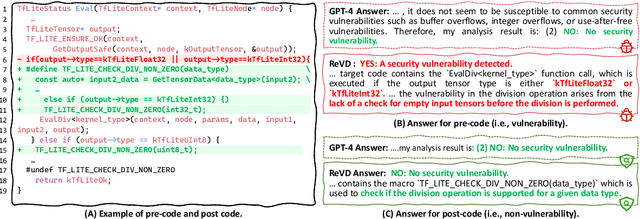


Large language models (LLMs) demonstrate considerable proficiency in numerous coding-related tasks; however, their capabilities in detecting software vulnerabilities remain limited. This limitation primarily stems from two factors: (1) the absence of reasoning data related to vulnerabilities, which hinders the models' ability to capture underlying vulnerability patterns; and (2) their focus on learning semantic representations rather than the reason behind them, thus failing to recognize semantically similar vulnerability samples. Furthermore, the development of LLMs specialized in vulnerability detection is challenging, particularly in environments characterized by the scarcity of high-quality datasets. In this paper, we propose a novel framework ReVD that excels at mining vulnerability patterns through reasoning data synthesizing and vulnerability-specific preference optimization. Specifically, we construct forward and backward reasoning processes for vulnerability and corresponding fixed code, ensuring the synthesis of high-quality reasoning data. Moreover, we design the triplet supervised fine-tuning followed by curriculum online preference optimization for enabling ReVD to better understand vulnerability patterns. The extensive experiments conducted on PrimeVul and SVEN datasets demonstrate that ReVD sets new state-of-the-art for LLM-based software vulnerability detection, e.g., 12.24\%-22.77\% improvement in the accuracy. The source code and data are available at https://github.com/Xin-Cheng-Wen/PO4Vul.