 Add to Chrome
 Add to Firefox
 Add to Edge
Semantically Orthogonal Framework for Citation Classification: Disentangling Intent and Content
Jan 08, 2026
Understanding the role of citations is essential for research assessment and citation-aware digital libraries. However, existing citation classification frameworks often conflate citation intent (why a work is cited) with cited content type (what part is cited), limiting their effectiveness in auto classification due to a dilemma between fine-grained type distinctions and practical classification reliability. We introduce SOFT, a Semantically Orthogonal Framework with Two dimensions that explicitly separates citation intent from cited content type, drawing inspiration from semantic role theory. We systematically re-annotate the ACL-ARC dataset using SOFT and release a cross-disciplinary test set sampled from ACT2. Evaluation with both zero-shot and fine-tuned Large Language Models demonstrates that SOFT enables higher agreement between human annotators and LLMs, and supports stronger classification performance and robust cross-domain generalization compared to ACL-ARC and SciCite annotation frameworks. These results confirm SOFT's value as a clear, reusable annotation standard, improving clarity, consistency, and generalizability for digital libraries and scholarly communication infrastructures. All code and data are publicly available on GitHub https://github.com/zhiyintan/SOFT.

Multi-Disciplinary Dataset Discovery from Citation-Verified Literature Contexts
Jan 08, 2026Identifying suitable datasets for a research question remains challenging because existing dataset search engines rely heavily on metadata quality and keyword overlap, which often fail to capture the semantic intent of scientific investigation. We introduce a literature-driven framework that discovers datasets from citation contexts in scientific papers, enabling retrieval grounded in actual research use rather than metadata availability. Our approach combines large-scale citation-context extraction, schema-guided dataset recognition with Large Language Models, and provenance-preserving entity resolution. We evaluate the system on eight survey-derived computer science queries and find that it achieves substantially higher recall than Google Dataset Search and DataCite Commons, with normalized recall ranging from an average of 47.47% to a highest value of 81.82%. Beyond recovering gold-standard datasets, the method also surfaces additional datasets not documented in the surveys. Expert assessments across five top-level Fields of Science indicate that a substantial portion of the additional datasets are considered high utility, and some are regarded as novel for the specific topics chosen by the experts. These findings establish citation-context mining as an effective and generalizable paradigm for dataset discovery, particularly in settings where datasets lack sufficient or reliable metadata. To support reproducibility and future extensions, we release our code, evaluation datasets, and results on GitHub (https://github.com/Fireblossom/citation-context-dataset-discovery).
Toward Purpose-oriented Topic Model Evaluation enabled by Large Language Models
Sep 08, 2025This study presents a framework for automated evaluation of dynamically evolving topic models using Large Language Models (LLMs). Topic modeling is essential for organizing and retrieving scholarly content in digital library systems, helping users navigate complex and evolving knowledge domains. However, widely used automated metrics, such as coherence and diversity, often capture only narrow statistical patterns and fail to explain semantic failures in practice. We introduce a purpose-oriented evaluation framework that employs nine LLM-based metrics spanning four key dimensions of topic quality: lexical validity, intra-topic semantic soundness, inter-topic structural soundness, and document-topic alignment soundness. The framework is validated through adversarial and sampling-based protocols, and is applied across datasets spanning news articles, scholarly publications, and social media posts, as well as multiple topic modeling methods and open-source LLMs. Our analysis shows that LLM-based metrics provide interpretable, robust, and task-relevant assessments, uncovering critical weaknesses in topic models such as redundancy and semantic drift, which are often missed by traditional metrics. These results support the development of scalable, fine-grained evaluation tools for maintaining topic relevance in dynamic datasets. All code and data supporting this work are accessible at https://github.com/zhiyintan/topic-model-LLMjudgment.
Bridging the Evaluation Gap: Leveraging Large Language Models for Topic Model Evaluation
Feb 11, 2025
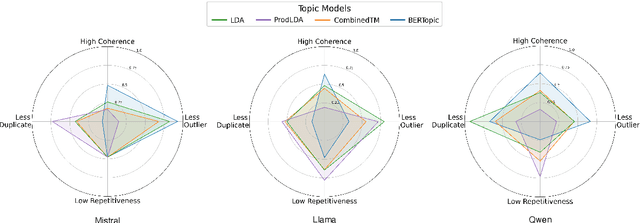

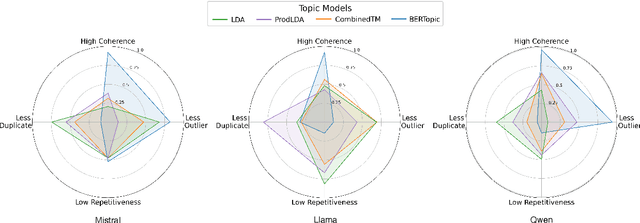
This study presents a framework for automated evaluation of dynamically evolving topic taxonomies in scientific literature using Large Language Models (LLMs). In digital library systems, topic modeling plays a crucial role in efficiently organizing and retrieving scholarly content, guiding researchers through complex knowledge landscapes. As research domains proliferate and shift, traditional human centric and static evaluation methods struggle to maintain relevance. The proposed approach harnesses LLMs to measure key quality dimensions, such as coherence, repetitiveness, diversity, and topic-document alignment, without heavy reliance on expert annotators or narrow statistical metrics. Tailored prompts guide LLM assessments, ensuring consistent and interpretable evaluations across various datasets and modeling techniques. Experiments on benchmark corpora demonstrate the method's robustness, scalability, and adaptability, underscoring its value as a more holistic and dynamic alternative to conventional evaluation strategies.