 Add to Chrome
 Add to Firefox
 Add to Edge
Leveraging Textual-Cues for Enhancing Multimodal Sentiment Analysis by Object Recognition
Jan 30, 2026
Multimodal sentiment analysis, which includes both image and text data, presents several challenges due to the dissimilarities in the modalities of text and image, the ambiguity of sentiment, and the complexities of contextual meaning. In this work, we experiment with finding the sentiments of image and text data, individually and in combination, on two datasets. Part of the approach introduces the novel `Textual-Cues for Enhancing Multimodal Sentiment Analysis' (TEMSA) based on object recognition methods to address the difficulties in multimodal sentiment analysis. Specifically, we extract the names of all objects detected in an image and combine them with associated text; we call this combination of text and image data TEMS. Our results demonstrate that only TEMS improves the results when considering all the object names for the overall sentiment of multimodal data compared to individual analysis. This research contributes to advancing multimodal sentiment analysis and offers insights into the efficacy of TEMSA in combining image and text data for multimodal sentiment analysis.

A Comparison of Automatic Labelling Approaches for Sentiment Analysis
Nov 05, 2022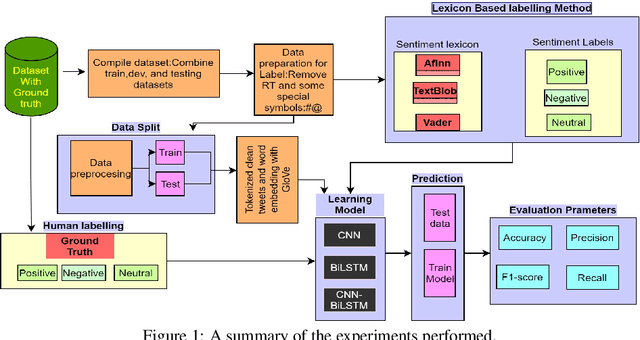


Labelling a large quantity of social media data for the task of supervised machine learning is not only time-consuming but also difficult and expensive. On the other hand, the accuracy of supervised machine learning models is strongly related to the quality of the labelled data on which they train, and automatic sentiment labelling techniques could reduce the time and cost of human labelling. We have compared three automatic sentiment labelling techniques: TextBlob, Vader, and Afinn to assign sentiments to tweets without any human assistance. We compare three scenarios: one uses training and testing datasets with existing ground truth labels; the second experiment uses automatic labels as training and testing datasets; and the third experiment uses three automatic labelling techniques to label the training dataset and uses the ground truth labels for testing. The experiments were evaluated on two Twitter datasets: SemEval-2013 (DS-1) and SemEval-2016 (DS-2). Results show that the Afinn labelling technique obtains the highest accuracy of 80.17% (DS-1) and 80.05% (DS-2) using a BiLSTM deep learning model. These findings imply that automatic text labelling could provide significant benefits, and suggest a feasible alternative to the time and cost of human labelling efforts.