 Add to Chrome
 Add to Firefox
 Add to Edge
TSN-IoT: A Two-Stage NOMA-Enabled Framework for Prioritized Traffic Handling in Dense IoT Networks
Jan 20, 2026
With the growing applications of the Internet of Things (IoT), a major challenge is to ensure continuous connectivity while providing prioritized access. In dense IoT scenarios, synchronization may be disrupted either by the movement of nodes away from base stations or by the unavailability of reliable Global Navigation Satellite System (GNSS) signals, which can be affected by physical obstructions, multipath fading, or environmental interference, such as such as walls, buildings, moving objects, or electromagnetic noise from surrounding devices. In such contexts, distributed synchronization through Non-Orthogonal Multiple Access (NOMA) offers a promising solution, as it enables simultaneous transmission to multiple users with different power levels, supporting efficient synchronization while minimizing the signaling overhead. Moreover, NOMA also plays a vital role for dynamic priority management in dense and heterogeneous IoT environments. In this article, we proposed a Two-Stage NOMA-Enabled Framework "TSN-IoT" that integrates the mechanisms of conventional Precision Time Protocol (PTP) based synchronization, distributed synchronization and data transmission. The framework is designed as a four-tier architecture that facilitates prioritized data delivery from sensor nodes to the central base station. We demonstrated the performance of "TSN-IoT" through a healthcare use case, where intermittent connectivity and varying data priority levels present key challenges for reliable communication. Synchronization speed and end-to-end delay were evaluated through a series of simulations implemented in Python. Results show that, compared to priority-based Orthogonal Frequency Division Multiple Access (OFDMA), TSN-IoT achieves significantly better performance by offering improved synchronization opportunities and enabling parallel transmissions over the same sub-carrier.

IoT-Enabled Sleep Monitoring and Cognitive Assessment for Evaluating Teacher Well-Being
Oct 22, 2025Sleep quality is an important indicator of the efficient cognitive function for high school teachers. Due to the high work stress and multi-tasking expectations, the teachers often face issues with their sleep quality and cognitive function, which has a clearly negative influence on their teaching abilities. In this work, we propose a unique but simple method of deploying Internet of Things (IoT) technology to monitor the sleep quality of high school teachers at Pakistan. Smart watches embedded with pulse rate and SpO2 sensors were used to collect data and categorize the sleep quality as "poor", "fair" or "good". Moreover, we used a psychological tool, Cognitive Assessment Questionnaire (CAQ) for the self-assessment of teachers' cognitive function. The study was conducted over 208 high school teachers from across Pakistan. It has been found that most of the teachers had a poor sleep quality and cognitive function; The link between these two variables indicate that the workload and other factors must be improved for the teachers to ensure their well-being, which will in turn have a positive impact on their teaching quality.
A Nano-Architecture for Fertility Monitoring via Intra-body Communication
Feb 04, 2022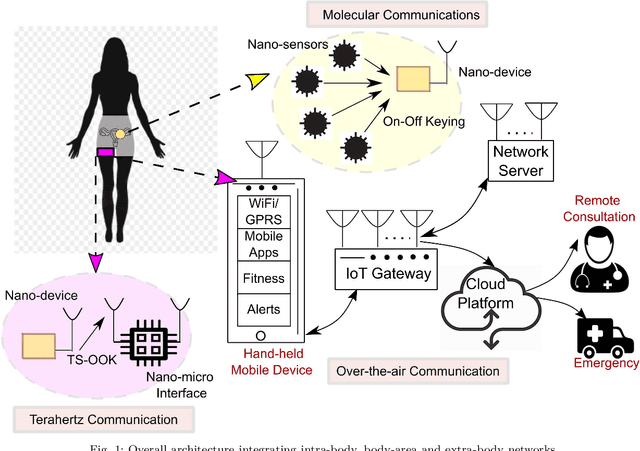
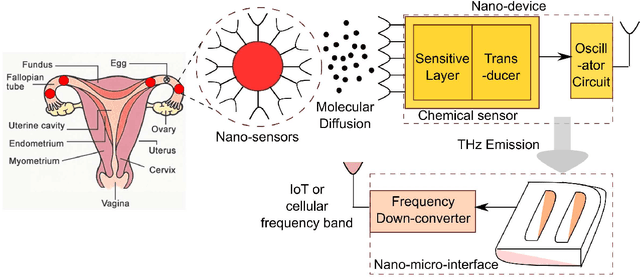
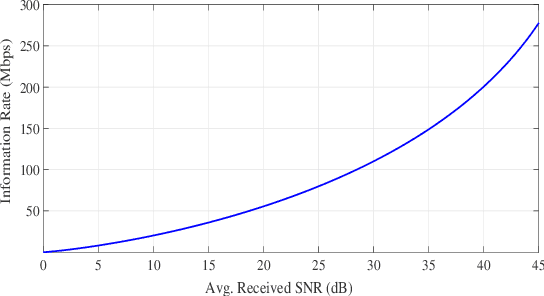
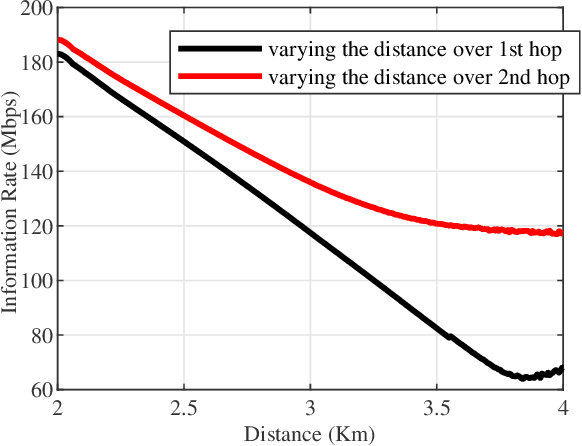
Fertility monitoring in humans for either natural conception or artificial insemination and fertilization has been a critical challenge both for the treating physician and the treated patients. Eggs in human female can be fertilized when they reach the Fallopian tube from the upper parts of the reproductive system. However, no technology, till date, on its own could detect the presence of eggs in the Fallopian tube and communicate their presence to the consulting physician or nurse and the patient, so that the next step can be initiated in a timely fashion. In this paper, we propose a conceptual architecture from a communications engineering point of view. The architecture combines intra-body nano-sensor network for detecting Fallopian tube activity, with body-area network for receiving information from the intra-body network and communicating the same over-the-air to the involved personnel (physician/nurse/patient). Preliminary simulations have been conducted using particle based stochastic simulator to investigate the relationship between achievable information rates, signal to noise ratio (SNR) and distance. It has been found that data rate as high as 300 Mbps is achievable at SNR 45. Hence, the proposed architecture ensures transfer of information with near-zero latency and minimum energy along with high throughput, so that necessary action can be taken within the short time-window of the Fallopian tube activity.