 Add to Chrome
 Add to Firefox
 Add to Edge
Reinforcement Learning Goal-Reaching Control with Guaranteed Lyapunov-Like Stabilizer for Mobile Robots
Jan 27, 2026
Reinforcement learning (RL) can be highly effective at learning goal-reaching policies, but it typically does not provide formal guarantees that the goal will always be reached. A common approach to provide formal goal-reaching guarantees is to introduce a shielding mechanism that restricts the agent to actions that satisfy predefined safety constraints. The main challenge here is integrating this mechanism with RL so that learning and exploration remain effective without becoming overly conservative. Hence, this paper proposes an RL-based control framework that provides formal goal-reaching guarantees for wheeled mobile robots operating in unstructured environments. We first design a real-time RL policy with a set of 15 carefully defined reward terms. These rewards encourage the robot to reach both static and dynamic goals while generating sufficiently smooth command signals that comply with predefined safety specifications, which is critical in practice. Second, a Lyapunov-like stabilizer layer is integrated into the benchmark RL framework as a policy supervisor to formally strengthen the goal-reaching control while preserving meaningful exploration of the state action space. The proposed framework is suitable for real-time deployment in challenging environments, as it provides a formal guarantee of convergence to the intended goal states and compensates for uncertainties by generating real-time control signals based on the current state, while respecting real-world motion constraints. The experimental results show that the proposed Lyapunov-like stabilizer consistently improves the benchmark RL policies, boosting the goal-reaching rate from 84.6% to 99.0%, sharply reducing failures, and improving efficiency.

Deep Reinforcement Learning-Based Motion Planning and PDE Control for Flexible Manipulators
Jun 10, 2025This article presents a motion planning and control framework for flexible robotic manipulators, integrating deep reinforcement learning (DRL) with a nonlinear partial differential equation (PDE) controller. Unlike conventional approaches that focus solely on control, we demonstrate that the desired trajectory significantly influences endpoint vibrations. To address this, a DRL motion planner, trained using the soft actor-critic (SAC) algorithm, generates optimized trajectories that inherently minimize vibrations. The PDE nonlinear controller then computes the required torques to track the planned trajectory while ensuring closed-loop stability using Lyapunov analysis. The proposed methodology is validated through both simulations and real-world experiments, demonstrating superior vibration suppression and tracking accuracy compared to traditional methods. The results underscore the potential of combining learning-based motion planning with model-based control for enhancing the precision and stability of flexible robotic manipulators.
Obstacle Avoidance Deep Reinforcement Learning-Based Trajectory Planner with Robust Low-Level Control for Robotic Manipulators
Feb 06, 2024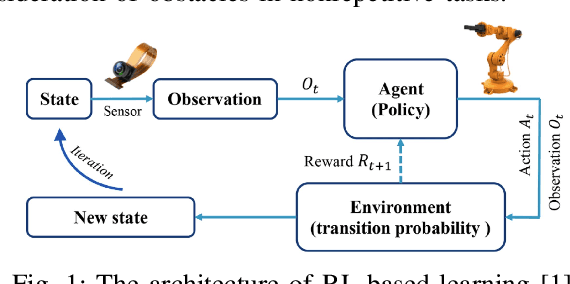
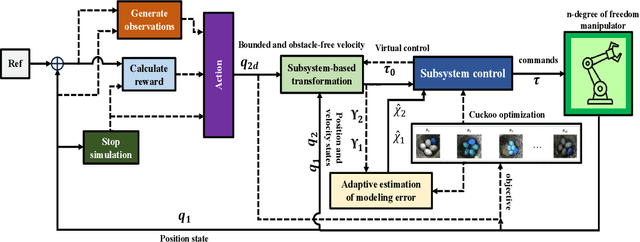
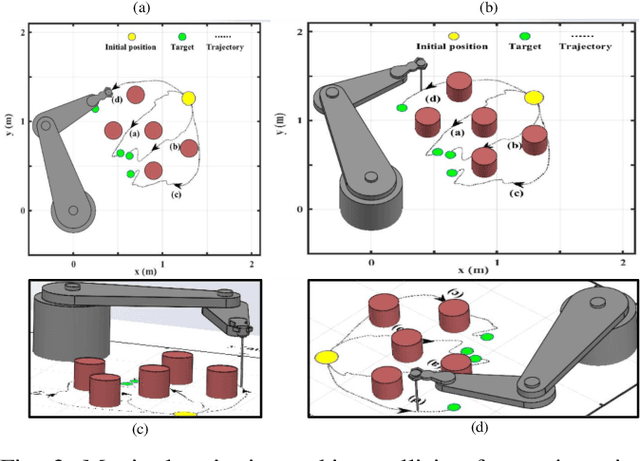
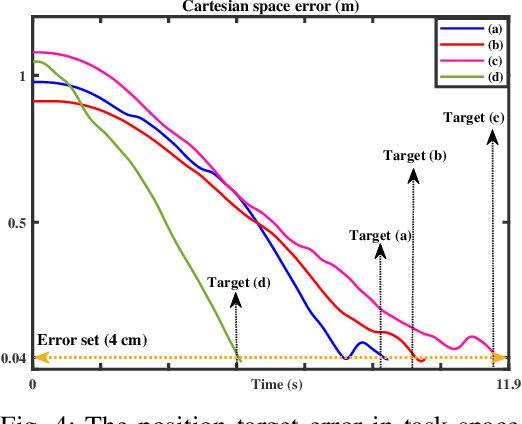
In robotics, contemporary strategies are learning-based, characterized by a complex black-box nature and a lack of interpretability, which may pose challenges in ensuring stability and safety. To address these issues, we propose integrating an obstacle-free deep reinforcement learning (DRL) trajectory planner with a novel auto-tuning low- and joint-level control strategy, all while actively engaging in the learning phase through interactions with the environment. This approach circumvents the complexities associated with computations while also addressing nonrepetitive and random obstacle avoidance tasks. First, a model-free DRL agent to plan velocity-bounded and obstacle-free motion is employed for a manipulator with 'n' degrees of freedom (DoF) in task space through joint-level reasoning. This plan is then input into a robust subsystem-based adaptive controller, which produces the necessary torques, while the Cuckoo Search Optimization (CSO) algorithm enhances control gains to minimize the time required to reach, time taken to stabilize, the maximum deviation from the desired value, and persistent tracking error in the steady state. This approach guarantees that position and velocity errors exponentially converge to zero in an unfamiliar environment, despite unknown robotic manipulator modeling. Theoretical assertions are validated through the presentation of simulation outcomes.