 Add to Chrome
 Add to Firefox
 Add to Edge
Wi-Fi Self-Coexistence in the 6 GHz Band: An ns-3 Evaluation of LPI and SP Usage
Jun 10, 2026
The U.S. has adopted four power regimes for opera tion in the shared unlicensed 6 GHz band -- standard power (SP), low-power indoor (LPI), geofenced variable power (GVP), and very low power (VLP) -- with maximum permitted EIRP levels of 36 dBm, 30 dBm, 24 dBm, and 14 dBm, respectively. Although these regimes are primarily intended to protect incumbent services, their heterogeneous transmit power levels also introduce additional coexistence challenges within 6 GHz Wi-Fi networks. In this paper, we develop an ns-3 Wi-Fi 6E/802.11ax coexistence testbed to study coexistence under heterogeneous power regimes and to provide a reproducible simulation methodology. To the best of our knowledge, prior work has not specifically examined self-coexistence issues within 6 GHz Wi-Fi networks. We evaluate two coexistence scenarios: one in which both the LPI AP and the SP AP are indoors, and another in which the LPI AP is indoors while the SP AP is outdoors. Results are compared against an indoor LPI--LPI baseline when applicable. Our findings show that: (i) the presence of an indoor SP AP can significantly degrade the goodput of an LPI AP; (ii) channel bandwidth is a key factor in determining the extent of SP-to-LPI impact, with the degradation being most severe at 20 MHz and partially alleviated at 160 MHz; (iii) physical blockage between outdoor SP and LPI APs improves fairness; and (iv) BSS coloring does not necessarily improve fairness in mixed-regime deployments. The simulation framework can be extended to study coexistence between Wi-Fi and cellular systems, as recently proposed by Ofcom in the U.K.

Data Driven Environmental Awareness Using Wireless Signals for Efficient Spectrum Sharing
Oct 17, 2024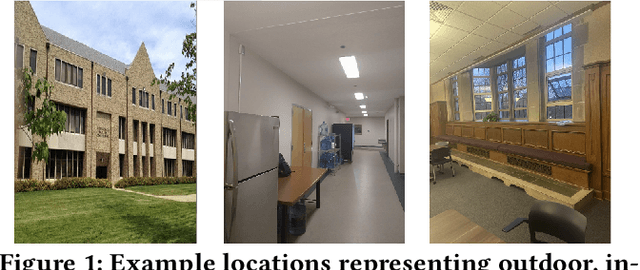
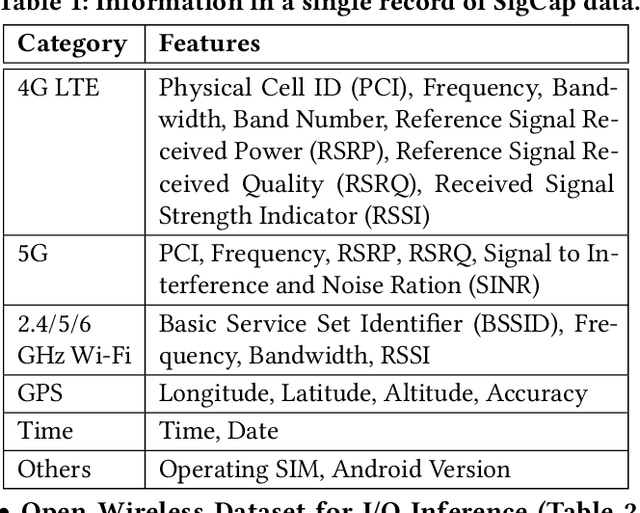
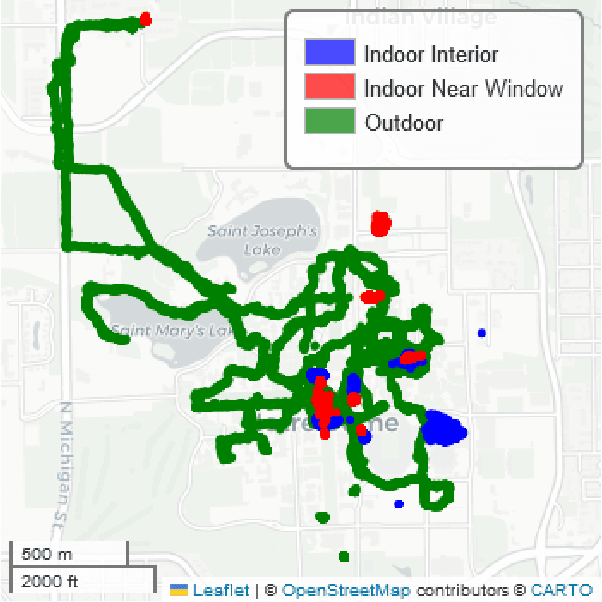
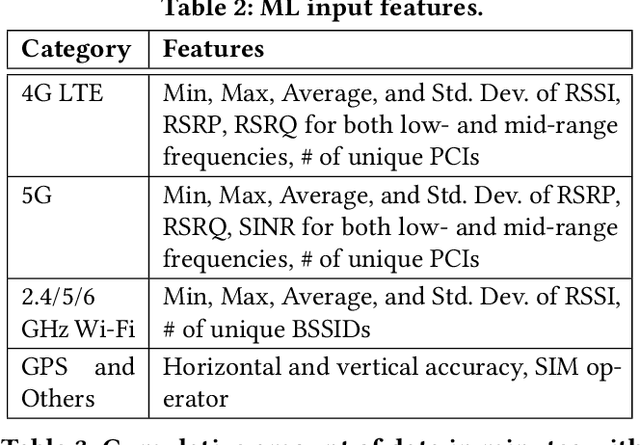
Robust classification of the operational environment of wireless devices is becoming increasingly important for wireless network optimization, particularly in a shared spectrum environment. Distinguishing between indoor and outdoor devices can enhance reliability and improve coexistence with existing, outdoor, incumbents. For instance, the unlicensed but shared 6 GHz band (5.925 - 7.125 GHz) enables sharing by imposing lower transmit power for indoor unlicensed devices and a spectrum coordination requirement for outdoor devices. Further, indoor devices are prohibited from using battery power, external antennas, and weatherization to prevent outdoor operations. As these rules may be circumvented, we propose a robust indoor/outdoor classification method by leveraging the fact that the radio-frequency environment faced by a device are quite different indoors and outdoors. We first collect signal strength data from all cellular and Wi-Fi bands that can be received by a smartphone in various environments (indoor interior, indoor near windows, and outdoors), along with GPS accuracy, and then evaluate three machine learning (ML) methods: deep neural network (DNN), decision tree, and random forest to perform classification into these three categories. Our results indicate that the DNN model performs the best, particularly in minimizing the most important classification error, that of classifying outdoor devices as indoor interior devices.