 Add to Chrome
 Add to Firefox
 Add to Edge
Predicting Open Source Software Sustainability with Deep Temporal Neural Hierarchical Architectures and Explainable AI
Feb 13, 2026
Open Source Software (OSS) projects follow diverse lifecycle trajectories shaped by evolving patterns of contribution, coordination, and community engagement. Understanding these trajectories is essential for stakeholders seeking to assess project organization and health at scale. However, prior work has largely relied on static or aggregated metrics, such as project age or cumulative activity, providing limited insight into how OSS sustainability unfolds over time. In this paper, we propose a hierarchical predictive framework that models OSS projects as belonging to distinct lifecycle stages grounded in established socio-technical categorizations of OSS development. Rather than treating sustainability solely as project longevity, these lifecycle stages operationalize sustainability as a multidimensional construct integrating contribution activity, community participation, and maintenance dynamics. The framework combines engineered tabular indicators with 24-month temporal activity sequences and employs a multi-stage classification pipeline to distinguish lifecycle stages associated with different coordination and participation regimes. To support transparency, we incorporate explainable AI techniques to examine the relative contribution of feature categories to model predictions. Evaluated on a large corpus of OSS repositories, the proposed approach achieves over 94\% overall accuracy in lifecycle stage classification. Attribution analyses consistently identify contribution activity and community-related features as dominant signals, highlighting the central role of collective participation dynamics.

Beyond Code Contributions: How Network Position, Temporal Bursts, and Code Review Activities Shape Contributor Influence in Large-Scale Open Source Ecosystems
Feb 06, 2026Open source software (OSS) projects rely on complex networks of contributors whose interactions drive innovation and sustainability. This study presents a comprehensive analysis of OSS contributor networks using advanced graph neural networks and temporal network analysis on data spanning 25 years from the Cloud Native Computing Foundation ecosystem, encompassing sandbox, incubating, and graduated projects. Our analysis of thousands of contributors across hundreds of repositories reveals that OSS networks exhibit strong power-law distributions in influence, with the top 1\% of contributors controlling a substantial portion of network influence. Using GPU-accelerated PageRank, betweenness centrality, and custom LSTM models, we identify five distinct contributor roles: Core, Bridge, Connector, Regular, and Peripheral, each with unique network positions and structural importance. Statistical analysis reveals significant correlations between specific action types (commits, pull requests, issues) and contributor influence, with multiple regression models explaining substantial variance in influence metrics. Temporal analysis shows that network density, clustering coefficients, and modularity exhibit statistically significant temporal trends, with distinct regime changes coinciding with major project milestones. Structural integrity simulations show that Bridge contributors, despite representing a small fraction of the network, have a disproportionate impact on network cohesion when removed. Our findings provide empirical evidence for strategic contributor retention policies and offer actionable insights into community health metrics.
MRANet: A Modified Residual Attention Networks for Lung and Colon Cancer Classification
Dec 23, 2024Lung and colon cancers are predominant contributors to cancer mortality. Early and accurate diagnosis is crucial for effective treatment. By utilizing imaging technology in different image detection, learning models have shown promise in automating cancer classification from histopathological images. This includes the histopathological diagnosis, an important factor in cancer type identification. This research focuses on creating a high-efficiency deep-learning model for identifying lung and colon cancer from histopathological images. We proposed a novel approach based on a modified residual attention network architecture. The model was trained on a dataset of 25,000 high-resolution histopathological images across several classes. Our proposed model achieved an exceptional accuracy of 99.30%, 96.63%, and 97.56% for two, three, and five classes, respectively; those are outperforming other state-of-the-art architectures. This study presents a highly accurate deep learning model for lung and colon cancer classification. The superior performance of our proposed model addresses a critical need in medical AI applications.
Early diagnosis of autism spectrum disorder using machine learning approaches
Sep 20, 2023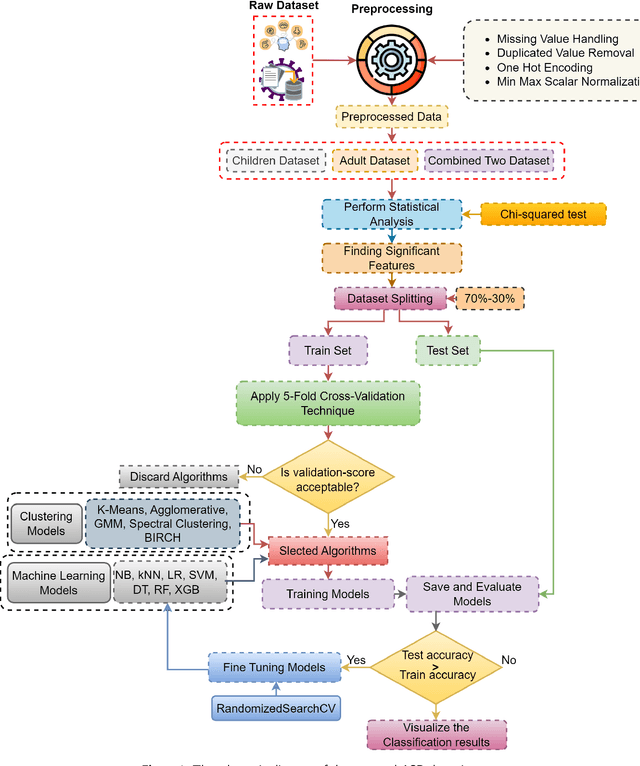
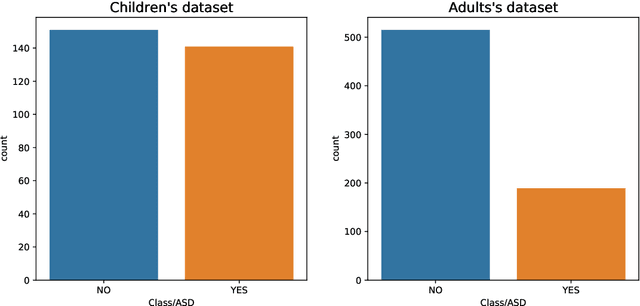
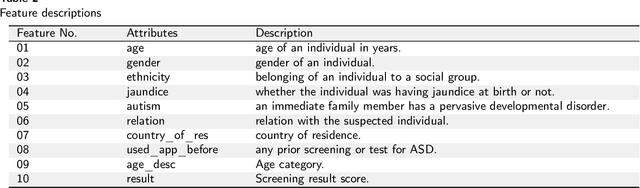
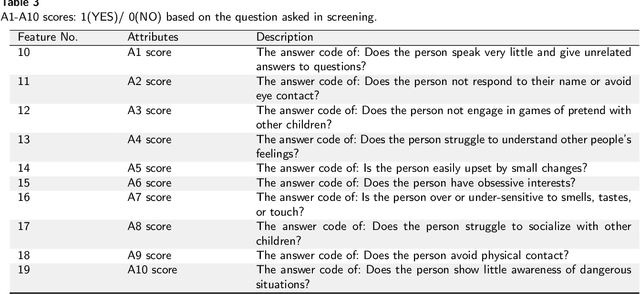
Autistic Spectrum Disorder (ASD) is a neurological disease characterized by difficulties with social interaction, communication, and repetitive activities. The severity of these difficulties varies, and those with this diagnosis face unique challenges. While its primary origin lies in genetics, identifying and addressing it early can contribute to the enhancement of the condition. In recent years, machine learning-driven intelligent diagnosis has emerged as a supplement to conventional clinical approaches, aiming to address the potential drawbacks of time-consuming and costly traditional methods. In this work, we utilize different machine learning algorithms to find the most significant traits responsible for ASD and to automate the diagnostic process. We study six classification models to see which model works best to identify ASD and also study five popular clustering methods to get a meaningful insight of these ASD datasets. To find the best classifier for these binary datasets, we evaluate the models using accuracy, precision, recall, specificity, F1-score, AUC, kappa and log loss metrics. Our evaluation demonstrates that five out of the six selected models perform exceptionally, achieving a 100% accuracy rate on the ASD datasets when hyperparameters are meticulously tuned for each model. As almost all classification models are able to get 100% accuracy, we become interested in observing the underlying insights of the datasets by implementing some popular clustering algorithms on these datasets. We calculate Normalized Mutual Information (NMI), Adjusted Rand Index (ARI) & Silhouette Coefficient (SC) metrics to select the best clustering models. Our evaluation finds that spectral clustering outperforms all other benchmarking clustering models in terms of NMI & ARI metrics and it also demonstrates comparability to the optimal SC achieved by k-means.