 Add to Chrome
 Add to Firefox
 Add to Edge
Small Language Models for Privacy-Preserving Clinical Information Extraction in Low-Resource Languages
Feb 24, 2026
Extracting clinical information from medical transcripts in low-resource languages remains a significant challenge in healthcare natural language processing (NLP). This study evaluates a two-step pipeline combining Aya-expanse-8B as a Persian-to-English translation model with five open-source small language models (SLMs) -- Qwen2.5-7B-Instruct, Llama-3.1-8B-Instruct, Llama-3.2-3B-Instruct, Qwen2.5-1.5B-Instruct, and Gemma-3-1B-it -- for binary extraction of 13 clinical features from 1,221 anonymized Persian transcripts collected at a cancer palliative care call center. Using a few-shot prompting strategy without fine-tuning, models were assessed on macro-averaged F1-score, Matthews Correlation Coefficient (MCC), sensitivity, and specificity to account for class imbalance. Qwen2.5-7B-Instruct achieved the highest overall performance (median macro-F1: 0.899; MCC: 0.797), while Gemma-3-1B-it showed the weakest results. Larger models (7B--8B parameters) consistently outperformed smaller counterparts in sensitivity and MCC. A bilingual analysis of Aya-expanse-8B revealed that translating Persian transcripts to English improved sensitivity, reduced missing outputs, and boosted metrics robust to class imbalance, though at the cost of slightly lower specificity and precision. Feature-level results showed reliable extraction of physiological symptoms across most models, whereas psychological complaints, administrative requests, and complex somatic features remained challenging. These findings establish a practical, privacy-preserving blueprint for deploying open-source SLMs in multilingual clinical NLP settings with limited infrastructure and annotation resources, and highlight the importance of jointly optimizing model scale and input language strategy for sensitive healthcare applications.

AAVGen: Precision Engineering of Adeno-associated Viral Capsids for Renal Selective Targeting
Feb 21, 2026Adeno-associated viruses (AAVs) are promising vectors for gene therapy, but their native serotypes face limitations in tissue tropism, immune evasion, and production efficiency. Engineering capsids to overcome these hurdles is challenging due to the vast sequence space and the difficulty of simultaneously optimizing multiple functional properties. The complexity also adds when it comes to the kidney, which presents unique anatomical barriers and cellular targets that require precise and efficient vector engineering. Here, we present AAVGen, a generative artificial intelligence framework for de novo design of AAV capsids with enhanced multi-trait profiles. AAVGen integrates a protein language model (PLM) with supervised fine-tuning (SFT) and a reinforcement learning technique termed Group Sequence Policy Optimization (GSPO). The model is guided by a composite reward signal derived from three ESM-2-based regression predictors, each trained to predict a key property: production fitness, kidney tropism, and thermostability. Our results demonstrate that AAVGen produces a diverse library of novel VP1 protein sequences. In silico validations revealed that the majority of the generated variants have superior performance across all three employed indices, indicating successful multi-objective optimization. Furthermore, structural analysis via AlphaFold3 confirms that the generated sequences preserve the canonical capsid folding despite sequence diversification. AAVGen establishes a foundation for data-driven viral vector engineering, accelerating the development of next-generation AAV vectors with tailored functional characteristics.
Large Language Models versus Classical Machine Learning: Performance in COVID-19 Mortality Prediction Using High-Dimensional Tabular Data
Sep 02, 2024
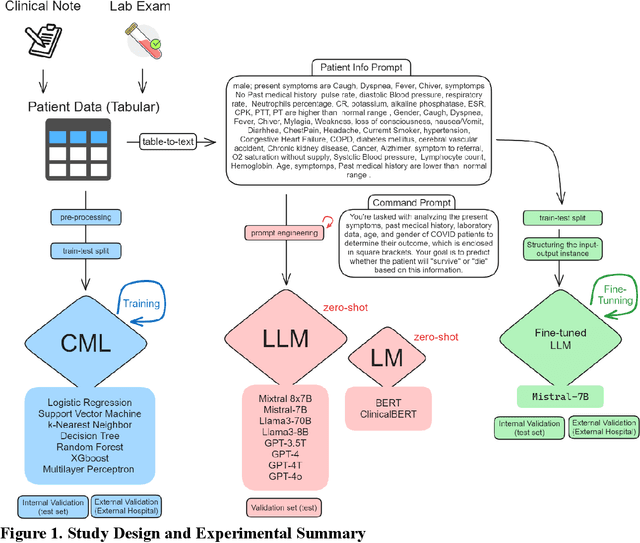
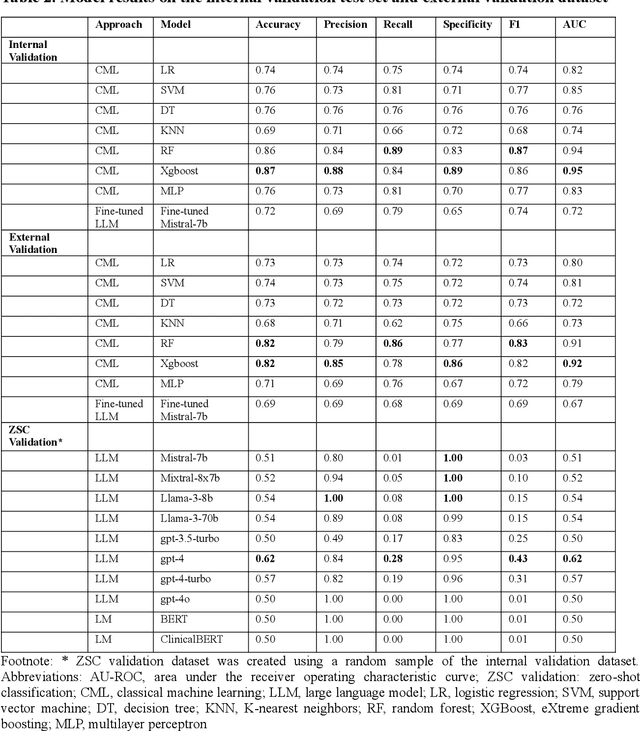
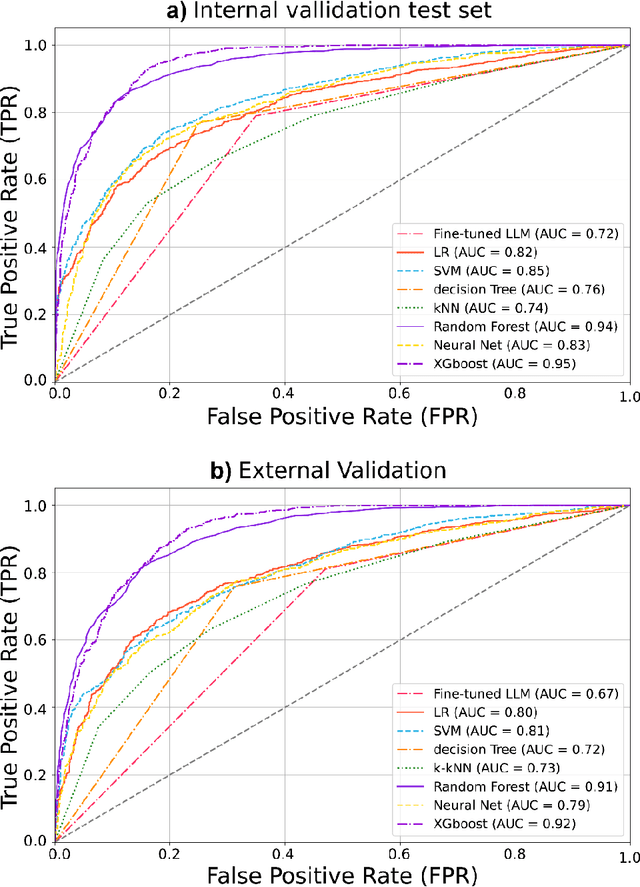
Background: This study aimed to evaluate and compare the performance of classical machine learning models (CMLs) and large language models (LLMs) in predicting mortality associated with COVID-19 by utilizing a high-dimensional tabular dataset. Materials and Methods: We analyzed data from 9,134 COVID-19 patients collected across four hospitals. Seven CML models, including XGBoost and random forest (RF), were trained and evaluated. The structured data was converted into text for zero-shot classification by eight LLMs, including GPT-4 and Mistral-7b. Additionally, Mistral-7b was fine-tuned using the QLoRA approach to enhance its predictive capabilities. Results: Among the CML models, XGBoost and RF achieved the highest accuracy, with F1 scores of 0.87 for internal validation and 0.83 for external validation. In the LLM category, GPT-4 was the top performer with an F1 score of 0.43. Fine-tuning Mistral-7b significantly improved its recall from 1% to 79%, resulting in an F1 score of 0.74, which was stable during external validation. Conclusion: While LLMs show moderate performance in zero-shot classification, fine-tuning can significantly enhance their effectiveness, potentially aligning them closer to CML models. However, CMLs still outperform LLMs in high-dimensional tabular data tasks.