 Add to Chrome
 Add to Firefox
 Add to Edge
Modeling of UAV Tether Aerodynamics for Real-Time Simulation
Dec 27, 2025
One of the main limitations of multirotor UAVs is their short flight time due to battery constraints. A practical solution for continuous operation is to power the drone from the ground via a tether. While this approach has been demonstrated for stationary systems, scenarios with a fast-moving base vehicle or strong wind conditions require modeling the tether forces, including aerodynamic effects. In this work, we propose two complementary approaches for real-time quasi-static tether modeling with aerodynamics. The first is an analytical method based on catenary theory with a uniform drag assumption, achieving very fast solve times below 1ms. The second is a numerical method that discretizes the tether into segments and lumped masses, solving the equilibrium equations using CasADi and IPOPT. By leveraging initialization strategies, such as warm starting and analytical initialization, real-time performance was achieved with a solve time of 5ms, while allowing for flexible force formulations. Both approaches were validated in real-world tests using a load cell to measure the tether force. The results show that the analytical method provides sufficient accuracy for most tethered UAV applications with minimal computational cost, while the numerical method offers higher flexibility and physical accuracy when required. These approaches form a lightweight and extensible framework for real-time tether simulation, applicable to both offline optimization and online tasks such as simulation, control, and trajectory planning.

Cable Optimization and Drag Estimation for Tether-Powered Multirotor UAVs
Apr 10, 2025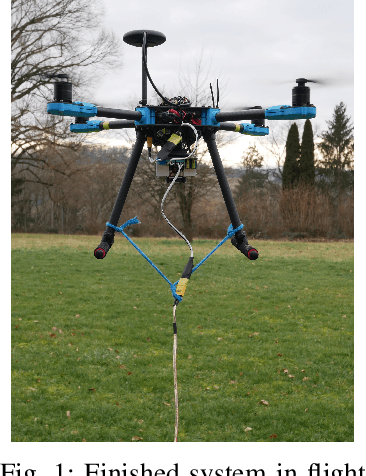
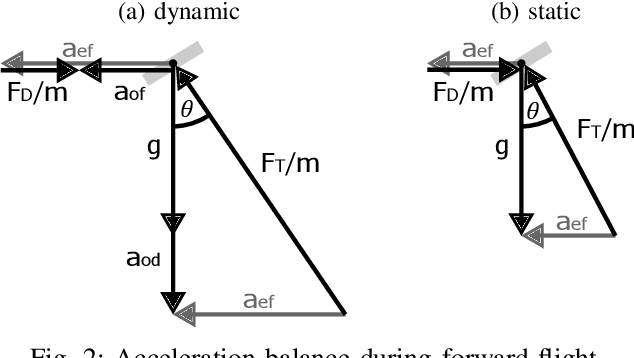
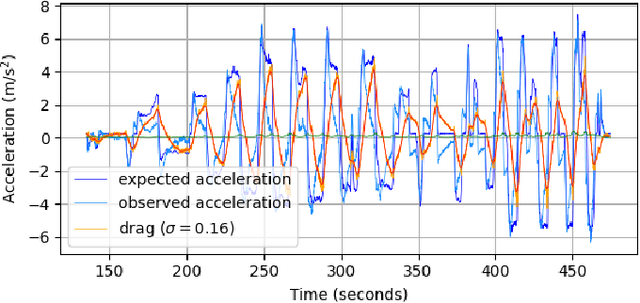
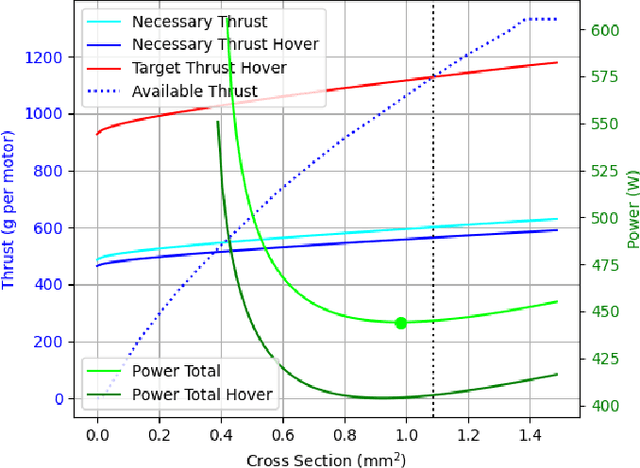
The flight time of multirotor unmanned aerial vehicles (UAVs) is typically constrained by their high power consumption. Tethered power systems present a viable solution to extend flight times while maintaining the advantages of multirotor UAVs, such as hover capability and agility. This paper addresses the critical aspect of cable selection for tether-powered multirotor UAVs, considering both hover and forward flight. Existing research often overlooks the trade-offs between cable mass, power losses, and system constraints. We propose a novel methodology to optimize cable selection, accounting for thrust requirements and power efficiency across various flight conditions. The approach combines physics-informed modeling with system identification to combine hover and forward flight dynamics, incorporating factors such as motor efficiency, tether resistance, and aerodynamic drag. This work provides an intuitive and practical framework for optimizing tethered UAV designs, ensuring efficient power transmission and flight performance. Thus allowing for better, safer, and more efficient tethered drones.