 Add to Chrome
 Add to Firefox
 Add to Edge
Systematic Evaluation of Hip Exoskeleton Assistance Parameters for Enhancing Gait Stability During Ground Slip Perturbations
Jan 21, 2026
Falls are the leading cause of injury related hospitalization and mortality among older adults. Consequently, mitigating age-related declines in gait stability and reducing fall risk during walking is a critical goal for assistive devices. Lower-limb exoskeletons have the potential to support users in maintaining stability during walking. However, most exoskeleton controllers are optimized to reduce the energetic cost of walking rather than to improve stability. While some studies report stability benefits with assistance, the effects of specific parameters, such as assistance magnitude and duration, remain unexplored. To address this gap, we systematically modulated the magnitude and duration of torque provided by a bilateral hip exoskeleton during slip perturbations in eight healthy adults, quantifying stability using whole-body angular momentum (WBAM). WBAM responses were governed by a significant interaction between assistance magnitude and duration, with duration determining whether exoskeleton assistance was stabilizing or destabilizing relative to not wearing the exoskeleton device. Compared to an existing energy-optimized controller, experimentally identified stability-optimal parameters reduced WBAM range by 25.7% on average. Notably, substantial inter-subject variability was observed in the parameter combinations that minimized WBAM during perturbations. We found that optimizing exoskeleton assistance for energetic outcomes alone is insufficient for improving reactive stability during gait perturbations. Stability-focused exoskeleton control should prioritize temporal assistance parameters and include user-specific personalization. This study represents an important step toward personalized, stability-focused exoskeleton control, with direct implications for improving stability and reducing fall risk in older adults.

Ground Perturbation Detection via Lower-Limb Kinematic States During Locomotion
Dec 09, 2024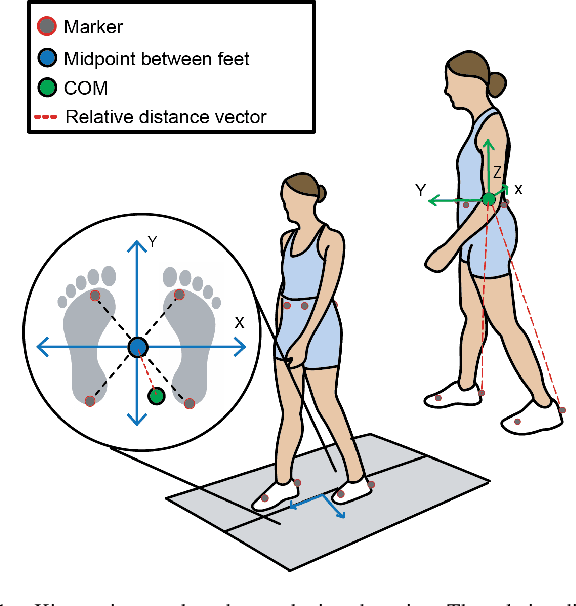
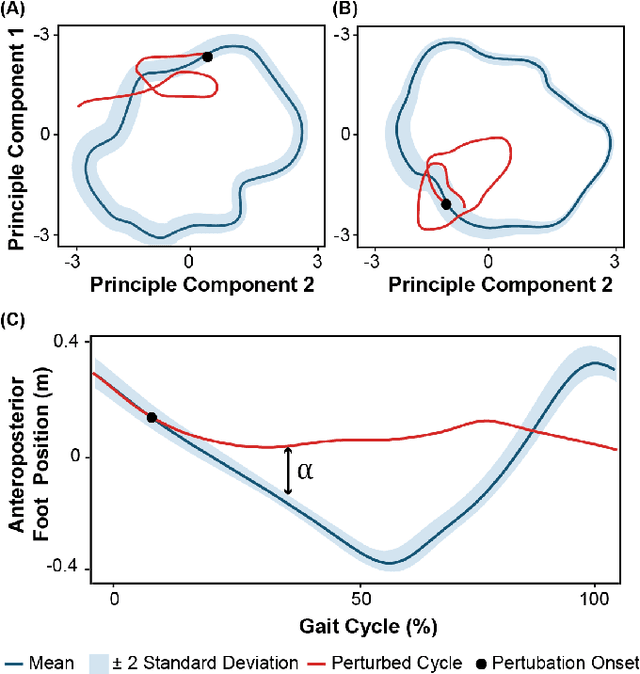
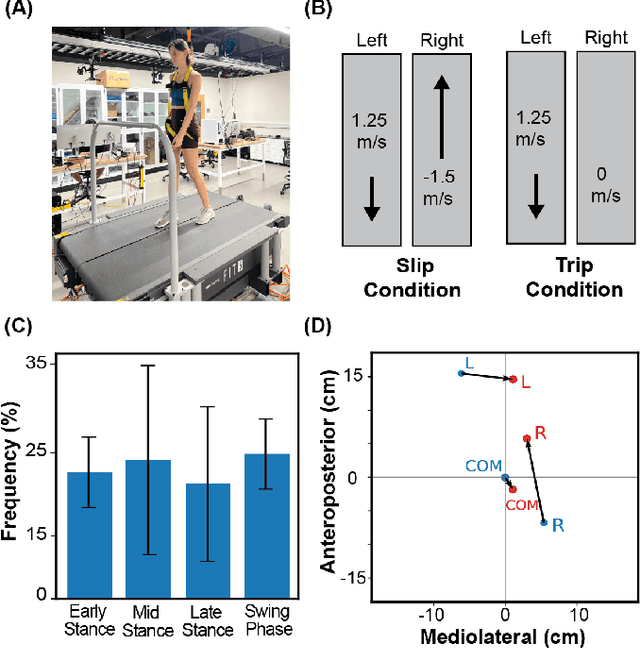

Falls during daily ambulation activities are a leading cause of injury in older adults due to delayed physiological responses to disturbances of balance. Lower-limb exoskeletons have the potential to mitigate fall incidents by detecting and reacting to perturbations before the user. Although commonly used, the standard metric for perturbation detection, whole-body angular momentum, is poorly suited for exoskeleton applications due to computational delays and additional tunings. To address this, we developed a novel ground perturbation detector using lower-limb kinematic states during locomotion. To identify perturbations, we tracked deviations in the kinematic states from their nominal steady-state trajectories. Using a data-driven approach, we further optimized our detector with an open-source ground perturbation biomechanics dataset. A pilot experimental validation with five able-bodied subjects demonstrated that our model detected ground perturbations with 97.8% accuracy and only a delay of 23.1% within the gait cycle, outperforming the benchmark by 46.8% in detection accuracy. The results of our study offer exciting promise for our detector and its potential utility to enhance the controllability of robotic assistive exoskeletons.