 Add to Chrome
 Add to Firefox
 Add to Edge
Impact of diversity on bounded archives for multi-objective local search
Feb 04, 2026
This work tackles two critical challenges related to the development of metaheuristics for Multi-Objective Optimization Problems (MOOPs): the exponential growth of non-dominated solutions and the tendency of metaheuristics to disproportionately concentrate their search on a subset of the Pareto Front. To counteract the first, bounded archives are employed as a strategic mechanism for effectively managing the increasing number of non-dominated solutions. Addressing the second challenge involves an in-depth exploration of solution diversity algorithms found in existing literature. Upon recognizing that current approaches predominantly center on diversity within the objective space, this research introduces innovative methods specifically designed to enhance diversity in the solution space. Results demonstrate the efficacy of the Hamming Distance Archiving Algorithm, one of the newly proposed algorithms for multi-objective local search, surpassing the performance of the Adaptive Grid Archiving and the Hypervolume Archiving, both drawn from the literature. This outcome suggests a promising avenue for enhancing the overall efficiency of metaheuristics employed for solving MOOPs.

Exploiting Promising Sub-Sequences of Jobs to solve the No-Wait Flowshop Scheduling Problem
Mar 21, 2019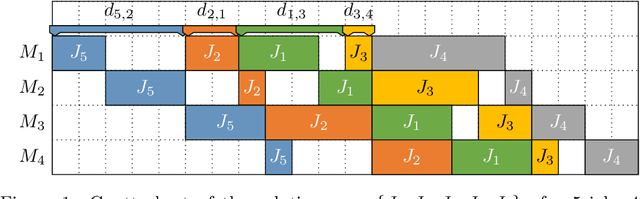


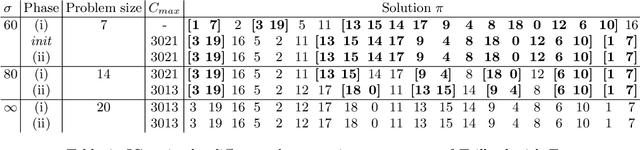
The no-wait flowshop scheduling problem is a variant of the classical permutation flowshop problem, with the additional constraint that jobs have to be processed by the successive machines without waiting time. To efficiently address this NP-hard combinatorial optimization problem we conduct an analysis of the structure of good quality solutions. This analysis shows that the No-Wait specificity gives them a common structure: they share identical sub-sequences of jobs, we call super-jobs. After a discussion on the way to identify these super-jobs, we propose IG-SJ, an algorithm that exploits super-jobs within the state-of-the-art algorithm for the classical permutation flowshop, the well-known Iterated Greedy (IG) algorithm. An iterative approach of IG-SJ is also proposed. Experiments are conducted on Taillard's instances. The experimental results show that exploiting super-jobs is successful since IG-SJ is able to find 64 new best solutions.