 Add to Chrome
 Add to Firefox
 Add to Edge
ConvRML: High-Quality Lensless Imaging with Random Multi-Focal Lenslets
Feb 04, 2026
Mask-based lensless imagers use simple optics and computational reconstruction to design compact form factor cameras with compressive imaging ability. However, these imagers generally suffer from poor reconstruction quality. Here, we describe several advances in both hardware and software that result in improved lensless imaging quality. First, we use a precision-manufactured random multi-focal lenslet (RML) phase mask to produce improved measurements with reduced multiplexing. Next, we implement a ConvNeXt-based reconstruction architecture, which provides up to 6.68 dB improvement in peak signal-to-noise ratio over state-of-the-art attention-based architectures. Finally, we establish a parallel imaging setup that simultaneously images a scene with RML, diffuser and lens systems, with which we collect datasets with 100,000 measurements for each system, to be used for reconstruction model training and evaluation. Using this standardized system, we quantify the improved measurement quality of the RML compared to a diffuser using the modulation transfer function and mutual information. Our ConvRML system benefits from both the optical and the computational developments presented in this work, and our contributions establish resources to support continued development of high-quality, compact, and compressive lensless imagers.

Designing lensless imaging systems to maximize information capture
Jun 10, 2025Mask-based lensless imaging uses an optical encoder (e.g. a phase or amplitude mask) to capture measurements, then a computational decoding algorithm to reconstruct images. In this work, we evaluate and design encoders based on the information content of their measurements using mutual information estimation. With this approach, we formalize the object-dependent nature of lensless imaging and study the interdependence between object sparsity, encoder multiplexing, and noise. Our analysis reveals that optimal encoder designs should tailor encoder multiplexing to object sparsity for maximum information capture, and that all optimally-encoded measurements share the same level of sparsity. Using mutual information-based optimization, we design information-optimal encoders with improved downstream reconstruction performance. We validate the benefits of reduced multiplexing for dense, natural images by evaluating experimental lensless imaging systems directly from captured measurements, without the need for image formation models, reconstruction algorithms, or ground truth images. Our comprehensive analysis establishes design and engineering principles for improving lensless imaging systems, and offers a model for the study of general multiplexing systems, especially those with object-dependent performance.
Estimation-theoretic analysis of lensless imaging
Jan 24, 2025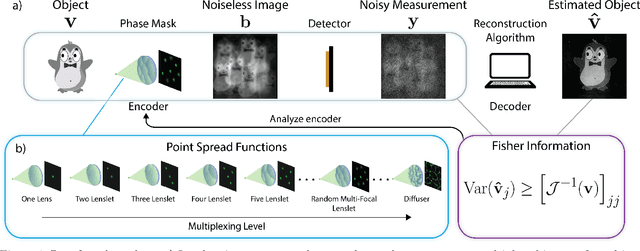

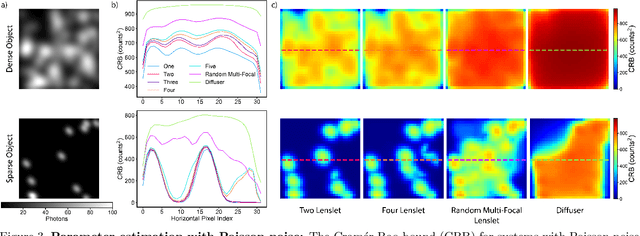
We analyze lensless imaging systems with estimation-theoretic techniques based on Fisher information. Our analysis evaluates multiple optical encoder designs on objects with varying sparsity, in the context of both Gaussian and Poisson noise models. Our simulations verify that lensless imaging system performance is object-dependent and highlight tradeoffs between encoder multiplexing and object sparsity, showing quantitatively that sparse objects tolerate higher levels of multiplexing than dense objects. Insights from our analysis promise to inform and improve optical encoder designs for lensless imaging.
Automotive Elevation Mapping with Interferometric Synthetic Aperture Radar
Jan 14, 2025Radar is a low-cost and ubiquitous automotive sensor, but is limited by array resolution and sensitivity when performing direction of arrival analysis. Synthetic Aperture Radar (SAR) is a class of techniques to improve azimuth resolution and sensitivity for radar. Interferometric SAR (InSAR) can be used to extract elevation from the variations in phase measurements in SAR images. Utilizing InSAR we show that a typical, low-resolution radar array mounted on a vehicle can be used to accurately localize detections in 3D space for both urban and agricultural environments. We generate point clouds in each environment by combining InSAR with a signal processing scheme tailored to automotive driving. This low-compute approach allows radar to be used as a primary sensor to map fine details in complex driving environments, and be used to make autonomous perception decisions.