 Add to Chrome
 Add to Firefox
 Add to Edge
CSR-RAG: An Efficient Retrieval System for Text-to-SQL on the Enterprise Scale
Jan 10, 2026
Natural language to SQL translation (Text-to-SQL) is one of the long-standing problems that has recently benefited from advances in Large Language Models (LLMs). While most academic Text-to-SQL benchmarks request schema description as a part of natural language input, enterprise-scale applications often require table retrieval before SQL query generation. To address this need, we propose a novel hybrid Retrieval Augmented Generation (RAG) system consisting of contextual, structural, and relational retrieval (CSR-RAG) to achieve computationally efficient yet sufficiently accurate retrieval for enterprise-scale databases. Through extensive enterprise benchmarks, we demonstrate that CSR-RAG achieves up to 40% precision and over 80% recall while incurring a negligible average query generation latency of only 30ms on commodity data center hardware, which makes it appropriate for modern LLM-based enterprise-scale systems.

Automating Code Adaptation for MLOps -- A Benchmarking Study on LLMs
May 10, 2024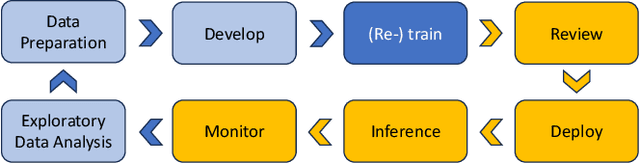
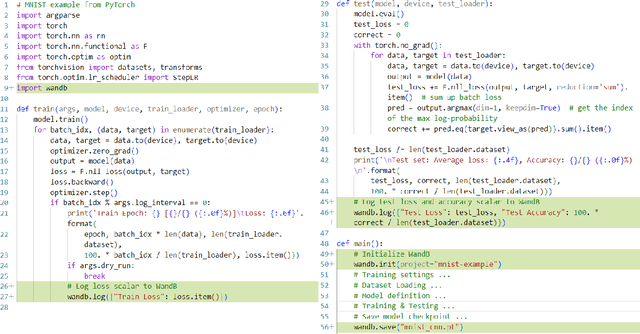
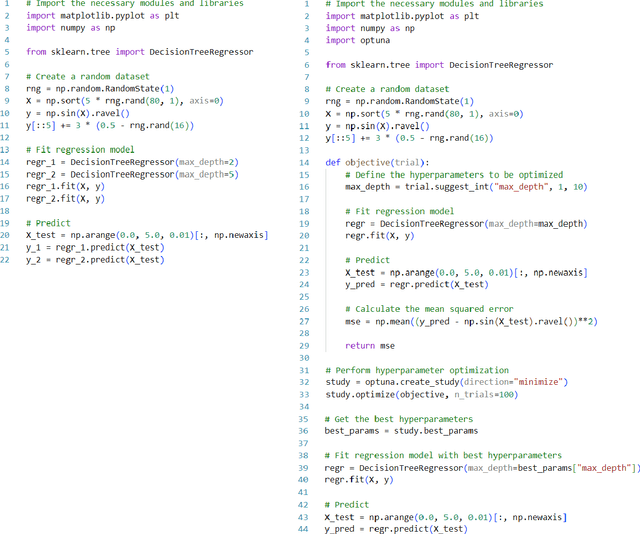
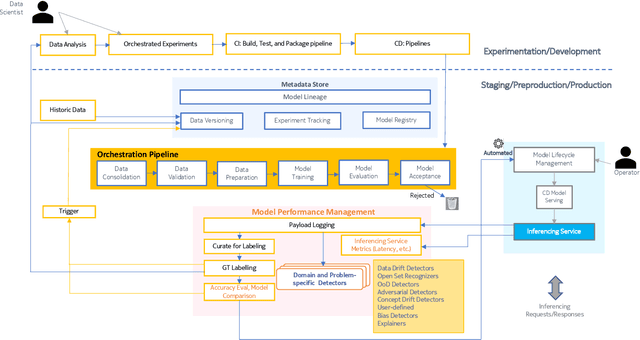
This paper explores the possibilities of the current generation of Large Language Models for incorporating Machine Learning Operations (MLOps) functionalities into ML training code bases. We evaluate the performance of OpenAI (gpt-3.5-turbo) and WizardCoder (open-source, 15B parameters) models on the automated accomplishment of various MLOps functionalities in different settings. We perform a benchmarking study that assesses the ability of these models to: (1) adapt existing code samples (Inlining) with component-specific MLOps functionality such as MLflow and Weights & Biases for experiment tracking, Optuna for hyperparameter optimization etc., and (2) perform the task of Translation from one component of an MLOps functionality to another, e.g., translating existing GitPython library based version control code to Data Version Control library based. We also propose three different approaches that involve teaching LLMs to comprehend the API documentation of the components as a reference while accomplishing the Translation tasks. In our evaluations, the gpt-3.5-turbo model significantly outperforms WizardCoder by achieving impressive Pass@3 accuracy in model optimization (55% compared to 0% by WizardCoder), experiment tracking (100%, compared to 62.5% by WizardCoder), model registration (92% compared to 42% by WizardCoder) and hyperparameter optimization (83% compared to 58% by WizardCoder) on average, in their best possible settings, showcasing its superior code adaptability performance in complex MLOps tasks.