 Add to Chrome
 Add to Firefox
 Add to Edge
Double-Edged Sword or Sharp Tool? Designing and Evaluating Triadic LLM-Teacher Collaboration for K-12 Writing at Scale
May 28, 2026
The double-edged sword of integrating Large Language Models (LLMs) requires an effective triadic collaboration mechanism among LLMs, teachers and students, especially for K-12 education. By developing a triadic collaboration system to support K-12 writing learning, a multidimensional evaluation framework grounded in Systemic Functional Linguistics and the suggestion trajectory tracing pipeline, this paper contributes a large-scale empirical dataset involving $57,954$ essays from $10,195$ students across $120$ schools over two years. Our findings confirm the efficacy of this system in improving writing quality through a strategic labor division: the LLM serves as a generative engine to mitigate teacher burnout, and the teacher acts as a pedagogical gatekeeper and bridge to guarantee feedback quality. While both LLM and teacher are critical for skill improvement, we uncover a ceiling effect where excessive linguistic expansion yields diminishing marginal utility. These suggest a dynamically adaptive LLM-teacher collaboration as student proficiency increases.

Depending on yourself when you should: Mentoring LLM with RL agents to become the master in cybersecurity games
Mar 26, 2024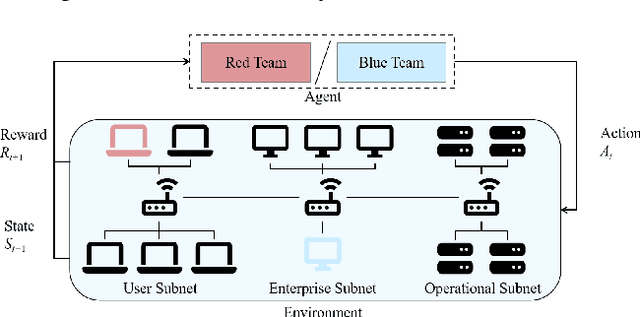
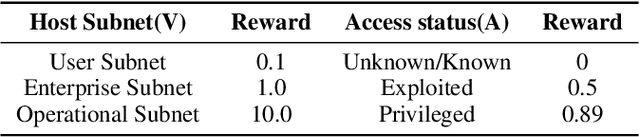
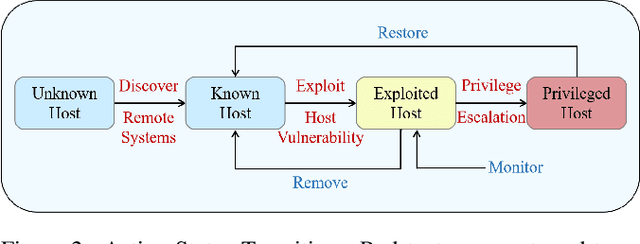
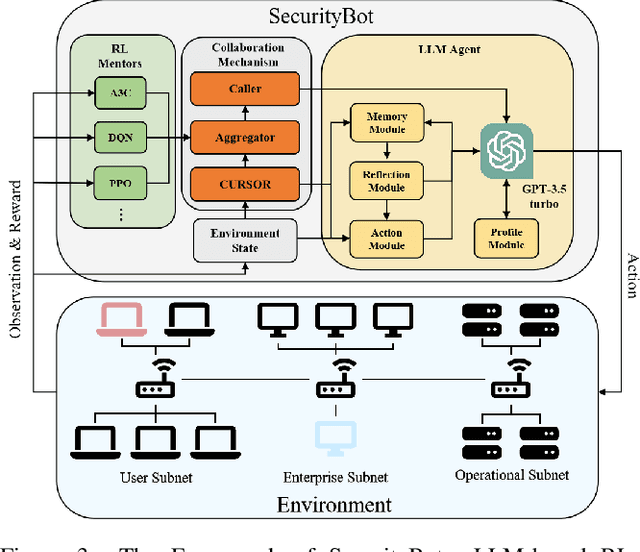
Integrating LLM and reinforcement learning (RL) agent effectively to achieve complementary performance is critical in high stake tasks like cybersecurity operations. In this study, we introduce SecurityBot, a LLM agent mentored by pre-trained RL agents, to support cybersecurity operations. In particularly, the LLM agent is supported with a profile module to generated behavior guidelines, a memory module to accumulate local experiences, a reflection module to re-evaluate choices, and an action module to reduce action space. Additionally, it adopts the collaboration mechanism to take suggestions from pre-trained RL agents, including a cursor for dynamic suggestion taken, an aggregator for multiple mentors' suggestions ranking and a caller for proactive suggestion asking. Building on the CybORG experiment framework, our experiences show that SecurityBot demonstrates significant performance improvement compared with LLM or RL standalone, achieving the complementary performance in the cybersecurity games.