 Add to Chrome
 Add to Firefox
 Add to Edge
Bandwidth-Efficient Multi-Agent Communication through Information Bottleneck and Vector Quantization
Feb 02, 2026
Multi-agent reinforcement learning systems deployed in real-world robotics applications face severe communication constraints that significantly impact coordination effectiveness. We present a framework that combines information bottleneck theory with vector quantization to enable selective, bandwidth-efficient communication in multi-agent environments. Our approach learns to compress and discretize communication messages while preserving task-critical information through principled information-theoretic optimization. We introduce a gated communication mechanism that dynamically determines when communication is necessary based on environmental context and agent states. Experimental evaluation on challenging coordination tasks demonstrates that our method achieves 181.8% performance improvement over no-communication baselines while reducing bandwidth usage by 41.4%. Comprehensive Pareto frontier analysis shows dominance across the entire success-bandwidth spectrum with area-under-curve of 0.198 vs 0.142 for next-best methods. Our approach significantly outperforms existing communication strategies and establishes a theoretically grounded framework for deploying multi-agent systems in bandwidth-constrained environments such as robotic swarms, autonomous vehicle fleets, and distributed sensor networks.

Reimagining Peer Review Process Through Multi-Agent Mechanism Design
Jan 27, 2026The software engineering research community faces a systemic crisis: peer review is failing under growing submissions, misaligned incentives, and reviewer fatigue. Community surveys reveal that researchers perceive the process as "broken." This position paper argues that these dysfunctions are mechanism design failures amenable to computational solutions. We propose modeling the research community as a stochastic multi-agent system and applying multi-agent reinforcement learning to design incentive-compatible protocols. We outline three interventions: a credit-based submission economy, MARL-optimized reviewer assignment, and hybrid verification of review consistency. We present threat models, equity considerations, and phased pilot metrics. This vision charts a research agenda toward sustainable peer review.
Machine Learning-Based Basil Yield Prediction in IoT-Enabled Indoor Vertical Hydroponic Farms
Dec 15, 2025As agriculture faces increasing pressure from water scarcity, especially in regions like Tunisia, innovative, resource-efficient solutions are urgently needed. This work explores the integration of indoor vertical hydroponics with Machine Learning (ML) techniques to optimize basil yield while saving water. This research develops a prediction system that uses different ML models and assesses their performance. The models were systematically trained and tested using data collected from IoT sensors of various environmental parameters like CO2, light. The experimental setup features 21 basil crops and uses Raspberry Pi and Arduino. 10k data points were collected and used to train and evaluate three ML models: Linear Regression (LR), Long Short-Term Memory (LSTM), and Deep Neural Networks (DNN). The comparative analysis of the performance of each model revealed that, while LSTM showed high predictive capability and accuracy of 99%, its execution time was 10 times longer than LR and its RAM usage was about 3 times higher than DNN's when simulated on a standard CPU environment. Conversely, the DNN model had an accuracy rate of 98%. This proves an efficient balance between computational speed and prediction quality, which makes this model well-suited for real-life deployment. Moreover, LR excelled in fast processing of basic prediction with an execution time of 11 seconds. This makes the LR model more suitable for low-complexity or resource-limited applications. These performance trade-offs highlight the potential of DNN-based solutions for building responsive, high-accuracy decision-support systems tailored to agricultural environments, making it suitable for future edge-device deployment.
A Survey of Reinforcement Learning for Optimization in Automation
Feb 13, 2025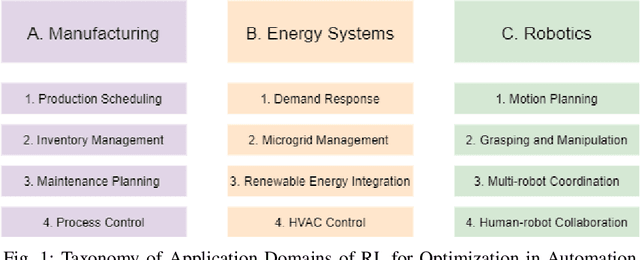
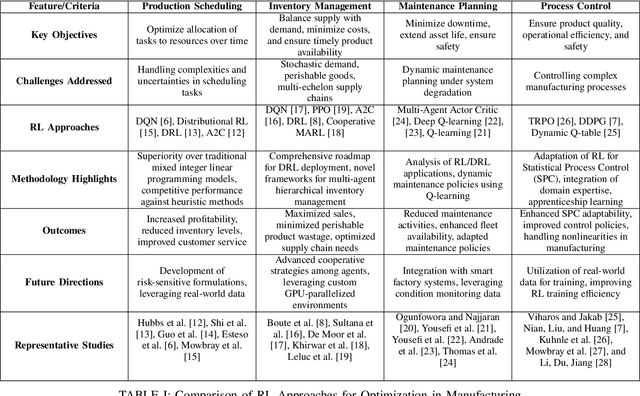
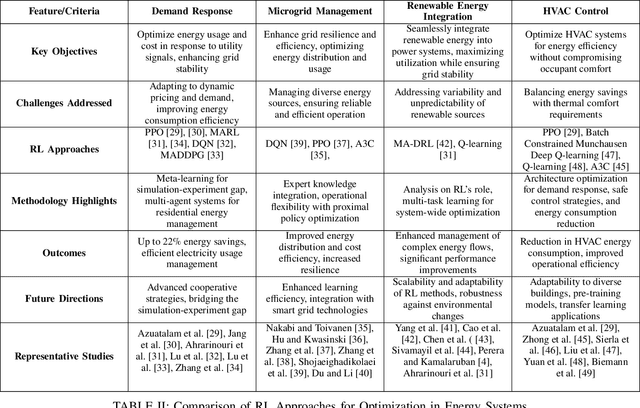
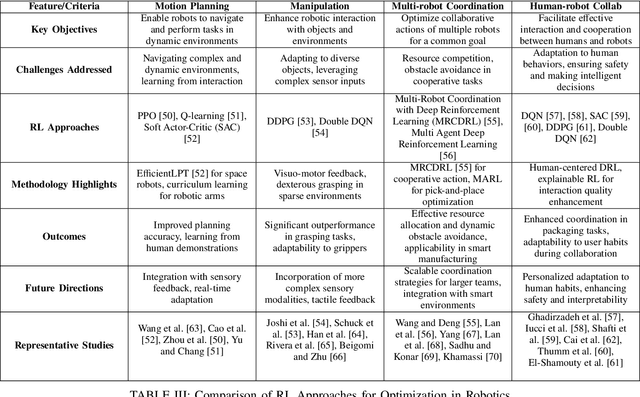
Reinforcement Learning (RL) has become a critical tool for optimization challenges within automation, leading to significant advancements in several areas. This review article examines the current landscape of RL within automation, with a particular focus on its roles in manufacturing, energy systems, and robotics. It discusses state-of-the-art methods, major challenges, and upcoming avenues of research within each sector, highlighting RL's capacity to solve intricate optimization challenges. The paper reviews the advantages and constraints of RL-driven optimization methods in automation. It points out prevalent challenges encountered in RL optimization, including issues related to sample efficiency and scalability; safety and robustness; interpretability and trustworthiness; transfer learning and meta-learning; and real-world deployment and integration. It further explores prospective strategies and future research pathways to navigate these challenges. Additionally, the survey includes a comprehensive list of relevant research papers, making it an indispensable guide for scholars and practitioners keen on exploring this domain.
* 8 pages, 4 tables, and 1 figure. Accepted at IEEE 20th International Conference on Automation Science and Engineering (CASE) 2024