 Add to Chrome
 Add to Firefox
 Add to Edge
Data-Chain Backdoor: Do You Trust Diffusion Models as Generative Data Supplier?
Dec 12, 2025
The increasing use of generative models such as diffusion models for synthetic data augmentation has greatly reduced the cost of data collection and labeling in downstream perception tasks. However, this new data source paradigm may introduce important security concerns. This work investigates backdoor propagation in such emerging generative data supply chains, namely Data-Chain Backdoor (DCB). Specifically, we find that open-source diffusion models can become hidden carriers of backdoors. Their strong distribution-fitting ability causes them to memorize and reproduce backdoor triggers during generation, which are subsequently inherited by downstream models, resulting in severe security risks. This threat is particularly concerning under clean-label attack scenarios, as it remains effective while having negligible impact on the utility of the synthetic data. Furthermore, we discover an Early-Stage Trigger Manifestation (ESTM) phenomenon: backdoor trigger patterns tend to surface more explicitly in the early, high-noise stages of the diffusion model's reverse generation process before being subtly integrated into the final samples. Overall, this work reveals a previously underexplored threat in generative data pipelines and provides initial insights toward mitigating backdoor risks in synthetic data generation.

Risk-optimized Outlier Removal for Robust Point Cloud Classification
Jul 20, 2023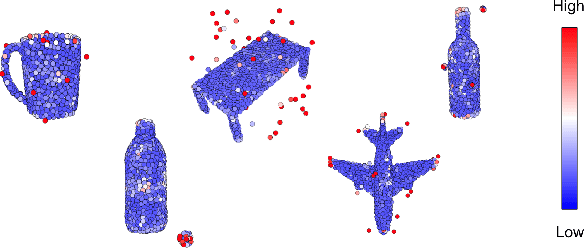
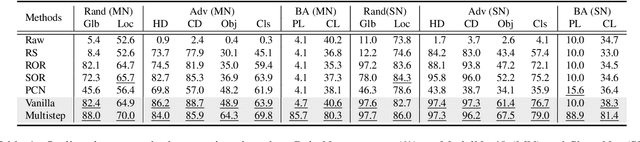
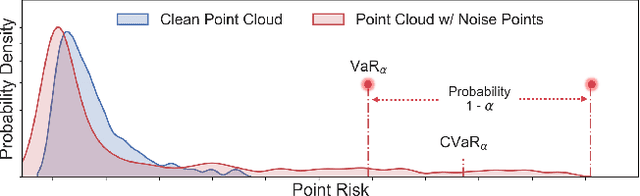
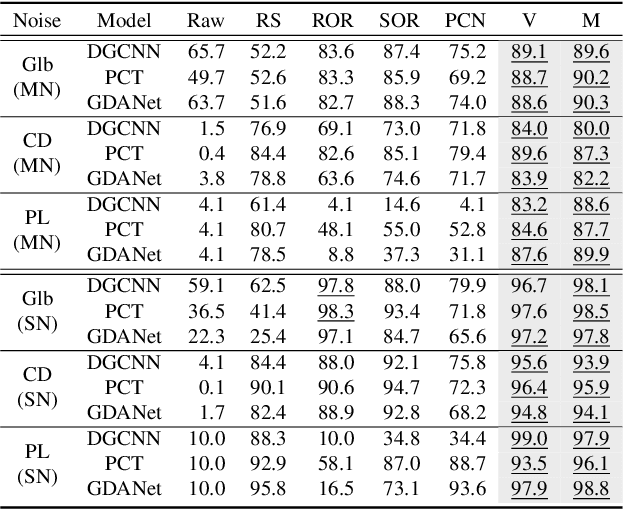
The popularity of point cloud deep models for safety-critical purposes has increased, but the reliability and security of these models can be compromised by intentional or naturally occurring point cloud noise. To combat this issue, we present a novel point cloud outlier removal method called PointCVaR, which empowers standard-trained models to eliminate additional outliers and restore the data. Our approach begins by conducting attribution analysis to determine the influence of each point on the model output, which we refer to as point risk. We then optimize the process of filtering high-risk points using Conditional Value at Risk (CVaR) as the objective. The rationale for this approach is based on the observation that noise points in point clouds tend to cluster in the tail of the risk distribution, with a low frequency but a high level of risk, resulting in significant interference with classification results. Despite requiring no additional training effort, our method produces exceptional results in various removal-and-classification experiments for noisy point clouds, which are corrupted by random noise, adversarial noise, and backdoor trigger noise. Impressively, it achieves 87% accuracy in defense against the backdoor attack by removing triggers. Overall, the proposed PointCVaR effectively eliminates noise points and enhances point cloud classification, making it a promising plug-in module for various models in different scenarios.