 Add to Chrome
 Add to Firefox
 Add to Edge
Joint Subarray Selection, User Scheduling, and Pilot Assignment for XL-MIMO
Jan 19, 2026
Extra-large scale MIMO (XL-MIMO) is a key technology for meeting sixth-generation (6G) requirements for high-rate connectivity and uniform quality of service (QoS); however, its deployment is challenged by the prohibitive complexity of resource management based on instantaneous channel state information (CSI). To address this intractability, this work derives novel closed-form deterministic signal-to-interference-plus-noise ratio (SINR) expressions for both centralized and distributed uplink operations. Valid for Rician fading channels with minimum mean square error (MMSE) receive combining and MMSE channel estimation, these expressions depend exclusively on long-term channel statistics, providing a tractable alternative to computationally expensive instantaneous CSI-driven optimization. Building on these results, we develop statistical-CSI-based algorithms for joint subarray selection, users scheduling, and pilot assignment, leveraging the derived SINR approximations to maximize the minimum spectral efficiency (SE) among scheduled users while preserving computational tractability. The proposed framework exploits the spatial sparsity of user equipment (UE) visibility regions (VRs) to enable more aggressive pilot reuse than is possible in conventional massive MIMO. Numerical results validate the high accuracy of the derived SINR approximations and demonstrate that the proposed algorithms significantly enhance fairness and throughput in crowded scenarios.

Exploring the Non-Overlapping Visibility Regions in XL-MIMO Random Access Protocol
Jul 19, 2021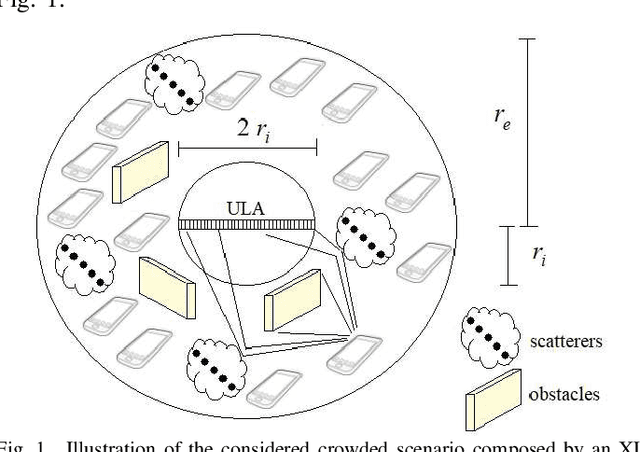
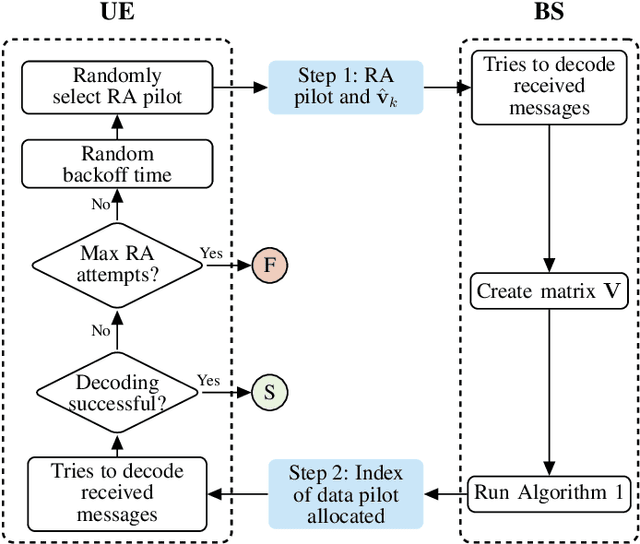
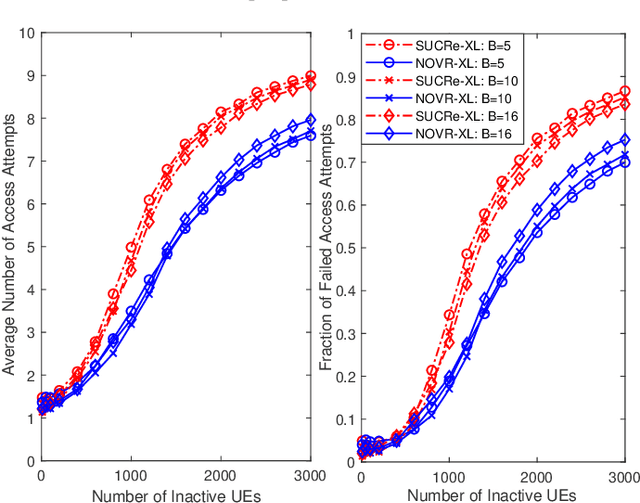
The recent extra-large scale massive multiple-input multiple-output (XL-MIMO) systems are seen as a promising technology for providing very high data rates in increased user-density scenarios. Spatial non-stationarities and visibility regions (VRs) appear across the XL-MIMO array since its large dimension is of the same order as the distances to the user-equipments (UEs). Due to the increased density of UEs in typical applications of XL-MIMO systems and the scarcity of pilots, the design of random access (RA) protocols and scheduling algorithms become challenging. In this paper, we propose a joint RA and scheduling protocol, namely non-overlapping VR XL- MIMO (NOVR-XL) RA protocol, which takes advantage of the different VRs of the UEs for improving RA performance, besides seeking UEs with non-overlapping VRs to be scheduled in the same payload data pilot resource. Our results reveal that the proposed scheme achieves significant gains in terms of sum rate compared with traditional RA schemes, as well as reducing access latency and improving connectivity performance as a whole.