 Add to Chrome
 Add to Firefox
 Add to Edge
DiffusionQC: Artifact Detection in Histopathology via Diffusion Model
Jan 18, 2026
Digital pathology plays a vital role across modern medicine, offering critical insights for disease diagnosis, prognosis, and treatment. However, histopathology images often contain artifacts introduced during slide preparation and digitization. Detecting and excluding them is essential to ensure reliable downstream analysis. Traditional supervised models typically require large annotated datasets, which is resource-intensive and not generalizable to novel artifact types. To address this, we propose DiffusionQC, which detects artifacts as outliers among clean images using a diffusion model. It requires only a set of clean images for training rather than pixel-level artifact annotations and predefined artifact types. Furthermore, we introduce a contrastive learning module to explicitly enlarge the distribution separation between artifact and clean images, yielding an enhanced version of our method. Empirical results demonstrate superior performance to state-of-the-art and offer cross-stain generalization capacity, with significantly less data and annotations.

Enhanced Diagnostic Performance via Large-Resolution Inference Optimization for Pathology Foundation Models
Jan 17, 2026Despite their prominent performance on tasks such as ROI classification and segmentation, many pathology foundation models remain constrained by a specific input size e.g. 224 x 224, creating substantial inefficiencies when applied to whole-slide images (WSIs), which span thousands of resolutions. A naive strategy is to either enlarge inputs or downsample the WSIs. However, enlarging inputs results in prohibitive GPU memory consumption, while downsampling alters the microns-per-pixel resolution and obscures critical morphological details. To overcome these limitations, we propose an space- and time- efficient inference strategy that sparsifies attention using spatially aware neighboring blocks and filters out non-informative tokens through global attention scores. This design substantially reduces GPU memory and runtime during high-resolution WSI inference while preserving and even improving the downstream performance, enabling inference at higher resolutions under the same GPU budget. The experimental results show that our method can achieves up to an 7.67% improvement in the ROI classification and compatible results in segmentation.
Semi-automated extraction of research topics and trends from NCI funding in radiological sciences from 2000-2020
Jun 22, 2023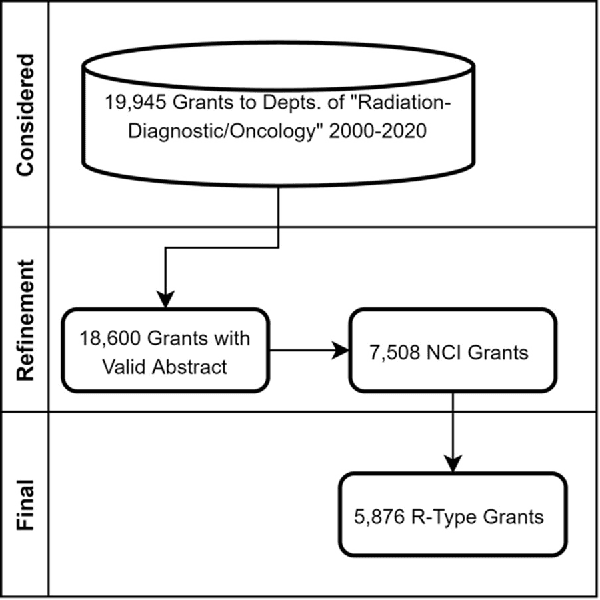
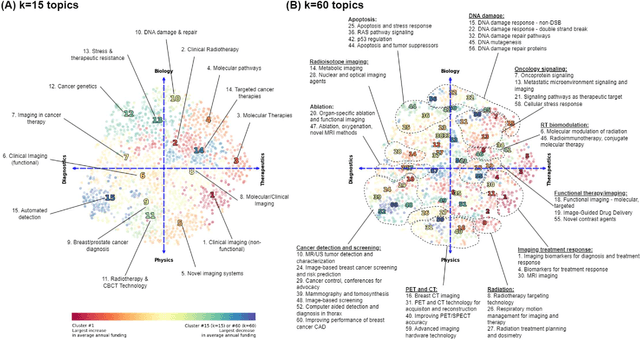
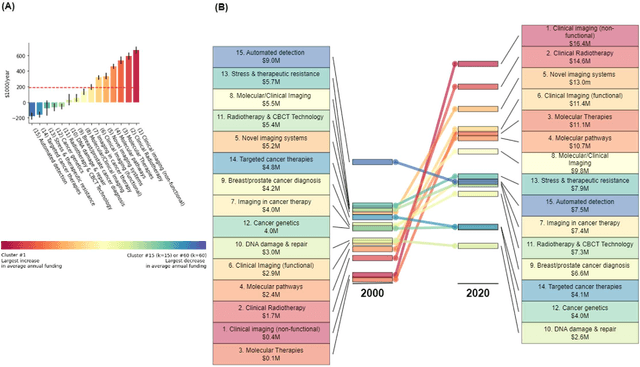
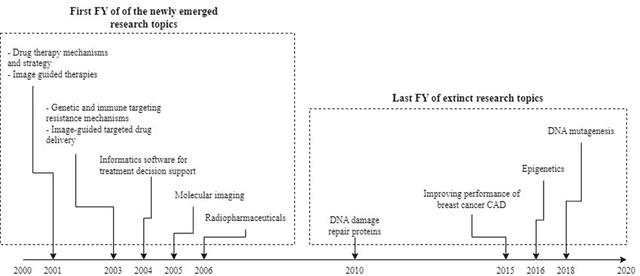
Investigators, funders, and the public desire knowledge on topics and trends in publicly funded research but current efforts in manual categorization are limited in scale and understanding. We developed a semi-automated approach to extract and name research topics, and applied this to \$1.9B of NCI funding over 21 years in the radiological sciences to determine micro- and macro-scale research topics and funding trends. Our method relies on sequential clustering of existing biomedical-based word embeddings, naming using subject matter experts, and visualization to discover trends at a macroscopic scale above individual topics. We present results using 15 and 60 cluster topics, where we found that 2D projection of grant embeddings reveals two dominant axes: physics-biology and therapeutic-diagnostic. For our dataset, we found that funding for therapeutics- and physics-based research have outpaced diagnostics- and biology-based research, respectively. We hope these results may (1) give insight to funders on the appropriateness of their funding allocation, (2) assist investigators in contextualizing their work and explore neighboring research domains, and (3) allow the public to review where their tax dollars are being allocated.