 Add to Chrome
 Add to Firefox
 Add to Edge
SMART: Scalable Mesh-free Aerodynamic Simulations from Raw Geometries using a Transformer-based Surrogate Model
Jan 26, 2026
Machine learning-based surrogate models have emerged as more efficient alternatives to numerical solvers for physical simulations over complex geometries, such as car bodies. Many existing models incorporate the simulation mesh as an additional input, thereby reducing prediction errors. However, generating a simulation mesh for new geometries is computationally costly. In contrast, mesh-free methods, which do not rely on the simulation mesh, typically incur higher errors. Motivated by these considerations, we introduce SMART, a neural surrogate model that predicts physical quantities at arbitrary query locations using only a point-cloud representation of the geometry, without requiring access to the simulation mesh. The geometry and simulation parameters are encoded into a shared latent space that captures both structural and parametric characteristics of the physical field. A physics decoder then attends to the encoder's intermediate latent representations to map spatial queries to physical quantities. Through this cross-layer interaction, the model jointly updates latent geometric features and the evolving physical field. Extensive experiments show that SMART is competitive with and often outperforms existing methods that rely on the simulation mesh as input, demonstrating its capabilities for industry-level simulations.

CALM-PDE: Continuous and Adaptive Convolutions for Latent Space Modeling of Time-dependent PDEs
May 19, 2025Solving time-dependent Partial Differential Equations (PDEs) using a densely discretized spatial domain is a fundamental problem in various scientific and engineering disciplines, including modeling climate phenomena and fluid dynamics. However, performing these computations directly in the physical space often incurs significant computational costs. To address this issue, several neural surrogate models have been developed that operate in a compressed latent space to solve the PDE. While these approaches reduce computational complexity, they often use Transformer-based attention mechanisms to handle irregularly sampled domains, resulting in increased memory consumption. In contrast, convolutional neural networks allow memory-efficient encoding and decoding but are limited to regular discretizations. Motivated by these considerations, we propose CALM-PDE, a model class that efficiently solves arbitrarily discretized PDEs in a compressed latent space. We introduce a novel continuous convolution-based encoder-decoder architecture that uses an epsilon-neighborhood-constrained kernel and learns to apply the convolution operator to adaptive and optimized query points. We demonstrate the effectiveness of CALM-PDE on a diverse set of PDEs with both regularly and irregularly sampled spatial domains. CALM-PDE is competitive with or outperforms existing baseline methods while offering significant improvements in memory and inference time efficiency compared to Transformer-based methods.
Vectorized Conditional Neural Fields: A Framework for Solving Time-dependent Parametric Partial Differential Equations
Jun 06, 2024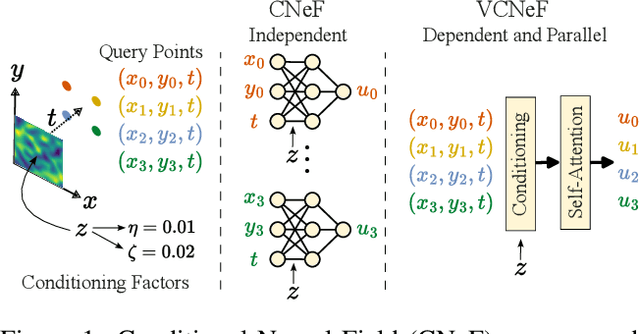
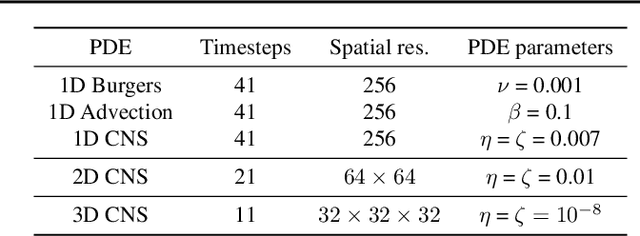
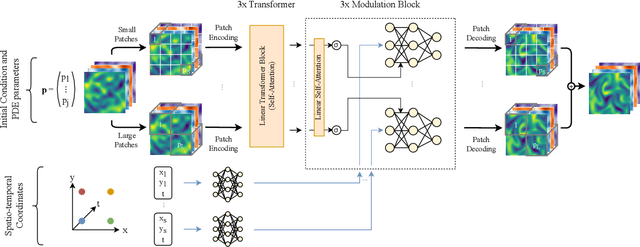
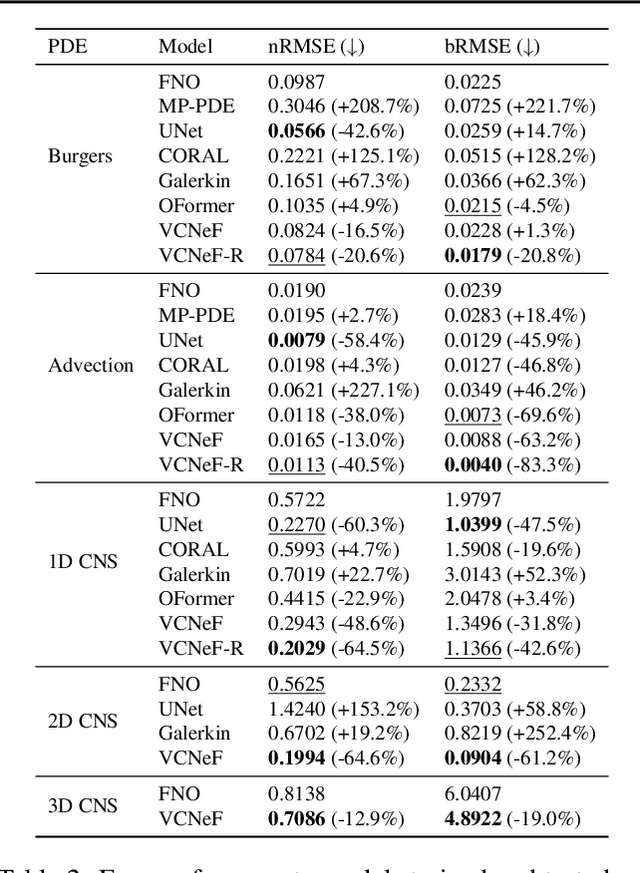
Transformer models are increasingly used for solving Partial Differential Equations (PDEs). Several adaptations have been proposed, all of which suffer from the typical problems of Transformers, such as quadratic memory and time complexity. Furthermore, all prevalent architectures for PDE solving lack at least one of several desirable properties of an ideal surrogate model, such as (i) generalization to PDE parameters not seen during training, (ii) spatial and temporal zero-shot super-resolution, (iii) continuous temporal extrapolation, (iv) support for 1D, 2D, and 3D PDEs, and (v) efficient inference for longer temporal rollouts. To address these limitations, we propose Vectorized Conditional Neural Fields (VCNeFs), which represent the solution of time-dependent PDEs as neural fields. Contrary to prior methods, however, VCNeFs compute, for a set of multiple spatio-temporal query points, their solutions in parallel and model their dependencies through attention mechanisms. Moreover, VCNeF can condition the neural field on both the initial conditions and the parameters of the PDEs. An extensive set of experiments demonstrates that VCNeFs are competitive with and often outperform existing ML-based surrogate models.