 Add to Chrome
 Add to Firefox
 Add to Edge
TextClass Benchmark: A Continuous Elo Rating of LLMs in Social Sciences
Nov 30, 2024
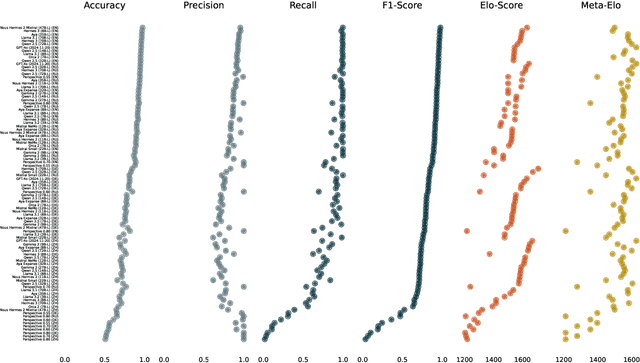
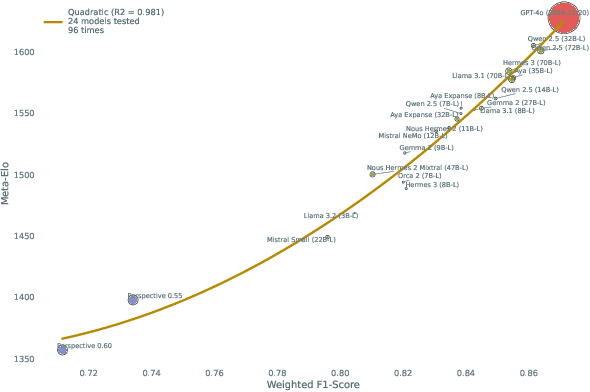
The TextClass Benchmark project is an ongoing, continuous benchmarking process that aims to provide a comprehensive, fair, and dynamic evaluation of LLMs and transformers for text classification tasks. This evaluation spans various domains and languages in social sciences disciplines engaged in NLP and text-as-data approach. The leaderboards present performance metrics and relative ranking using a tailored Elo rating system. With each leaderboard cycle, novel models are added, fixed test sets can be replaced for unseen, equivalent data to test generalisation power, ratings are updated, and a Meta-Elo leaderboard combines and weights domain-specific leaderboards. This article presents the rationale and motivation behind the project, explains the Elo rating system in detail, and estimates Meta-Elo across different classification tasks in social science disciplines. We also present a snapshot of the first cycle of classification tasks on incivility data in Chinese, English, German and Russian. This ongoing benchmarking process includes not only additional languages such as Arabic, Hindi, and Spanish but also a classification of policy agenda topics, misinformation, among others.

Benchmarking LLMs in Political Content Text-Annotation: Proof-of-Concept with Toxicity and Incivility Data
Sep 15, 2024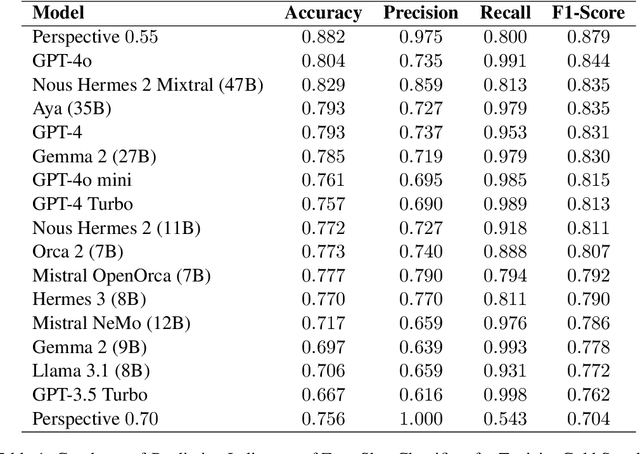
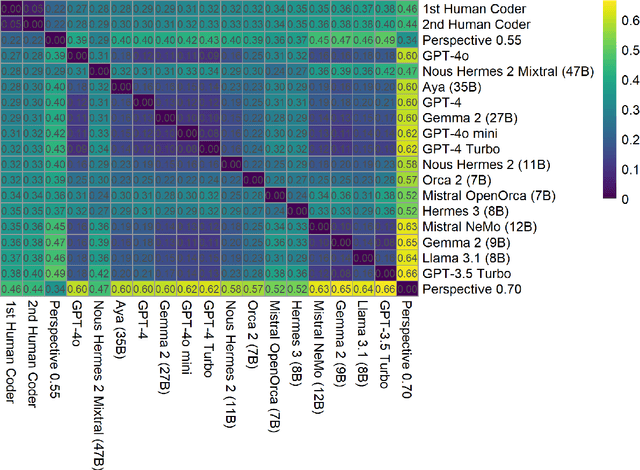
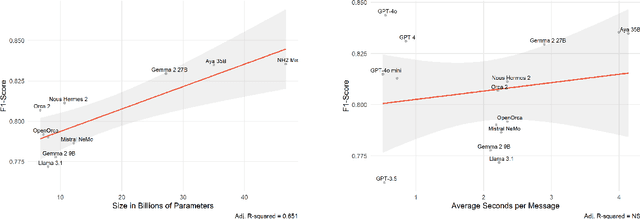
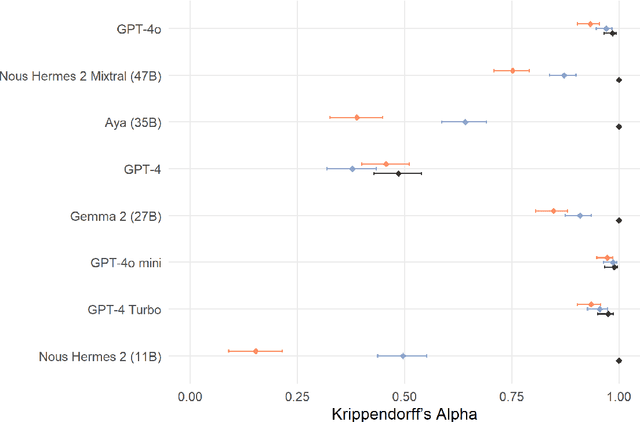
This article benchmarked the ability of OpenAI's GPTs and a number of open-source LLMs to perform annotation tasks on political content. We used a novel protest event dataset comprising more than three million digital interactions and created a gold standard that includes ground-truth labels annotated by human coders about toxicity and incivility on social media. We included in our benchmark Google's Perspective algorithm, which, along with GPTs, was employed throughout their respective APIs while the open-source LLMs were deployed locally. The findings show that Perspective API using a laxer threshold, GPT-4o, and Nous Hermes 2 Mixtral outperform other LLM's zero-shot classification annotations. In addition, Nous Hermes 2 and Mistral OpenOrca, with a smaller number of parameters, are able to perform the task with high performance, being attractive options that could offer good trade-offs between performance, implementing costs and computing time. Ancillary findings using experiments setting different temperature levels show that although GPTs tend to show not only excellent computing time but also overall good levels of reliability, only open-source LLMs ensure full reproducibility in the annotation.