 Add to Chrome
 Add to Firefox
 Add to Edge
DMA-aided MU-MISO Systems for Power Splitting SWIPT via Lorentzian-Constrained Holography
Nov 11, 2025
This paper presents an optimal power splitting and beamforming design for co-located simultaneous wireless information and power transfer (SWIPT) users in Dynamic Metasurface Antenna (DMA)-aided multiuser multiple-input single-output (MISO) systems. The objective is to minimize transmit power while meeting users signal-to-interference-plus-noise ratio (SINR) and energy harvesting (EH) requirements. The problem is solved via an alternating optimization framework based on semidefinite programming (SDP), where metasurface tunability follows Lorentzian-constrained holography (LCH). In contrast to traditional beamforming architectures, DMA-assisted architectures reduce the need for RF chains and phase shifters but require optimization under the Lorentzian constraint limiting the amplitude and phase optimizations. Hence, the proposed method integrates several LCH schemes, including the recently proposed adaptive-radius LCH (ARLCH), and evaluates nonlinear EH models and circuit noise effects. Simulation results show that the proposed design significantly reduces transmit power compared with baseline methods, highlighting the efficiency of ARLCH and optimal power splitting in DMA-assisted SWIPT systems.

Lorentzian-Constrained Holographic Beamforming Optimization in Multi-user Networks with Dynamic Metasurface Antennas
May 13, 2025Dynamic metasurface antennas (DMAs) are promising alternatives to fully digital (FD) architectures, enabling hybrid beamforming via low-cost reconfigurable metasurfaces. In DMAs, holographic beamforming is achieved through tunable elements by Lorentzian-constrained holography (LCH), significantly reducing the need for radio-frequency (RF) chains and analog circuitry. However, the Lorentzian constraints and limited RF chains introduce a trade-off between reduced system complexity and beamforming performance, especially in dense network scenarios. This paper addresses resource allocation in multi-user multiple-input-single-output (MISO) networks under the Signal-to-Interference-plus-Noise Ratio (SINR) constraints, aiming to minimize total transmit power. We propose a holographic beamforming algorithm based on the Generalized Method of Lorentzian-Constrained Holography (GMLCH), which optimizes DMA weights, yielding flexibility for using various LCH techniques to tackle the aforementioned trade-offs. Building upon GMLCH, we further propose a new algorithm, Adaptive Radius Lorentzian Constrained Holography (ARLCH), which achieves optimization of DMA weights with additional degree of freedom in a greater optimization space, and provides lower transmitted power, while improving scalability for higher number of users. Numerical results show that ARLCH reduces power consumption by over 20% compared to benchmarks, with increasing effectiveness as the number of users grows.
Investigation of Holographic Beamforming via Dynamic Metasurface Antennas in QoS Guaranteed Power Efficient Networks
Nov 08, 2024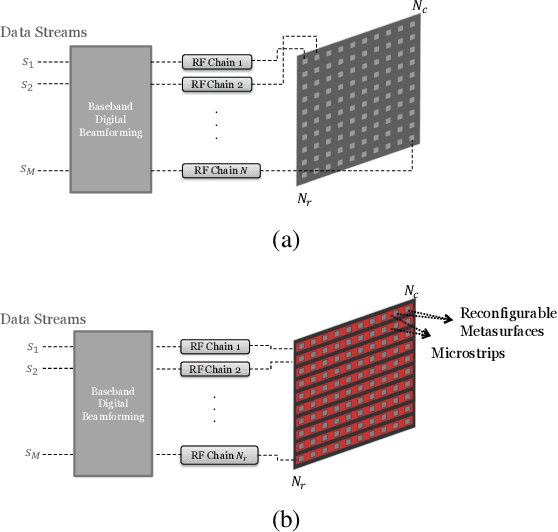
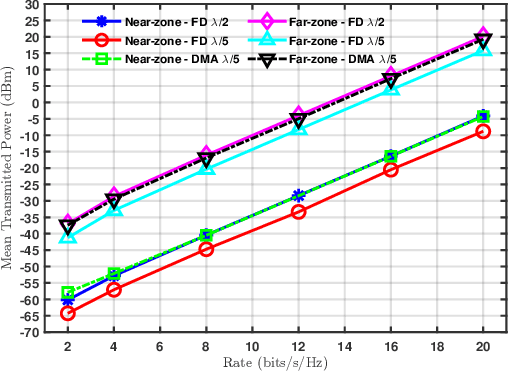
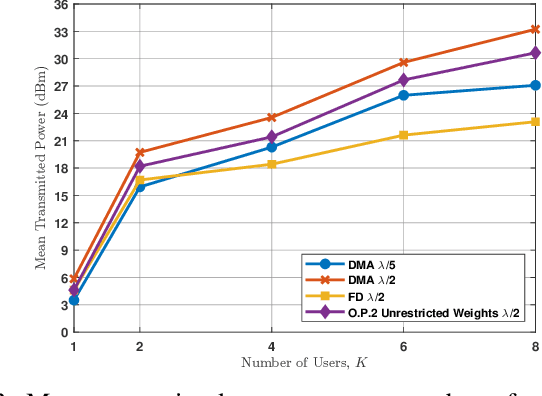
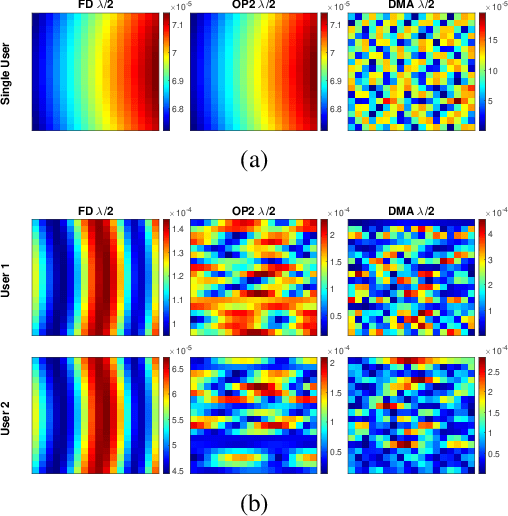
This work focuses on designing a power-efficient network for Dynamic Metasurface Antennas (DMAs)-aided multiuser multiple-input single output (MISO) antenna systems. The main objective is to minimize total transmitted power by the DMAs while ensuring a guaranteed signal-to-noise-and-interference ratio (SINR) for multiple users in downlink beamforming. Unlike conventional MISO systems, which have well-explored beamforming solutions, DMAs require specialized methods due to their unique physical constraints and wavedomain precoding capabilities. To achieve this, optimization algorithms relying on alternating optimization and semi-definite programming, are developed, including spherical-wave channel modelling of near-field communication. The dynamic reconfigurability and holography-based beamforming of metasurface arrays make DMAs promising candidates for power-efficient networks by reducing the need for power-hungry RF chains. On the other hand, the physical constraints on DMA weights and wave-domain precoding of multiple DMA elements through reduced number of RF suppliers can limit the degrees of freedom (DoF) in beamforming optimizations compared to conventional fully digital (FD) architectures. This paper investigates the optimization of downlink beamforming in DMA-aided networks, focusing on power efficiency and addressing these challenges.