 Add to Chrome
 Add to Firefox
 Add to Edge
Adaptive Sampling for Hydrodynamic Stability
Dec 15, 2025
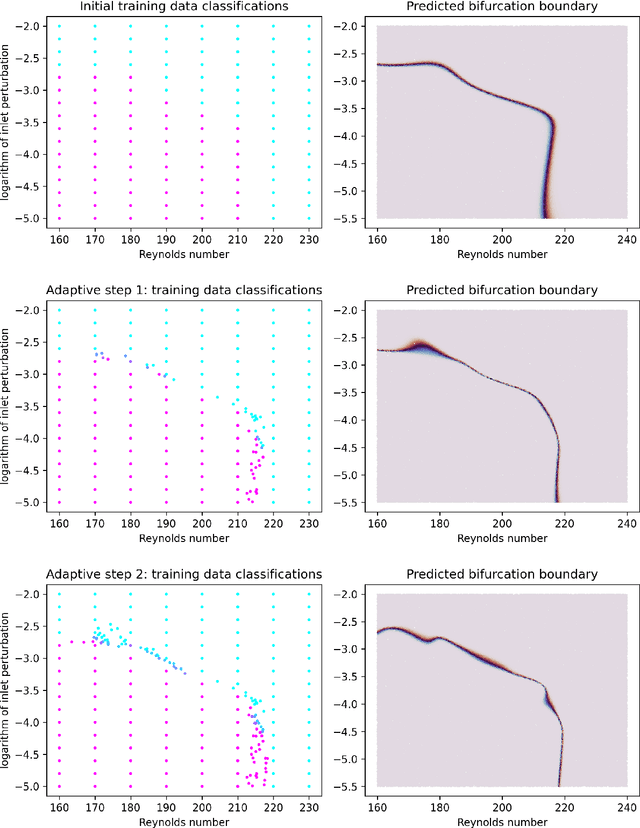
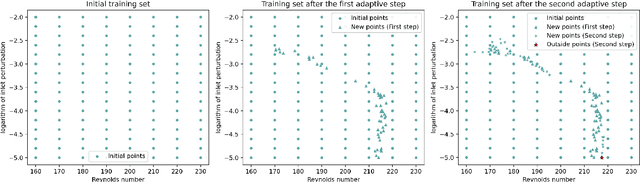
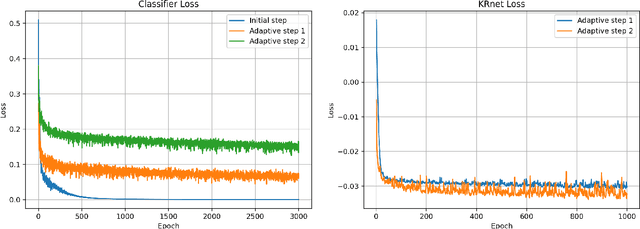
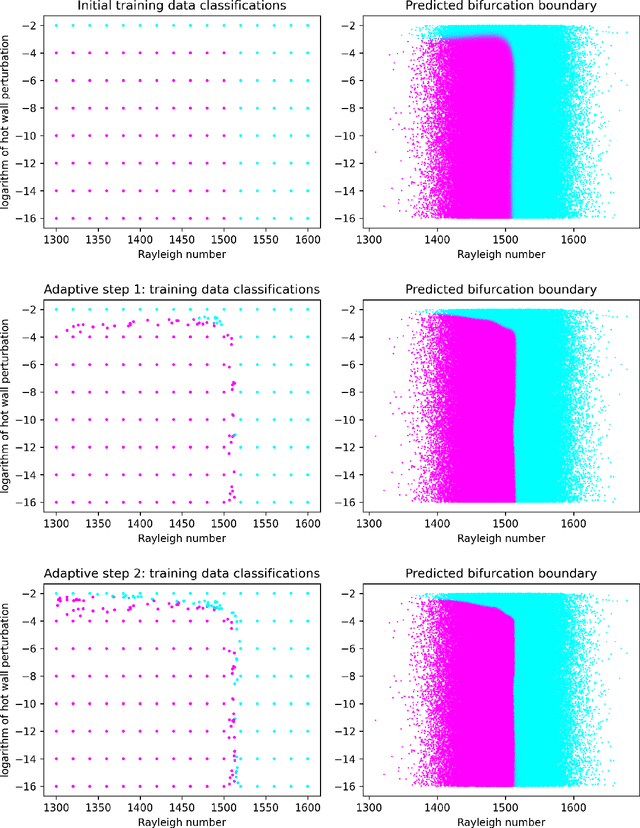
An adaptive sampling approach for efficient detection of bifurcation boundaries in parametrized fluid flow problems is presented herein. The study extends the machine-learning approach of Silvester (Machine Learning for Hydrodynamic Stability, arXiv:2407.09572), where a classifier network was trained on preselected simulation data to identify bifurcated and nonbifurcated flow regimes. In contrast, the proposed methodology introduces adaptivity through a flow-based deep generative model that automatically refines the sampling of the parameter space. The strategy has two components: a classifier network maps the flow parameters to a bifurcation probability, and a probability density estimation technique (KRnet) for the generation of new samples at each adaptive step. The classifier output provides a probabilistic measure of flow stability, and the Shannon entropy of these predictions is employed as an uncertainty indicator. KRnet is trained to approximate a probability density function that concentrates sampling in regions of high entropy, thereby directing computational effort towards the evolving bifurcation boundary. This coupling between classification and generative modeling establishes a feedback-driven adaptive learning process analogous to error-indicator based refinement in contemporary partial differential equation solution strategies. Starting from a uniform parameter distribution, the new approach achieves accurate bifurcation boundary identification with significantly fewer Navier--Stokes simulations, providing a scalable foundation for high-dimensional stability analysis.

An efficient wavelet-based physics-informed neural networks for singularly perturbed problems
Sep 18, 2024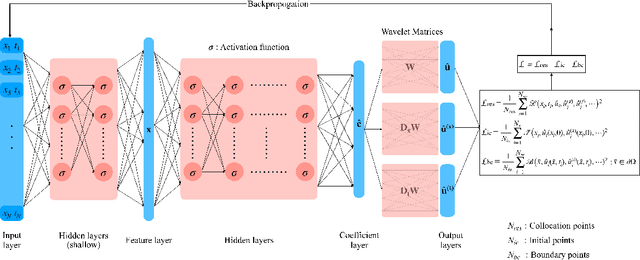
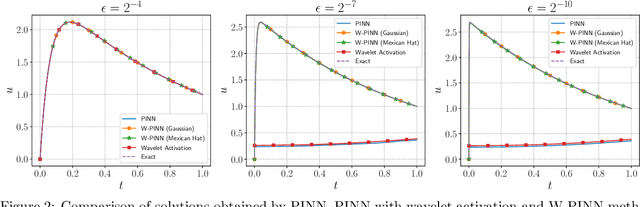
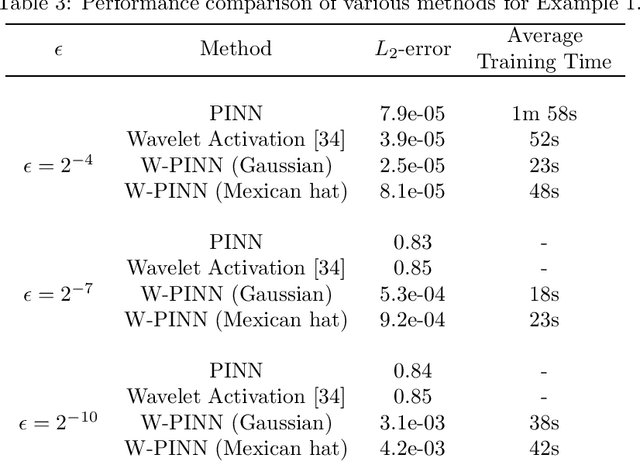
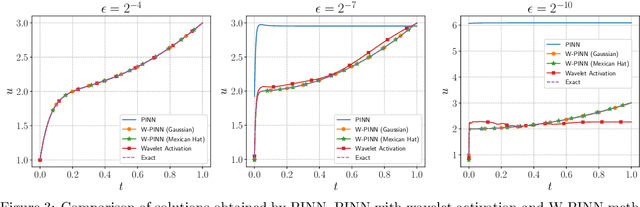
Physics-informed neural networks (PINNs) are a class of deep learning models that utilize physics as differential equations to address complex problems, including ones that may involve limited data availability. However, tackling solutions of differential equations with oscillations or singular perturbations and shock-like structures becomes challenging for PINNs. Considering these challenges, we designed an efficient wavelet-based PINNs (W-PINNs) model to solve singularly perturbed differential equations. Here, we represent the solution in wavelet space using a family of smooth-compactly supported wavelets. This framework represents the solution of a differential equation with significantly fewer degrees of freedom while still retaining in capturing, identifying, and analyzing the local structure of complex physical phenomena. The architecture allows the training process to search for a solution within wavelet space, making the process faster and more accurate. The proposed model does not rely on automatic differentiations for derivatives involved in differential equations and does not require any prior information regarding the behavior of the solution, such as the location of abrupt features. Thus, through a strategic fusion of wavelets with PINNs, W-PINNs excel at capturing localized nonlinear information, making them well-suited for problems showing abrupt behavior in certain regions, such as singularly perturbed problems. The efficiency and accuracy of the proposed neural network model are demonstrated in various test problems, i.e., highly singularly perturbed nonlinear differential equations, the FitzHugh-Nagumo (FHN), and Predator-prey interaction models. The proposed design model exhibits impressive comparisons with traditional PINNs and the recently developed wavelet-based PINNs, which use wavelets as an activation function for solving nonlinear differential equations.