 Add to Chrome
 Add to Firefox
 Add to Edge
Distorted or Fabricated? A Survey on Hallucination in Video LLMs
Apr 14, 2026
Despite significant progress in video-language modeling, hallucinations remain a persistent challenge in Video Large Language Models (Vid-LLMs), referring to outputs that appear plausible yet contradict the content of the input video. This survey presents a comprehensive analysis of hallucinations in Vid-LLMs and introduces a systematic taxonomy that categorizes them into two core types: dynamic distortion and content fabrication, each comprising two subtypes with representative cases. Building on this taxonomy, we review recent advances in the evaluation and mitigation of hallucinations, covering key benchmarks, metrics, and intervention strategies. We further analyze the root causes of dynamic distortion and content fabrication, which often result from limited capacity for temporal representation and insufficient visual grounding. These insights inform several promising directions for future work, including the development of motion-aware visual encoders and the integration of counterfactual learning techniques. This survey consolidates scattered progress to foster a systematic understanding of hallucinations in Vid-LLMs, laying the groundwork for building robust and reliable video-language systems. An up-to-date curated list of related works is maintained at https://github.com/hukcc/Awesome-Video-Hallucination .

Physically Inspired Gaussian Splatting for HDR Novel View Synthesis
Mar 30, 2026High dynamic range novel view synthesis (HDR-NVS) reconstructs scenes with dynamic details by fusing multi-exposure low dynamic range (LDR) views, yet it struggles to capture ambient illumination-dependent appearance. Implicitly supervising HDR content by constraining tone-mapped results fails in correcting abnormal HDR values, and results in limited gradients for Gaussians in under/over-exposed regions. To this end, we introduce PhysHDR-GS, a physically inspired HDR-NVS framework that models scene appearance via intrinsic reflectance and adjustable ambient illumination. PhysHDR-GS employs a complementary image-exposure (IE) branch and Gaussian-illumination (GI) branch to faithfully reproduce standard camera observations and capture illumination-dependent appearance changes, respectively. During training, the proposed cross-branch HDR consistency loss provides explicit supervision for HDR content, while an illumination-guided gradient scaling strategy mitigates exposure-biased gradient starvation and reduces under-densified representations. Experimental results across realistic and synthetic datasets demonstrate our superiority in reconstructing HDR details (e.g., a PSNR gain of 2.04 dB over HDR-GS), while maintaining real-time rendering speed (up to 76 FPS). Code and models are available at https://huimin-zeng.github.io/PhysHDR-GS/.
Variable-Length Audio Fingerprinting
Mar 25, 2026Audio fingerprinting converts audio to much lower-dimensional representations, allowing distorted recordings to still be recognized as their originals through similar fingerprints. Existing deep learning approaches rigidly fingerprint fixed-length audio segments, thereby neglecting temporal dynamics during segmentation. To address limitations due to this rigidity, we propose Variable-Length Audio FingerPrinting (VLAFP), a novel method that supports variable-length fingerprinting. To the best of our knowledge, VLAFP is the first deep audio fingerprinting model capable of processing audio of variable length, for both training and testing. Our experiments show that VLAFP outperforms existing state-of-the-arts in live audio identification and audio retrieval across three real-world datasets.
Ref-Adv: Exploring MLLM Visual Reasoning in Referring Expression Tasks
Feb 27, 2026Referring Expression Comprehension (REC) links language to region level visual perception. Standard benchmarks (RefCOCO, RefCOCO+, RefCOCOg) have progressed rapidly with multimodal LLMs but remain weak tests of visual reasoning and grounding: (i) many expressions are very short, leaving little reasoning demand; (ii) images often contain few distractors, making the target easy to find; and (iii) redundant descriptors enable shortcut solutions that bypass genuine text understanding and visual reasoning. We introduce Ref-Adv, a modern REC benchmark that suppresses shortcuts by pairing linguistically nontrivial expressions with only the information necessary to uniquely identify the target. The dataset contains referring expressions on real images, curated with hard distractors and annotated with reasoning facets including negation. We conduct comprehensive ablations (word order perturbations and descriptor deletion sufficiency) to show that solving Ref-Adv requires reasoning beyond simple cues, and we evaluate a broad suite of contemporary multimodal LLMs on Ref-Adv. Despite strong results on RefCOCO, RefCOCO+, and RefCOCOg, models drop markedly on Ref-Adv, revealing reliance on shortcuts and gaps in visual reasoning and grounding. We provide an in depth failure analysis and aim for Ref-Adv to guide future work on visual reasoning and grounding in MLLMs.
FASA: Frequency-aware Sparse Attention
Feb 03, 2026The deployment of Large Language Models (LLMs) faces a critical bottleneck when handling lengthy inputs: the prohibitive memory footprint of the Key Value (KV) cache. To address this bottleneck, the token pruning paradigm leverages attention sparsity to selectively retain a small, critical subset of tokens. However, existing approaches fall short, with static methods risking irreversible information loss and dynamic strategies employing heuristics that insufficiently capture the query-dependent nature of token importance. We propose FASA, a novel framework that achieves query-aware token eviction by dynamically predicting token importance. FASA stems from a novel insight into RoPE: the discovery of functional sparsity at the frequency-chunk (FC) level. Our key finding is that a small, identifiable subset of "dominant" FCs consistently exhibits high contextual agreement with the full attention head. This provides a robust and computationally free proxy for identifying salient tokens. %making them a powerful and efficient proxy for token importance. Building on this insight, FASA first identifies a critical set of tokens using dominant FCs, and then performs focused attention computation solely on this pruned subset. % Since accessing only a small fraction of the KV cache, FASA drastically lowers memory bandwidth requirements and computational cost. Across a spectrum of long-context tasks, from sequence modeling to complex CoT reasoning, FASA consistently outperforms all token-eviction baselines and achieves near-oracle accuracy, demonstrating remarkable robustness even under constraint budgets. Notably, on LongBench-V1, FASA reaches nearly 100\% of full-KV performance when only keeping 256 tokens, and achieves 2.56$\times$ speedup using just 18.9\% of the cache on AIME24.
Controlling Output Rankings in Generative Engines for LLM-based Search
Feb 03, 2026The way customers search for and choose products is changing with the rise of large language models (LLMs). LLM-based search, or generative engines, provides direct product recommendations to users, rather than traditional online search results that require users to explore options themselves. However, these recommendations are strongly influenced by the initial retrieval order of LLMs, which disadvantages small businesses and independent creators by limiting their visibility. In this work, we propose CORE, an optimization method that \textbf{C}ontrols \textbf{O}utput \textbf{R}ankings in g\textbf{E}nerative Engines for LLM-based search. Since the LLM's interactions with the search engine are black-box, CORE targets the content returned by search engines as the primary means of influencing output rankings. Specifically, CORE optimizes retrieved content by appending strategically designed optimization content to steer the ranking of outputs. We introduce three types of optimization content: string-based, reasoning-based, and review-based, demonstrating their effectiveness in shaping output rankings. To evaluate CORE in realistic settings, we introduce ProductBench, a large-scale benchmark with 15 product categories and 200 products per category, where each product is associated with its top-10 recommendations collected from Amazon's search interface. Extensive experiments on four LLMs with search capabilities (GPT-4o, Gemini-2.5, Claude-4, and Grok-3) demonstrate that CORE achieves an average Promotion Success Rate of \textbf{91.4\% @Top-5}, \textbf{86.6\% @Top-3}, and \textbf{80.3\% @Top-1}, across 15 product categories, outperforming existing ranking manipulation methods while preserving the fluency of optimized content.
See, Think, Act: Online Shopper Behavior Simulation with VLM Agents
Oct 22, 2025LLMs have recently demonstrated strong potential in simulating online shopper behavior. Prior work has improved action prediction by applying SFT on action traces with LLM-generated rationales, and by leveraging RL to further enhance reasoning capabilities. Despite these advances, current approaches rely on text-based inputs and overlook the essential role of visual perception in shaping human decision-making during web GUI interactions. In this paper, we investigate the integration of visual information, specifically webpage screenshots, into behavior simulation via VLMs, leveraging OPeRA dataset. By grounding agent decision-making in both textual and visual modalities, we aim to narrow the gap between synthetic agents and real-world users, thereby enabling more cognitively aligned simulations of online shopping behavior. Specifically, we employ SFT for joint action prediction and rationale generation, conditioning on the full interaction context, which comprises action history, past HTML observations, and the current webpage screenshot. To further enhance reasoning capabilities, we integrate RL with a hierarchical reward structure, scaled by a difficulty-aware factor that prioritizes challenging decision points. Empirically, our studies show that incorporating visual grounding yields substantial gains: the combination of text and image inputs improves exact match accuracy by more than 6% over text-only inputs. These results indicate that multi-modal grounding not only boosts predictive accuracy but also enhances simulation fidelity in visually complex environments, which captures nuances of human attention and decision-making that text-only agents often miss. Finally, we revisit the design space of behavior simulation frameworks, identify key methodological limitations, and propose future research directions toward building efficient and effective human behavior simulators.
Multi-Agent-as-Judge: Aligning LLM-Agent-Based Automated Evaluation with Multi-Dimensional Human Evaluation
Jul 28, 2025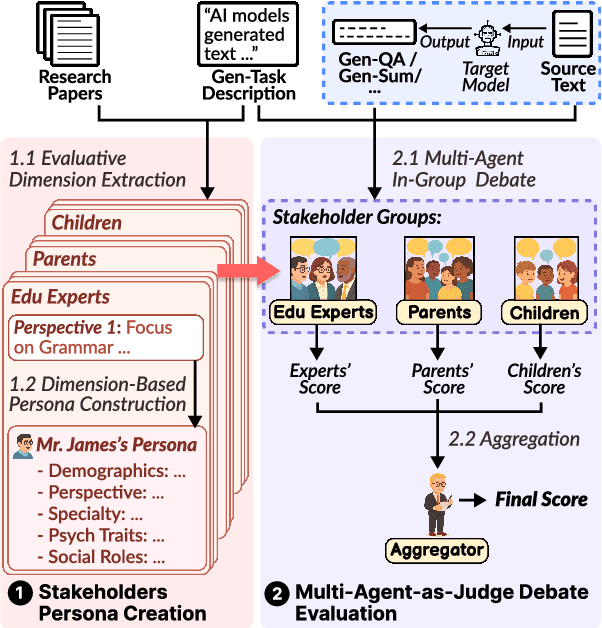


Nearly all human work is collaborative; thus, the evaluation of real-world NLP applications often requires multiple dimensions that align with diverse human perspectives. As real human evaluator resources are often scarce and costly, the emerging "LLM-as-a-judge" paradigm sheds light on a promising approach to leverage LLM agents to believably simulate human evaluators. Yet, to date, existing LLM-as-a-judge approaches face two limitations: persona descriptions of agents are often arbitrarily designed, and the frameworks are not generalizable to other tasks. To address these challenges, we propose MAJ-EVAL, a Multi-Agent-as-Judge evaluation framework that can automatically construct multiple evaluator personas with distinct dimensions from relevant text documents (e.g., research papers), instantiate LLM agents with the personas, and engage in-group debates with multi-agents to Generate multi-dimensional feedback. Our evaluation experiments in both the educational and medical domains demonstrate that MAJ-EVAL can generate evaluation results that better align with human experts' ratings compared with conventional automated evaluation metrics and existing LLM-as-a-judge methods.
Hybrid Latent Reasoning via Reinforcement Learning
May 24, 2025Recent advances in large language models (LLMs) have introduced latent reasoning as a promising alternative to autoregressive reasoning. By performing internal computation with hidden states from previous steps, latent reasoning benefit from more informative features rather than sampling a discrete chain-of-thought (CoT) path. Yet latent reasoning approaches are often incompatible with LLMs, as their continuous paradigm conflicts with the discrete nature of autoregressive generation. Moreover, these methods rely on CoT traces for training and thus fail to exploit the inherent reasoning patterns of LLMs. In this work, we explore latent reasoning by leveraging the intrinsic capabilities of LLMs via reinforcement learning (RL). To this end, we introduce hybrid reasoning policy optimization (HRPO), an RL-based hybrid latent reasoning approach that (1) integrates prior hidden states into sampled tokens with a learnable gating mechanism, and (2) initializes training with predominantly token embeddings while progressively incorporating more hidden features. This design maintains LLMs' generative capabilities and incentivizes hybrid reasoning using both discrete and continuous representations. In addition, the hybrid HRPO introduces stochasticity into latent reasoning via token sampling, thereby enabling RL-based optimization without requiring CoT trajectories. Extensive evaluations across diverse benchmarks show that HRPO outperforms prior methods in both knowledge- and reasoning-intensive tasks. Furthermore, HRPO-trained LLMs remain interpretable and exhibit intriguing behaviors like cross-lingual patterns and shorter completion lengths, highlighting the potential of our RL-based approach and offer insights for future work in latent reasoning.
Plug-and-Play Versatile Compressed Video Enhancement
Apr 21, 2025As a widely adopted technique in data transmission, video compression effectively reduces the size of files, making it possible for real-time cloud computing. However, it comes at the cost of visual quality, posing challenges to the robustness of downstream vision models. In this work, we present a versatile codec-aware enhancement framework that reuses codec information to adaptively enhance videos under different compression settings, assisting various downstream vision tasks without introducing computation bottleneck. Specifically, the proposed codec-aware framework consists of a compression-aware adaptation (CAA) network that employs a hierarchical adaptation mechanism to estimate parameters of the frame-wise enhancement network, namely the bitstream-aware enhancement (BAE) network. The BAE network further leverages temporal and spatial priors embedded in the bitstream to effectively improve the quality of compressed input frames. Extensive experimental results demonstrate the superior quality enhancement performance of our framework over existing enhancement methods, as well as its versatility in assisting multiple downstream tasks on compressed videos as a plug-and-play module. Code and models are available at https://huimin-zeng.github.io/PnP-VCVE/.