 Add to Chrome
 Add to Firefox
 Add to Edge
FP4 Explore, BF16 Train: Diffusion Reinforcement Learning via Efficient Rollout Scaling
Apr 08, 2026
Reinforcement-Learning-based post-training has recently emerged as a promising paradigm for aligning text-to-image diffusion models with human preferences. In recent studies, increasing the rollout group size yields pronounced performance improvements, indicating substantial room for further alignment gains. However, scaling rollouts on large-scale foundational diffusion models (e.g., FLUX.1-12B) imposes a heavy computational burden. To alleviate this bottleneck, we explore the integration of FP4 quantization into Diffusion RL rollouts. Yet, we identify that naive quantized pipelines inherently introduce risks of performance degradation. To overcome this dilemma between efficiency and training integrity, we propose Sol-RL (Speed-of-light RL), a novel FP4-empowered Two-stage Reinforcement Learning framework. First, we utilize high-throughput NVFP4 rollouts to generate a massive candidate pool and extract a highly contrastive subset. Second, we regenerate these selected samples in BF16 precision and optimize the policy exclusively on them. By decoupling candidate exploration from policy optimization, Sol-RL integrates the algorithmic mechanisms of rollout scaling with the system-level throughput gains of NVFP4. This synergistic algorithm-hardware design effectively accelerates the rollout phase while reserving high-fidelity samples for optimization. We empirically demonstrate that our framework maintains the training integrity of BF16 precision pipeline while fully exploiting the throughput gains enabled by FP4 arithmetic. Extensive experiments across SANA, FLUX.1, and SD3.5-L substantiate that our approach delivers superior alignment performance across multiple metrics while accelerating training convergence by up to $4.64\times$, unlocking the power of massive rollout scaling at a fraction of the cost.

Fast-dVLM: Efficient Block-Diffusion VLM via Direct Conversion from Autoregressive VLM
Apr 08, 2026Vision-language models (VLMs) predominantly rely on autoregressive decoding, which generates tokens one at a time and fundamentally limits inference throughput. This limitation is especially acute in physical AI scenarios such as robotics and autonomous driving, where VLMs are deployed on edge devices at batch size one, making AR decoding memory-bandwidth-bound and leaving hardware parallelism underutilized. While block-wise discrete diffusion has shown promise for parallel text generation, extending it to VLMs remains challenging due to the need to jointly handle continuous visual representations and discrete text tokens while preserving pretrained multimodal capabilities. We present Fast-dVLM, a block-diffusion-based VLM that enables KV-cache-compatible parallel decoding and speculative block decoding for inference acceleration. We systematically compare two AR-to-diffusion conversion strategies: a two-stage approach that first adapts the LLM backbone with text-only diffusion fine-tuning before multimodal training, and a direct approach that converts the full AR VLM in one stage. Under comparable training budgets, direct conversion proves substantially more efficient by leveraging the already multimodally aligned VLM; we therefore adopt it as our recommended recipe. We introduce a suite of multimodal diffusion adaptations, block size annealing, causal context attention, auto-truncation masking, and vision efficient concatenation, that collectively enable effective block diffusion in the VLM setting. Extensive experiments across 11 multimodal benchmarks show Fast-dVLM matches its autoregressive counterpart in generation quality. With SGLang integration and FP8 quantization, Fast-dVLM achieves over 6x end-to-end inference speedup over the AR baseline.
MHLA: Restoring Expressivity of Linear Attention via Token-Level Multi-Head
Jan 12, 2026While the Transformer architecture dominates many fields, its quadratic self-attention complexity hinders its use in large-scale applications. Linear attention offers an efficient alternative, but its direct application often degrades performance, with existing fixes typically re-introducing computational overhead through extra modules (e.g., depthwise separable convolution) that defeat the original purpose. In this work, we identify a key failure mode in these methods: global context collapse, where the model loses representational diversity. To address this, we propose Multi-Head Linear Attention (MHLA), which preserves this diversity by computing attention within divided heads along the token dimension. We prove that MHLA maintains linear complexity while recovering much of the expressive power of softmax attention, and verify its effectiveness across multiple domains, achieving a 3.6\% improvement on ImageNet classification, a 6.3\% gain on NLP, a 12.6\% improvement on image generation, and a 41\% enhancement on video generation under the same time complexity.
Efficient-DLM: From Autoregressive to Diffusion Language Models, and Beyond in Speed
Dec 16, 2025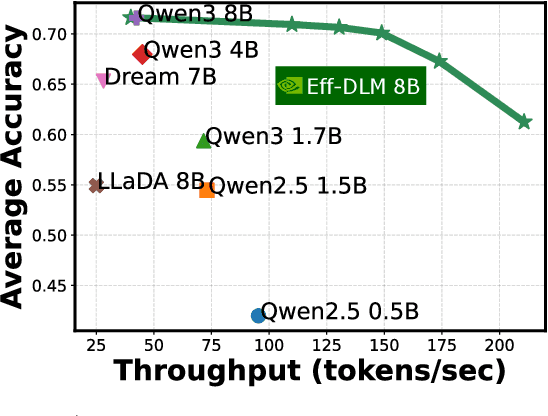
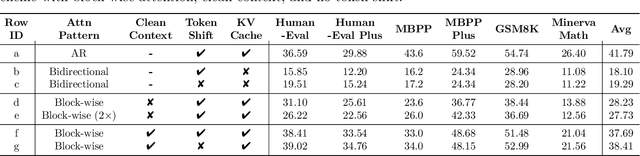
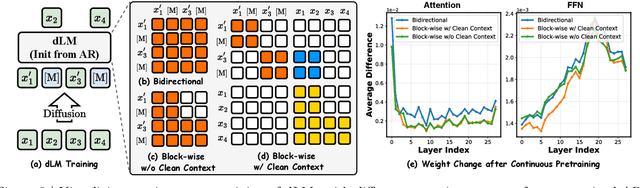
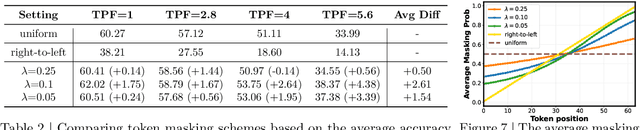
Diffusion language models (dLMs) have emerged as a promising paradigm that enables parallel, non-autoregressive generation, but their learning efficiency lags behind that of autoregressive (AR) language models when trained from scratch. To this end, we study AR-to-dLM conversion to transform pretrained AR models into efficient dLMs that excel in speed while preserving AR models' task accuracy. We achieve this by identifying limitations in the attention patterns and objectives of existing AR-to-dLM methods and then proposing principles and methodologies for more effective AR-to-dLM conversion. Specifically, we first systematically compare different attention patterns and find that maintaining pretrained AR weight distributions is critical for effective AR-to-dLM conversion. As such, we introduce a continuous pretraining scheme with a block-wise attention pattern, which remains causal across blocks while enabling bidirectional modeling within each block. We find that this approach can better preserve pretrained AR models' weight distributions than fully bidirectional modeling, in addition to its known benefit of enabling KV caching, and leads to a win-win in accuracy and efficiency. Second, to mitigate the training-test gap in mask token distributions (uniform vs. highly left-to-right), we propose a position-dependent token masking strategy that assigns higher masking probabilities to later tokens during training to better mimic test-time behavior. Leveraging this framework, we conduct extensive studies of dLMs' attention patterns, training dynamics, and other design choices, providing actionable insights into scalable AR-to-dLM conversion. These studies lead to the Efficient-DLM family, which outperforms state-of-the-art AR models and dLMs, e.g., our Efficient-DLM 8B achieves +5.4%/+2.7% higher accuracy with 4.5x/2.7x higher throughput compared to Dream 7B and Qwen3 4B, respectively.
ChronoEdit: Towards Temporal Reasoning for Image Editing and World Simulation
Oct 05, 2025Recent advances in large generative models have significantly advanced image editing and in-context image generation, yet a critical gap remains in ensuring physical consistency, where edited objects must remain coherent. This capability is especially vital for world simulation related tasks. In this paper, we present ChronoEdit, a framework that reframes image editing as a video generation problem. First, ChronoEdit treats the input and edited images as the first and last frames of a video, allowing it to leverage large pretrained video generative models that capture not only object appearance but also the implicit physics of motion and interaction through learned temporal consistency. Second, ChronoEdit introduces a temporal reasoning stage that explicitly performs editing at inference time. Under this setting, the target frame is jointly denoised with reasoning tokens to imagine a plausible editing trajectory that constrains the solution space to physically viable transformations. The reasoning tokens are then dropped after a few steps to avoid the high computational cost of rendering a full video. To validate ChronoEdit, we introduce PBench-Edit, a new benchmark of image-prompt pairs for contexts that require physical consistency, and demonstrate that ChronoEdit surpasses state-of-the-art baselines in both visual fidelity and physical plausibility. Code and models for both the 14B and 2B variants of ChronoEdit will be released on the project page: https://research.nvidia.com/labs/toronto-ai/chronoedit
LongLive: Real-time Interactive Long Video Generation
Sep 26, 2025We present LongLive, a frame-level autoregressive (AR) framework for real-time and interactive long video generation. Long video generation presents challenges in both efficiency and quality. Diffusion and Diffusion-Forcing models can produce high-quality videos but suffer from low efficiency due to bidirectional attention. Causal attention AR models support KV caching for faster inference, but often degrade in quality on long videos due to memory challenges during long-video training. In addition, beyond static prompt-based generation, interactive capabilities, such as streaming prompt inputs, are critical for dynamic content creation, enabling users to guide narratives in real time. This interactive requirement significantly increases complexity, especially in ensuring visual consistency and semantic coherence during prompt transitions. To address these challenges, LongLive adopts a causal, frame-level AR design that integrates a KV-recache mechanism that refreshes cached states with new prompts for smooth, adherent switches; streaming long tuning to enable long video training and to align training and inference (train-long-test-long); and short window attention paired with a frame-level attention sink, shorten as frame sink, preserving long-range consistency while enabling faster generation. With these key designs, LongLive fine-tunes a 1.3B-parameter short-clip model to minute-long generation in just 32 GPU-days. At inference, LongLive sustains 20.7 FPS on a single NVIDIA H100, achieves strong performance on VBench in both short and long videos. LongLive supports up to 240-second videos on a single H100 GPU. LongLive further supports INT8-quantized inference with only marginal quality loss.
Fast-dLLM: Training-free Acceleration of Diffusion LLM by Enabling KV Cache and Parallel Decoding
May 28, 2025Diffusion-based large language models (Diffusion LLMs) have shown promise for non-autoregressive text generation with parallel decoding capabilities. However, the practical inference speed of open-sourced Diffusion LLMs often lags behind autoregressive models due to the lack of Key-Value (KV) Cache and quality degradation when decoding multiple tokens simultaneously. To bridge this gap, we introduce a novel block-wise approximate KV Cache mechanism tailored for bidirectional diffusion models, enabling cache reuse with negligible performance drop. Additionally, we identify the root cause of generation quality degradation in parallel decoding as the disruption of token dependencies under the conditional independence assumption. To address this, we propose a confidence-aware parallel decoding strategy that selectively decodes tokens exceeding a confidence threshold, mitigating dependency violations and maintaining generation quality. Experimental results on LLaDA and Dream models across multiple LLM benchmarks demonstrate up to \textbf{27.6$\times$ throughput} improvement with minimal accuracy loss, closing the performance gap with autoregressive models and paving the way for practical deployment of Diffusion LLMs.
Magic 1-For-1: Generating One Minute Video Clips within One Minute
Feb 11, 2025In this technical report, we present Magic 1-For-1 (Magic141), an efficient video generation model with optimized memory consumption and inference latency. The key idea is simple: factorize the text-to-video generation task into two separate easier tasks for diffusion step distillation, namely text-to-image generation and image-to-video generation. We verify that with the same optimization algorithm, the image-to-video task is indeed easier to converge over the text-to-video task. We also explore a bag of optimization tricks to reduce the computational cost of training the image-to-video (I2V) models from three aspects: 1) model convergence speedup by using a multi-modal prior condition injection; 2) inference latency speed up by applying an adversarial step distillation, and 3) inference memory cost optimization with parameter sparsification. With those techniques, we are able to generate 5-second video clips within 3 seconds. By applying a test time sliding window, we are able to generate a minute-long video within one minute with significantly improved visual quality and motion dynamics, spending less than 1 second for generating 1 second video clips on average. We conduct a series of preliminary explorations to find out the optimal tradeoff between computational cost and video quality during diffusion step distillation and hope this could be a good foundation model for open-source explorations. The code and the model weights are available at https://github.com/DA-Group-PKU/Magic-1-For-1.
SANA 1.5: Efficient Scaling of Training-Time and Inference-Time Compute in Linear Diffusion Transformer
Jan 30, 2025


This paper presents SANA-1.5, a linear Diffusion Transformer for efficient scaling in text-to-image generation. Building upon SANA-1.0, we introduce three key innovations: (1) Efficient Training Scaling: A depth-growth paradigm that enables scaling from 1.6B to 4.8B parameters with significantly reduced computational resources, combined with a memory-efficient 8-bit optimizer. (2) Model Depth Pruning: A block importance analysis technique for efficient model compression to arbitrary sizes with minimal quality loss. (3) Inference-time Scaling: A repeated sampling strategy that trades computation for model capacity, enabling smaller models to match larger model quality at inference time. Through these strategies, SANA-1.5 achieves a text-image alignment score of 0.72 on GenEval, which can be further improved to 0.80 through inference scaling, establishing a new SoTA on GenEval benchmark. These innovations enable efficient model scaling across different compute budgets while maintaining high quality, making high-quality image generation more accessible.
Char-SAM: Turning Segment Anything Model into Scene Text Segmentation Annotator with Character-level Visual Prompts
Dec 27, 2024


The recent emergence of the Segment Anything Model (SAM) enables various domain-specific segmentation tasks to be tackled cost-effectively by using bounding boxes as prompts. However, in scene text segmentation, SAM can not achieve desirable performance. The word-level bounding box as prompts is too coarse for characters, while the character-level bounding box as prompts suffers from over-segmentation and under-segmentation issues. In this paper, we propose an automatic annotation pipeline named Char-SAM, that turns SAM into a low-cost segmentation annotator with a Character-level visual prompt. Specifically, leveraging some existing text detection datasets with word-level bounding box annotations, we first generate finer-grained character-level bounding box prompts using the Character Bounding-box Refinement CBR module. Next, we employ glyph information corresponding to text character categories as a new prompt in the Character Glyph Refinement (CGR) module to guide SAM in producing more accurate segmentation masks, addressing issues of over-segmentation and under-segmentation. These modules fully utilize the bbox-to-mask capability of SAM to generate high-quality text segmentation annotations automatically. Extensive experiments on TextSeg validate the effectiveness of Char-SAM. Its training-free nature also enables the generation of high-quality scene text segmentation datasets from real-world datasets like COCO-Text and MLT17.